How to Store Your Crypto Seed Phrase Safely: A Beginner’s Guide
How to Store Your Crypto Seed Phrase Safely: A Beginner’s Guide
Risk disclaimer: Cryptocurrencies are volatile and can lose most or all of their value. Nothing in this article is financial advice. Never invest money you cannot afford to lose, and do your own research before buying any cryptocurrency.
Your seed phrase is the most important thing in crypto, and most beginners do not realise that until it is too late. It is a short list of ordinary words, usually twelve or twenty-four, that can restore your entire wallet, and everything in it, on any device, at any time. If you lose it, and you lose access to your wallet, your crypto is gone, permanently, with no customer service to call and no password reset to request. If someone else finds it, they can take your crypto, and there is no way to get it back. There is no middle ground. The seed phrase is the wallet, in a very real sense, and how you store it is the single most important security decision you will make in crypto.
That sounds dramatic, and it is meant to. The crypto world is full of stories of people who lost fortunes because of a lost seed phrase: a hard drive thrown away, a piece of paper destroyed in a fire, a phrase stored in a phone that was stolen. It is also full of stories of people who were robbed because they stored their phrase carelessly: a photo in a cloud account that was hacked, a note in an email that was compromised, a phrase shared with a fake support agent. Both kinds of loss are preventable, and both are the result of the same mistake, which is treating the seed phrase like an ordinary password when it is something much more powerful.
This guide explains seed phrases from scratch. You will learn what a seed phrase is and how it works, why it matters so much, how to store it safely, what never to do, how to make a backup that survives fire and flood, and how to recover a wallet if something goes wrong. No technical background is needed, and no prior knowledge of wallets is assumed.
What Is a Seed Phrase, and How Does It Work?
A seed phrase, also called a recovery phrase or a mnemonic phrase, is a list of words, usually twelve or twenty-four, generated by your wallet when you first create it. The words are chosen from a standard list of 2,048 English words, and their order matters. Together, they encode the master key from which all of your wallet’s private keys are derived, which means that anyone who knows the phrase can recreate your wallet and access everything in it, on any compatible wallet app, on any device.
The system is based on a standard called BIP-39, which is used by almost every major wallet, including hardware wallets like Ledger and Trezor, software wallets like MetaMask and Trust Wallet, and many others. Because the standard is shared, a seed phrase from one wallet can usually be used to restore your funds in a different wallet, which is a useful feature if your original wallet stops working or if you want to switch. It also means that the phrase is not tied to a company or a service. It is yours, and it works independently of any business.
It helps to understand the relationship between the seed phrase, the private key, and the public address. The public address is like your bank account number: you can share it freely, and people use it to send you crypto. The private key is like your PIN: it proves you own the funds at that address, and it must never be shared. The seed phrase is like the master key that generates all of your private keys: it is the most powerful of the three, and it must be protected more carefully than anything else. If you lose a private key, you can recover it from the seed phrase. If you lose the seed phrase, there is no way to recover it, unless you have a backup.
When you create a wallet, the wallet will show you the seed phrase once, and it will ask you to write it down and confirm it. That moment is the most important moment in your crypto life, and it is worth treating with care. Do not rush through it. Do not screenshot it. Do not skip the backup step. Write it down, check it, and store it safely before you put any significant amount of crypto in the wallet. Our guide to crypto wallets (https://stylishnamees.com/crypto-wallets-beginners-2026-choose-stay-safe) explains the different types of wallets and how to choose one, and our guide to crypto cold storage (https://stylishnamees.com/crypto-cold-storage-explained-beginners-2026) explains how to keep crypto offline for maximum safety.
Why the Seed Phrase Matters So Much
The seed phrase matters because crypto has no central authority. In the traditional financial system, if you forget your password, you can call your bank, prove your identity, and reset it. If your card is stolen, you can freeze it. If a transaction is fraudulent, you can dispute it. Those safety nets exist because a trusted institution holds your money and can intervene. In crypto, there is no such institution. Your wallet is yours, and yours alone, and the seed phrase is the only proof of ownership. That is the trade-off of self-custody: you gain freedom from banks and intermediaries, and you lose the safety nets they provide.
That trade-off is not a flaw. It is the point. Crypto was designed so that no one can freeze your funds, censor your transactions, or take your money without your keys. But the same design means that no one can help you if you lose your keys. The responsibility is absolute, and it falls entirely on you. That is why the seed phrase is not a detail to be handled casually. It is the core of the system, and it deserves the same level of care you would give to the keys of your house or the title deeds to your property.
It is also worth understanding that the seed phrase is not just a backup. It is a live credential. Anyone who has it can access your funds immediately, from anywhere in the world, without needing your phone, your computer, or your password. That is why storing it in a place that is connected to the internet, like a cloud account or an email inbox, is so dangerous: a hacker who compromises that account gains full access to your crypto, and you may not even know it happened until the funds are gone.
The Golden Rules: What Never to Do
Before we talk about how to store a seed phrase, let us talk about what never to do, because the mistakes are more common than the correct practices, and they are the cause of most losses. These rules are simple, but they are absolute, and breaking any one of them can cost you everything.
Never store your seed phrase digitally. Do not take a screenshot of it. Do not save it in a note on your phone. Do not store it in a password manager, a cloud drive, a Google Doc, or an email. Do not send it to yourself in a message. The reason is simple: anything stored on a device connected to the internet can be stolen, through hacking, malware, phishing, or a compromised account. A photo of your seed phrase in your phone’s gallery is one of the most common ways people lose their crypto, because phones are stolen, hacked, and backed up to the cloud, often without the owner realising it. If your phrase has ever been on a screen, in a file, or in a message, assume it is compromised, and move your funds to a new wallet with a new phrase.
Never share your seed phrase with anyone. No legitimate support agent, exchange, wallet company, or project will ever ask for your seed phrase. If someone asks for it, they are trying to steal from you, full stop. This includes people who claim to be helping you with a problem, people who offer to verify your wallet, and people who promise to double your crypto. It also includes websites that ask you to enter your seed phrase to connect your wallet or claim a reward. Those are phishing sites, and entering your phrase there hands your funds to a scammer. Our guide to how to spot crypto scams (https://stylishnamees.com/how-to-spot-crypto-scams-rug-pulls-beginners) explains the warning signs in detail, and it is worth reading before you interact with any crypto service.
Never type your seed phrase into a website, an app, or a form, except into a wallet you have installed yourself, from an official source, for the purpose of restoring a wallet. And even then, be careful: make sure you are using the real wallet app, downloaded from the official site or app store, and not a fake copy. Fake wallet apps are a common scam, and they steal seed phrases from people who think they are restoring a legitimate wallet.
Never say your seed phrase out loud where it can be overheard, and never write it where someone else can see it. That includes writing it on a whiteboard during a video call, leaving it on a desk where visitors can see it, or reading it aloud to a family member who does not need to know it. The fewer people who know your phrase exists, and where it is stored, the safer you are.
Paper Backups: The Simple Method That Works
The simplest safe way to store a seed phrase is on paper, and it is the method that most experts recommend for beginners. It is not glamorous, and it is not high-tech, but it works, because paper is not connected to the internet, it cannot be hacked, and it does not depend on any company or service.
Here is how to do it properly. Write the words by hand, in order, on a piece of paper, using a pen that will not fade or smudge. Number each word, so that you know the order, and write clearly, so that you can read it years later. Double-check every word against the wallet’s display, letter by letter, because a single wrong word can make the phrase useless. Then write a second copy, on a separate piece of paper, and store the two copies in different places, so that a fire, a flood, or a burglary at one location does not destroy both.
Where should you store them? The answer depends on your situation, but the principles are the same: somewhere safe, somewhere dry, somewhere that only you can access, and somewhere you will remember. A home safe is a good option. A bank safety deposit box is another, though it has the drawback that you cannot access it outside banking hours, and it depends on a third party. A locked drawer or a hidden location in your home is a reasonable option for smaller amounts, but it is less secure than a safe. The key is to choose a place that is protected from fire, water, and theft, and that you will not forget. Tell no one where it is, except, if you wish, a trusted person who would need to access it if something happened to you, and even then, think carefully about who that person is and whether they can be trusted absolutely.
Paper has weaknesses, and you should know them. Paper burns, it gets wet, it fades, and it can be lost or thrown away by mistake. That is why two copies in different locations are important, and why some people prefer metal backups, which we will discuss next. But for a beginner, a well-stored paper backup is far better than no backup, or a digital backup, and it is the right starting point.
Metal Backups: The Upgrade for Serious Holders
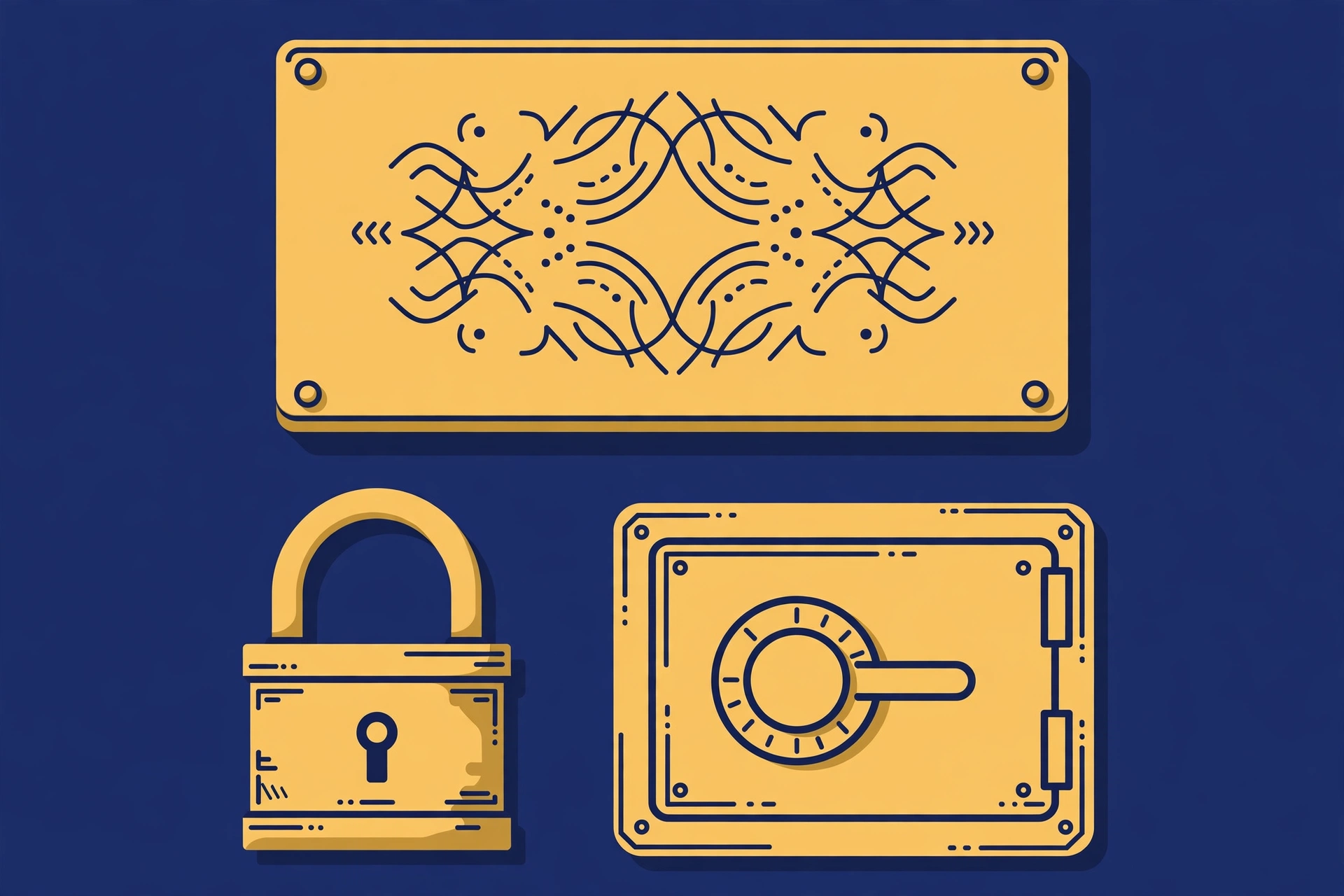
For people who hold a significant amount of crypto, or who want a backup that survives fire and flood, a metal backup is the next step. A metal backup is a plate, usually made of stainless steel, into which you stamp or engrave your seed phrase, using letter stamps or a specialised tool. The result is a backup that is fireproof, waterproof, and far more durable than paper, and that will survive conditions that would destroy a paper copy.
Metal backup kits are sold by several companies, and they come in different forms: plates with letter stamps, capsules that hold metal tiles, and washers that you stamp and thread onto a bolt. The principle is the same in all cases: you transfer the seed phrase onto metal, so that it cannot be destroyed by fire or water. The cost is modest, typically the price of a dinner out, and it is a worthwhile investment if you hold more crypto than you can afford to lose.
There are a few things to keep in mind. First, make sure you stamp the words correctly, and double-check them, because a mistake on metal is harder to fix than a mistake on paper. Second, store the metal backup in a safe place, just as you would a paper backup, because metal is durable but not invisible: it can still be stolen, and it can still be found by someone who knows where to look. Third, consider whether you need one metal backup or two, in different locations, just as with paper. The same principle applies: redundancy protects you against the loss of a single copy.
Some people go further, and use a technique called splitting, where the seed phrase is divided into parts and stored in different places, so that no single location holds the whole phrase. That can increase security, but it also increases complexity, and complexity increases the risk of mistakes. For most people, two complete copies in two safe locations is simpler and safer than a split scheme. If you do decide to split your phrase, make sure you understand the scheme thoroughly, test it, and document it in a way that you, or a trusted person, can follow years later.
How to Recover a Wallet with a Seed Phrase
Knowing how to recover a wallet is as important as knowing how to back it up, because a backup you cannot use is worthless. The recovery process is straightforward, but it is worth practising before you need it, so that you are not learning under pressure.
To recover a wallet, you need a compatible wallet app, installed from an official source, on a device you trust. Open the app, choose the option to restore or import a wallet, and enter your seed phrase, word by word, in the correct order. The app will ask you to confirm the words, and then it will recreate your wallet, with all of its addresses and balances, as if you had never lost it. The process takes a few minutes, and it works on any device, anywhere in the world, as long as you have the phrase.
There are a few important points. First, make sure you are using the real wallet app, not a fake copy, because fake apps steal seed phrases. Download from the official website or the official app store, and check the developer’s name and reviews. Second, make sure the device you are recovering on is clean, meaning it is not infected with malware and is not a public or shared computer. Third, after recovery, check that the addresses and balances match what you expect. If they do not, you may have entered a word incorrectly, or you may be using the wrong derivation path, which is a technical setting that most wallets handle automatically but that can cause confusion. If something looks wrong, do not panic, and do not send funds. Check the words again, letter by letter, and try again.
It is a good idea to test your backup before you rely on it. One way to do this is to create a new wallet, write down its seed phrase, put a tiny amount of crypto in it, and then delete the wallet and restore it from the phrase. If the funds reappear, your backup works, and you know how to use it. If they do not, you have learned that something is wrong, while the amount at risk is small. This is a valuable exercise, and it is worth doing at least once, with a small amount, before you store significant funds.
If you lose your seed phrase and you lose access to your wallet, there is no recovery. No company can help you, no support agent can reset it, and no government can intervene. That is the hard truth of self-custody, and it is why the backup is so important. The time to make a backup is before you need it, not after.
Inheritance and Planning for the Worst
One topic that beginners rarely think about, and that matters more than most people realise, is what happens to your crypto if you die or become incapacitated. In the traditional financial system, your family can go to a bank, present a death certificate, and access your accounts. In crypto, if no one knows your seed phrase, your funds are lost forever. That is not a hypothetical risk: a significant amount of Bitcoin is believed to be permanently lost because its owners died without sharing their keys.
Planning for this is uncomfortable, but it is responsible, especially if you hold a meaningful amount. The simplest approach is to tell a trusted person, such as a spouse or a close family member, where your seed phrase is stored, and how to use it. That person needs to be someone you trust absolutely, and someone who understands the responsibility. You can also write instructions, sealed in an envelope, stored with your will or with a lawyer, explaining where the backup is and how to recover the wallet. Some people use a safety deposit box for this purpose, with access granted to a named person.
There are more advanced approaches, including multi-signature wallets, where two or more people must approve a transaction, and social recovery systems, where trusted contacts can help restore access. Those are worth exploring if you hold a large amount, but they are complex, and they require careful setup. For most people, the important step is simply to think about the question, and to make sure that someone you trust knows enough to recover your funds if you cannot. Our guide to crypto cold storage (https://stylishnamees.com/crypto-cold-storage-explained-beginners-2026) explains cold storage in more detail, which is relevant here, because long-term holdings are often kept in cold storage, and the seed phrase for a cold wallet is even more important to protect.
It is also worth thinking about what happens if your backup is discovered by someone who should not have it. If you suspect your seed phrase has been seen, photographed, or otherwise compromised, do not wait. Create a new wallet with a new seed phrase, move your funds to it, and treat the old wallet as compromised. That is the only safe response, and it is better to move funds unnecessarily than to leave them in a wallet whose phrase may be in someone else’s hands.
Common Mistakes and How to Avoid Them
Even people who understand the rules make mistakes, and it is worth listing the most common ones, so that you can avoid them. The first is storing the phrase on a phone or computer, in a note, a screenshot, or a file. This is the most common mistake, and it is the most dangerous, because it puts the phrase on a device that is connected to the internet and vulnerable to hacking, theft, and malware. If you have ever stored your phrase digitally, move your funds to a new wallet with a new phrase, stored offline.
The first is storing the phrase on a phone or computer, in a note, a screenshot, or a file. This is the most common mistake, and it is the most dangerous, because it puts the phrase on a device that is connected to the internet and vulnerable to hacking, theft, and malware. If you have ever stored your phrase digitally, move your funds to a new wallet with a new phrase, stored offline.
The second is telling too many people. Some people share their phrase with friends, family, or online communities, either for help or for reassurance. Every person who knows your phrase is a risk, not because they are dishonest, but because they might be careless, or their phone might be hacked, or they might be tricked into revealing it. Keep the circle as small as possible, ideally just you.
The third is not testing the backup. A backup that has never been tested is a hope, not a guarantee. A word might be misspelled, the order might be wrong, or the paper might have faded. Test your backup with a small amount, as described above, so that you know it works.
The fourth is storing all copies in one place. If both copies are in the same house, a fire destroys both. If both are in the same safe, a burglary takes both. Redundancy only works if the copies are genuinely separate.
The fifth is forgetting where the backup is. This sounds unlikely, but it happens, especially if you store it in a clever hiding place and then forget the hiding place years later. Write down the location in a way that only you can understand, or store it in an obvious safe place rather than a secret one. A safe you can open is better than a hiding place you cannot find.
The sixth is using a weak or predictable phrase. Your seed phrase is generated by the wallet, and you should never choose your own words or modify the phrase. The wallet’s random generation is what makes it secure, and any human attempt to make it more memorable makes it weaker. Use the phrase exactly as the wallet gives it to you, word for word, in order.
Frequently Asked Questions
What is a crypto seed phrase?
A seed phrase is a list of twelve or twenty-four words, generated by your wallet, that can restore your entire wallet and all of its funds on any compatible wallet app. It encodes the master key from which all of your private keys are derived, and anyone who knows it can access your crypto.
How do I store my seed phrase safely?
Write it by hand on paper, in order, and store two copies in two different safe, dry locations, such as a home safe and a bank safety deposit box. For larger amounts, stamp it onto a metal plate, which is fireproof and waterproof. Never store it digitally, never photograph it, and never share it with anyone.
Can I store my seed phrase in a password manager?
No. Password managers are designed for passwords, not for seed phrases, and they store data on devices and servers that can be hacked. A seed phrase should never be stored digitally, in any form, including in a password manager, a cloud drive, or a note app.
What happens if I lose my seed phrase?
If you lose your seed phrase and you lose access to your wallet, your crypto is gone permanently. There is no customer service, no password reset, and no way to recover it. That is why making a backup, and testing it, is the most important thing you can do in crypto.
What should I do if someone asks for my seed phrase?
Never share it. No legitimate support agent, exchange, wallet company, or project will ever ask for your seed phrase. Anyone who asks for it is trying to steal your crypto, and you should treat the request as a scam, report it if possible, and never enter your phrase on any website or in any form.
Can I recover my wallet if my phone is lost or stolen?
Yes, as long as you have your seed phrase. Install a compatible wallet app on a new device, choose the option to restore a wallet, and enter your phrase in order. Your funds will be recreated, with all of your addresses and balances, because the phrase, not the phone, is what controls the wallet.
Is a metal backup better than paper?
Metal is more durable than paper: it survives fire and water, and it does not fade or tear. Paper is cheaper and simpler, and it is perfectly adequate for most beginners, especially if you store two copies in different locations. For larger holdings, a metal backup is a worthwhile upgrade, but either is far better than a digital backup.
Should I split my seed phrase across multiple locations?
Splitting can increase security, but it also increases complexity and the risk of mistakes. For most people, two complete copies in two safe locations is simpler and safer than a split scheme. If you do split your phrase, make sure you understand the scheme, test it, and document it clearly.
What is the difference between a seed phrase and a private key?
A private key controls a single address, while a seed phrase generates all of the private keys in a wallet. The seed phrase is more powerful, because it can restore the entire wallet, and it must be protected more carefully. If you lose a private key, you can recover it from the seed phrase. If you lose the seed phrase, there is no recovery.
Conclusion
Your seed phrase is the key to your crypto, and how you store it is the most important security decision you will make. Write it down by hand, on paper, in order, and store two copies in two safe places. For larger amounts, upgrade to a metal backup that survives fire and flood. Never store it digitally, never photograph it, never share it with anyone, and never type it into a website. Test your backup with a small amount, so that you know it works, and think about what happens if you cannot access it yourself, so that someone you trust can recover your funds. These steps are simple, they cost almost nothing, and they are the difference between owning your crypto and losing it. If you are new to wallets, start with our guide to crypto wallets (https://stylishnamees.com/crypto-wallets-beginners-2026-choose-stay-safe), and if you hold a significant amount, read our guide to crypto cold storage (https://stylishnamees.com/crypto-cold-storage-explained-beginners-2026) to learn how to keep it offline. And if you ever feel unsure about a request for your seed phrase, remember the simplest rule in crypto: no one legitimate will ever ask for it, and anyone who does is trying to steal from you.