Horse Racing Betting Basics for Beginners: Bet Types, Odds and Bankroll
18+ only. This article is educational only. Horse racing betting is gambling, and no tip, system, or reading of the form can guarantee a win. Only ever risk money you can afford to lose, set a limit before you start, and never chase losses. Help is available at BeGambleAware and Gamblers Anonymous.
Horse racing is one of the oldest betting sports in the world, and it is also one of the few forms of gambling that is legal in Thailand, through licensed horse racing. For many Thai people, a day at the races is a familiar tradition: the parade ring, the smell of the track, the noise of the crowd as the horses turn for home, and the small slip of paper that might turn into a payout. For a beginner, though, the sport can look baffling. The racecard is full of numbers and abbreviations, the betting options have names that sound like a foreign language, and the odds seem to change every few minutes.
This guide explains horse racing betting from scratch. You will learn how a race works, how to read a racecard, what the main bet types are and what they pay, how odds work and what they mean for your returns, and how to manage your bankroll so that a day at the races stays enjoyable. It also covers the legal position in Thailand, which is important, because licensed horse racing is one of only two legal exceptions to the country’s gambling laws.
How Horse Racing Works
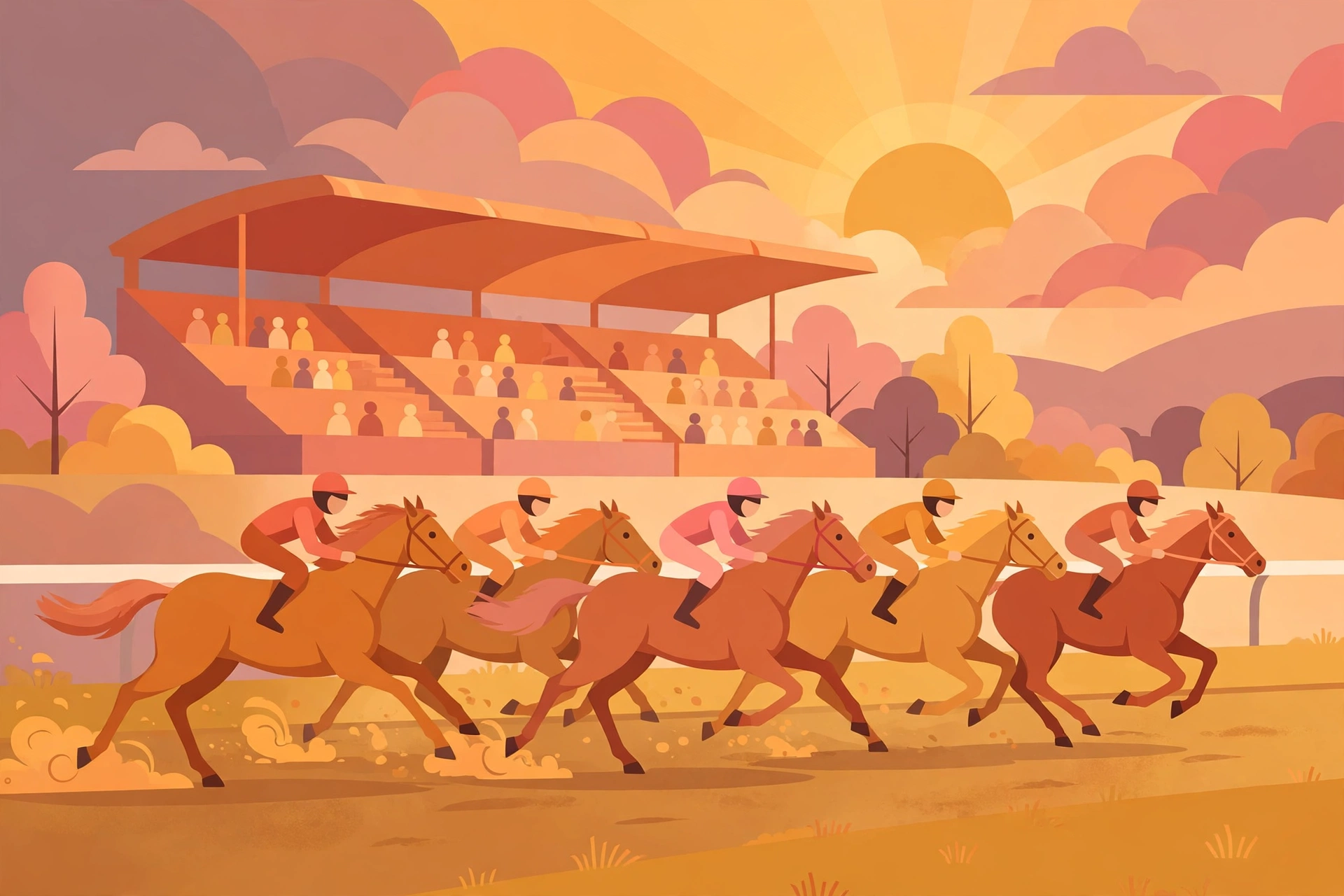
A horse race is simple in principle: a group of horses runs over a set distance, and the first one past the finishing post wins. In practice, the details matter, because they affect which horses are likely to do well and how the betting is priced.
Races are run over different distances, from short sprints of around 1,000 metres to long staying races of 3,000 metres or more. Some horses are sprinters, built for speed over short distances. Others are stayers, who need a longer trip to show their best. A horse that wins over a sprint distance may struggle over a longer one, and vice versa, so the distance of a race is one of the first things to look at when you are studying the form.
Races are also run on different surfaces. The most common are turf, which is grass, and dirt, which is a sand or soil track. Some tracks use an all-weather synthetic surface. Horses often have a preference for one surface over another, and a horse that runs well on turf may not run as well on dirt. The condition of the surface matters too. After rain, turf becomes soft, which suits some horses and not others. The going, as it is called, is reported before the race, and it can change the outcome significantly.
Horses carry weight, in the form of the jockey and the saddle, and sometimes extra lead weights. In handicap races, the weights are set by an official to give each horse a fair chance: better horses carry more weight, weaker horses carry less. The idea is that, with the right weights, every horse in the race has roughly an equal chance of winning. In other races, called conditions races or weight-for-age races, the weights are set by the rules of the race rather than by a handicapper, and the best horse on the day is expected to win. Understanding the type of race helps you judge how competitive it is likely to be.
The jockey matters as well. A good jockey can make a real difference, especially in a close finish, by judging the pace, finding a gap in the field, and timing the final run. Trainers matter too. Some trainers are known for preparing horses well for particular tracks or distances, and a horse from a top stable is often better prepared than one from a small yard. None of this guarantees a winner, but it is all part of the information that goes into the odds.
Reading a Racecard: The Beginner’s Guide
The racecard is the programme that lists the runners in each race, and it is the single most useful document a bettor has. At first glance, it looks like a wall of numbers, but it is organised logically, and once you know what each part means, it becomes easy to read.
At the top of each race, you will find the race name, the time, the distance, the surface, and the prize money. Below that is a list of the runners, usually in order of their saddlecloth number. For each horse, the racecard gives its name, its age, the weight it will carry, the name of its jockey and trainer, and its recent form.
Form is shown as a string of numbers, usually the horse’s finishing positions in its last few races. A form line of 1-2-3 means the horse won its last race, was second in the one before, and third in the one before that. A form line of 0-0-5 means the horse finished out of the placings in its last two races and fifth in the one before. Form is read from right to left, with the most recent race on the right in some countries and on the left in others, so it is worth checking which convention the racecard you are using follows.
The racecard also gives the horse’s official rating, which is a number that reflects how good the handicapper thinks it is, and the odds, which may be shown as starting prices from the morning or as live prices that change as money is bet. Some racecards include extra information, such as the horse’s breeding, its best distance, its record on the surface, and comments from a tipster about its chances. Not all of this matters for a beginner. What matters is the horse’s name, its recent form, its weight, its jockey, and its odds.
A sensible way to read a racecard for the first time is to pick one race, look at the favourite, and ask why it is the favourite. Usually the answer is in the form: it won last time out, it is well weighted, it has a top jockey, or it has won over this distance and surface before. Then look at the second and third favourites and ask the same question. After doing that for a few races, you will start to see the patterns that the odds reflect, and you will be in a much better position to decide whether you agree with the market or think it has got something wrong.
Understanding Horse Racing Odds
Odds are the price of a bet. They tell you two things: how likely the bookmaker or the betting pool thinks a horse is to win, and how much you will be paid if it does. Short odds mean a horse is strongly fancied. Long odds mean it is not. The relationship between odds and probability is the heart of betting, and understanding it will help you in every sport, not just horse racing.
Odds are shown in different formats depending on where you are. In Britain and in much of Asia, fractional odds are common, such as 3/1 or 7/2. Fractional odds of 3/1 mean that for every one unit you stake, you win three units, plus your stake back. A 100-baht bet at 3/1 returns 400 baht in total: 300 in winnings and your 100 stake. Decimal odds are common in Europe and Australia. Decimal odds of 4.0 mean the same as 3/1: a 100-baht bet returns 400 baht. You can convert between them by adding one to the fraction: 3/1 becomes 4.0, 7/2 becomes 4.5, and so on.
Odds also imply a probability. Decimal odds of 4.0 imply a 25 percent chance of winning, because 1 divided by 4 is 0.25. Decimal odds of 2.0 imply a 50 percent chance. This is useful because it lets you compare the odds with your own judgement. If you think a horse has a 40 percent chance of winning, and the odds imply only 25 percent, then the bet looks like value. If you think it has a 20 percent chance, and the odds imply 25 percent, then the bet is poor value, even if the horse might win. Value, not picking winners, is what separates a thoughtful bettor from a lucky one. Our guide to casino odds and probability explained for beginners covers this idea in more detail, and it applies to horse racing just as much as it applies to casino games.
There are two main ways horse racing odds are set. In many countries, including Thailand’s licensed racing, betting is done through a pari-mutuel pool, also called a tote. All the money bet on a race goes into a pool, the operator takes a percentage, and the rest is divided among the winning bettors. The odds are not fixed when you place your bet. They change as more money comes in, and the final odds are set when the race starts. That means the price you see when you bet may not be the price you get. With a bookmaker, by contrast, the odds are fixed at the moment you place the bet, and they do not change afterwards. Each system has its advantages. The tote is simple and transparent, and it is what you will find at a licensed racecourse. Fixed odds let you lock in a price, which is useful if you think the price will shorten.
The Main Bet Types
Horse racing offers more bet types than almost any other sport, and beginners should start with the simple ones before trying the exotic ones. Here are the main types, from simplest to most complex.
A win bet is the simplest bet of all. You pick a horse, and if it finishes first, you win. If it finishes second or third, you lose. Win bets are the best starting point for a beginner, because they are easy to understand and easy to track.
A place bet is a bet that a horse will finish in the placings, usually the first two or three, depending on how many runners there are. In a race with eight or more runners, a place usually means finishing in the first three. Place bets pay less than win bets, because they are easier to win, but they give you a better chance of getting some money back. Some beginners like place bets because they feel safer, and in a race with a strong favourite, a place bet on a longer-priced horse can be a sensible way to play.
An each-way bet is a combination of a win bet and a place bet. You place two equal stakes: one on the horse to win, and one on the horse to place. If the horse wins, both parts of the bet pay out. If it places but does not win, you lose the win part but the place part pays out, usually at a fraction of the win odds, such as a quarter or a fifth. Each-way bets are popular because they give you two chances to win, but remember that you are staking twice as much, so an each-way bet of 100 baht actually costs 200 baht in total.
A forecast, sometimes called an exacta, is a bet on the first two horses in the correct order. It pays much more than a win bet, because it is harder to get right, but it is also much harder to win. A reverse forecast lets you cover both orders, but it costs twice as much. A tricast or trifecta is a bet on the first three horses in the correct order, and it pays even more, but it is harder still.
Then there are the multiple bets, where you combine selections across races. A double is a bet on the winner of two races. A treble is a bet on three. An accumulator combines four or more. The winnings from each race roll onto the next, so the payout can be very large, but you need every selection to win, and the chance of that falls quickly with each race you add. A double at even money on both races pays three to one, which sounds good, but you have only a one-in-four chance of winning it. A four-fold accumulator is far harder. Multiples are fun, and they are the bets that produce the stories of small stakes turning into big payouts, but they are a poor way to make money steadily, because most of them lose.
For a beginner, the honest advice is to stick to win and place bets for your first few visits to the races, and to try an each-way bet only when you understand it fully. The exotic bets are tempting because the payouts are large, but large payouts exist precisely because the bets are hard to win, and the house takes its cut either way.
Picking a Horse: What Actually Matters
There is no reliable method for picking winners at the races. If there were, the people who knew it would not be sharing it. But there are factors that matter more than others, and a beginner who looks at the right things will do better than one who picks a horse because it has a pretty name or a lucky number.
Recent form is the single most important factor. A horse that has won or placed in its last two or three races is in good form, and it is more likely to run well again than a horse that has been finishing well down the field. Look for form figures that show consistency, not just one good run months ago. A horse that won its last race by a wide margin, at this distance, on this surface, is a much stronger candidate than one whose last win was a year ago over a different distance.
Distance and surface are the next things to check. Horses have preferences, and the racecard will often show a horse’s record at the distance and on the surface. A horse that has won twice over today’s distance is a better bet than one trying the distance for the first time. The same applies to the surface. A horse that loves soft turf will struggle on firm ground, and the going report will tell you what to expect.
The jockey and trainer matter, but not as much as form. A top jockey on a well-prepared horse is a good combination, but a top jockey cannot make a slow horse fast. Look at the jockey’s record at the track, and the trainer’s record with this type of horse, but do not let a famous name override poor form. A famous jockey on a horse in bad form is still a horse in bad form.
Weight matters in handicap races. A horse carrying less weight than it did when it last won has a better chance, because it is carrying less. A horse carrying more weight than it has ever carried before may struggle. The handicapper’s job is to make the race fair, so weight differences are often smaller than they look, but they are still worth checking, especially when a horse is dropping in weight after a poor run.
Finally, watch the odds. If a horse’s odds shorten significantly before the race, it often means that people with information, or at least confidence, are backing it. That is not a guarantee, and odds can move for other reasons, but a big move is worth noticing. Conversely, if a favourite’s odds drift longer, it may mean that something is wrong, or simply that other horses are being backed. Odds are information, and a beginner who watches them will learn a lot.
Bankroll Management for Horse Racing
Bankroll management matters in horse racing just as much as it matters in a casino, and the principles are the same. Our guide to casino bankroll management for beginners in Thailand covers the basics, and they apply directly to the races.
Before you go to the races, decide how much money you are willing to spend, and treat it as the cost of a day out, not as an investment. Take that amount in cash, and leave your bank card at home if you can. That way, when the money is gone, the day is over, and you cannot keep betting on impulse.
Divide your bankroll by the number of races you want to bet on, and stake roughly the same amount on each race. If you have 1,000 baht for a ten-race card, that is 100 baht per race. Betting the same amount each time stops you from staking everything on one race after a loss, which is the most common way beginners lose their bankroll quickly. It also stops you from staking too little on the races you feel confident about and too much on the ones you do not.
Set a loss limit and a win limit before you start. A loss limit is the point at which you stop betting for the day, no matter what. A win limit is the point at which you stop and enjoy your profit, rather than giving it back. Both are hard to stick to in the moment, which is why you should decide them in advance, when you are thinking clearly.
Never chase losses. This is the most important rule in all gambling, and it applies at the races more than anywhere else, because there is always another race starting in twenty minutes, and it is always tempting to try to win your money back on the next one. Chasing losses is how a bad day becomes a terrible day. If you have lost your bankroll, the day is over. Go home, enjoy the rest of the afternoon, and come back another time.
Never borrow money to bet, and never bet with money you need for essentials. If you find yourself doing either of those things, that is a sign to stop and seek help.
Common Beginner Mistakes
The mistakes beginners make at the races are predictable, and they are mostly the same mistakes beginners make in a casino. Our guide to casino myths debunked for Thai beginners covers several of them, and they are worth keeping in mind here too.
The first mistake is betting on every race. A full racecard might have eight or ten races, and betting on all of them is a good way to lose money steadily, because you are paying the operator’s cut on every bet. It is better to wait for the races where you have a genuine opinion, and to skip the ones where you do not. Sitting out a race costs nothing. Betting on a race you do not understand costs money.
The second is following tips blindly. Tipsters, friends, and strangers at the track will all offer advice, and some of it will be good, but none of it is guaranteed. A tip is someone else’s opinion, not a certainty. If you follow a tip, make sure you understand why the horse is fancied, and never stake more on a tip than you would on your own judgement.
The third is betting on a horse because of its name, its colour, or its number. Horses do not know their names, and their names have no effect on how fast they run. Picking a horse because it shares your name, or because it is your lucky number, is a fun way to choose a bet, but it is not a strategy, and you should only do it with money you are happy to lose.
The fourth is betting more after a win. Winning feels good, and it is tempting to think you are on a hot streak and should stake more. But each race is independent, and a win on the last race does not make you more likely to win the next one. Keep your stakes level, and enjoy the win for what it is.
The fifth is ignoring the cost of exotic bets. A trifecta or an accumulator looks cheap when the stake is small, but the chance of winning is very low, and most of these bets lose. If you enjoy them, treat them as a lottery ticket: a small stake, for fun, with no expectation of winning. Do not make them the core of your betting.
A Day at the Races: What to Expect
If you have never been to a racecourse, it is worth knowing what to expect. The day usually starts with the horses arriving and being saddled. You can watch them in the parade ring before each race, and experienced racegoers pay close attention to how a horse looks: a horse that is calm, fit, and moving well is a better sign than one that is sweating heavily or agitated, though this is an art rather than a science, and beginners should not read too much into it.
Betting opens well before each race, and the odds move as money comes in. You place your bet at the tote or with a bookmaker, you receive a ticket, and you keep it safe, because it is your proof of the bet. Then you watch the race, either from the grandstand or on a screen, and if you win, you collect your payout with your ticket.
The atmosphere is part of the appeal. Racing is a social sport, and a day at the races is as much about the company, the food, and the excitement of the crowd as it is about the betting. The sensible approach is to treat the betting as a small part of the day, not the whole of it. Bet a little, enjoy a lot, and go home with your bankroll intact, whether you won or lost.
Legal Status in Thailand — Read This First
Gambling in Thailand is largely prohibited under the Gambling Act B.E. 2478 (1935). That law has been in force for ninety years, and it makes most forms of gambling illegal. There are only two legal exceptions: the government lottery, and licensed horse racing. Everything else, including casinos, is not legal in Thailand, and there are no licensed casinos in the country.
Licensed horse racing is one of those two exceptions, and it is the reason this guide exists. Racing is run under licence, and betting on licensed racing through the official channels is legal. That is a genuine difference from casino gambling, which has no legal route in Thailand at all. But it does not mean that all horse racing betting is legal. Betting on unlicensed racing, or through unlicensed operators, or on overseas races through sites that are not licensed in Thailand, is not covered by the exception, and it carries legal risk.
Online casinos are NOT licensed in Thailand. There is no Thai licence for an online casino, and websites that offer casino games to Thai players are operating outside Thai law. This article is educational only. It explains how horse racing betting works so that you understand the sport, and it does not encourage gambling of any kind beyond the legal exceptions that already exist.
Horse racing betting is for adults only. You must be 18 or older to gamble anywhere it is legal. Never gamble with money you need for rent, food, bills, or family. Never chase losses, and never borrow money to gamble. Set a limit before you go to the races, and stop when you reach it, whether you are ahead or behind. There are no guaranteed winnings in horse racing or in any form of gambling. The operator always takes a cut, and over time, that means most bettors lose more than they win. Anyone who tells you they have a system that guarantees profits from horse racing is selling you something.
If gambling stops being fun, or if you find yourself spending more than you planned, hiding your betting from family, or borrowing money to keep going, help is available. BeGambleAware offers free, confidential information and support, and Gamblers Anonymous runs meetings and a support network for people who want to stop. Asking for help is not a weakness. It is the sensible thing to do, and the sooner the better.
Frequently Asked Questions
Is horse racing betting legal in Thailand?
Licensed horse racing is one of only two legal exceptions to the Gambling Act B.E. 2478 (1935), the other being the government lottery. Betting on licensed racing through official channels is legal. Betting through unlicensed operators or on unlicensed racing is not.
What is the simplest bet for a beginner?
A win bet. You pick a horse, and if it finishes first, you win. It is easy to understand, easy to track, and the best starting point for anyone new to the sport.
How do I read a racecard?
Look at the horse’s name, its recent form figures, the weight it will carry, its jockey and trainer, and its odds. Form is shown as finishing positions in recent races. A horse that has won or placed recently, over today’s distance and surface, is usually a stronger candidate than one that has not.
What does 3/1 mean in horse racing odds?
Fractional odds of 3/1 mean that for every one unit you stake, you win three units, plus your stake back. A 100-baht bet at 3/1 returns 400 baht in total. In decimal odds, the same price is 4.0.
What is an each-way bet?
An each-way bet is two bets in one: a win bet and a place bet, for equal stakes. If the horse wins, both parts pay out. If it places but does not win, you lose the win part but the place part pays out at a fraction of the win odds. Remember that an each-way bet costs twice the stake you name.
What is the difference between the tote and a bookmaker?
The tote, or pari-mutuel pool, collects all the money bet on a race, takes a percentage, and divides the rest among the winning bettors. The odds are not fixed and change as money comes in. A bookmaker offers fixed odds at the moment you place the bet, and those odds do not change afterwards.
Should I bet on every race?
No. It is better to wait for the races where you have a genuine opinion and to skip the ones where you do not. Betting on every race means paying the operator’s cut on every bet, which adds up quickly.
Do tips from tipsters work?
Sometimes, but never reliably. A tip is someone else’s opinion, not a certainty. If you follow a tip, make sure you understand why the horse is fancied, and never stake more on a tip than you would on your own judgement.
What is a handicap race?
A handicap is a race where the weights are set by an official to give each horse a fair chance. Better horses carry more weight, weaker horses carry less. The aim is that, with the right weights, every horse has roughly an equal chance of winning.
How much money should I take to the races?
Decide in advance how much you are willing to spend, treat it as the cost of a day out, and take that amount in cash. Divide it by the number of races you plan to bet on, and stake roughly the same amount on each race. Never take money you need for essentials.
Can I make a living from horse racing betting?
For almost everyone, no. The operator takes a cut of every pool, and the odds are set by people who study the sport full time. A small number of professional bettors make money, but they do so with deep knowledge, strict discipline, and large bankrolls. For a beginner, racing should be entertainment, not income.
What is the going, and why does it matter?
The going describes the condition of the racing surface, for example firm, good, or soft. After rain, turf becomes soft, which suits some horses and not others. The going is reported before the race, and it can change the outcome significantly, so it is worth checking.
Conclusion
Horse racing betting is a rich and rewarding hobby when it is approached sensibly. The sport itself is beautiful: the horses, the jockeys, the crowd, and the excitement of a close finish are worth enjoying for their own sake. The betting adds a layer of interest, but it should never become the reason for the day. Learn to read a racecard, start with simple win and place bets, understand what the odds are telling you, and manage your bankroll with a fixed budget and a firm stopping point, and you will get far more out of racing than someone who bets on every race and chases every loss.
In Thailand, licensed horse racing is one of only two legal forms of gambling, alongside the government lottery, and that makes it a special case. But legality does not make it safe. The operator always takes a cut, and over time most bettors lose more than they win. Treat racing as entertainment, bet only what you can afford to lose, and enjoy the day for the sport itself. If you want to understand the maths behind the odds, read our guide to casino odds and probability explained for beginners, and if you want to learn how to set a betting budget that lasts, read our guide to casino bankroll management for beginners in Thailand. If you are curious about the other legal exception, our guide to the Thai government lottery explained covers how it works, including draws and prizes. Know the horses, know the odds, know the law, and know when to walk away.