
What Is Hedera (HBAR)? A Beginner’s Guide to How It Works
What Is Hedera (HBAR)? A Beginner’s Guide to How It Works
Risk disclaimer: Cryptocurrencies are volatile and can lose most or all of their value. Nothing in this article is financial advice. Never invest money you cannot afford to lose, and do your own research before buying any cryptocurrency.
What is Hedera? It is a question that comes up often among beginners who have heard of Bitcoin and Ethereum, and then run into a project that claims to be neither a blockchain nor a traditional cryptocurrency network. Hedera is a public distributed ledger, and its native token is called HBAR. What makes Hedera unusual is that it does not use a blockchain at all. Instead, it uses a different data structure called hashgraph, which its supporters say is faster, fairer, and more energy-efficient than the blockchains most people know.
That claim is worth understanding properly, because the crypto world is full of projects that promise speed and efficiency. Hedera is interesting not only because of its technology, but also because of how it is governed: by a council of large, well-known companies and institutions, rather than by an open community of anonymous miners or validators alone. That governance model is both its most distinctive feature and the source of some of its strongest criticism. This guide explains Hedera from scratch, in plain language: what hashgraph is, how the network reaches agreement, what HBAR is used for, where Hedera is actually being used, and what risks a beginner should weigh before forming any view about it. No hype, and no invented numbers.
Hedera in One Paragraph
Hedera is a public distributed ledger designed for fast, low-cost transactions and for running applications such as payments, tokenised assets, and digital identity. Unlike Bitcoin and Ethereum, which record transactions in blocks chained together, Hedera records them in a hashgraph, a kind of graph where events are linked to each other and the order of transactions is worked out from the structure of the graph itself. Its native token, HBAR, is used to pay transaction fees and to help secure the network through staking. The network is governed by the Hedera Governing Council, a group of organisations that each run a node and take part in decisions about the network. If that sounds technical, the rest of this guide breaks each part down step by step.
What Problem Is Hedera Trying to Solve?
To understand Hedera, it helps to start with the problems that older blockchains face. Bitcoin was designed to be a decentralised digital currency, and it does that job well, but it is slow and expensive for everyday payments, and it uses a great deal of energy through its proof-of-work mining system. Ethereum added the ability to run applications through smart contracts, which opened up an enormous world of decentralised finance and digital collectibles, but it has historically struggled with high fees and congestion when many people use it at once. Our guide to what Bitcoin is explains the first network in more detail, and our guide to what Ethereum is explains the second.
Hedera’s answer to these problems is to take a different approach from the start. Instead of trying to make a blockchain faster by changing how blocks are produced, Hedera’s founders, Leemon Baird and Mance Harmon, built a different kind of ledger altogether. Baird developed the hashgraph consensus algorithm, and the two founded the company behind Hedera, originally called Swirlds, before the public network launched in 2019. Their goal was a network that could handle a large number of transactions per second, confirm them in seconds, keep fees low and predictable, and use very little energy. That is an ambitious goal, and whether Hedera achieves it in the real world, rather than in theory, is the question that matters for anyone trying to understand the project.
What Is Hashgraph, and How Is It Different from a Blockchain?
A blockchain is a chain of blocks. Each block contains a group of transactions, and each block points to the block before it, forming a chain. Only one block can be added at a time, and miners or validators compete or are chosen to produce the next block. This design is simple and secure, but it has a built-in bottleneck: transactions must wait their turn to be included in a block, and if two miners produce a block at the same time, one of them is discarded.
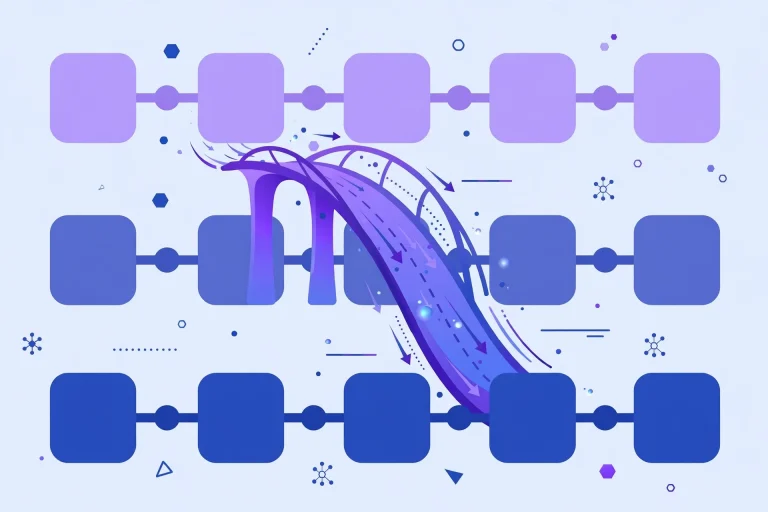
Hashgraph works differently. Instead of blocks, it uses events. Every time a participant in the network creates an event, which is a record of one or more transactions, that event is linked to two earlier events: one created by the same participant, and one received from another participant. Over time, this creates a graph of events, with each event connected to earlier ones, and the whole structure is shared between the participants. This is known as gossip: participants share what they know with randomly chosen other participants, who then share it with others, and the information spreads quickly across the network, much like gossip spreads through a group of people.
The clever part is that once the graph is shared, every participant can work out the order of the events on their own, using the same mathematical rules, without needing to vote on each transaction one by one. Because everyone is working from the same graph and the same rules, they all reach the same conclusion about which transactions happened and in what order. This is called virtual voting, and it is one of the key ideas behind hashgraph.
For a beginner, the practical difference comes down to three things. First, hashgraph does not waste work by discarding blocks, because there are no blocks to discard. Second, it can process many transactions in parallel, because events are created continuously by many participants at once. Third, once a transaction is confirmed, it is considered final quickly, which means it cannot easily be reversed. Supporters argue that this makes Hedera faster and fairer than a blockchain, because the order of transactions is determined by the time they were received by the network, rather than by which miner or validator happened to include them in a block. Critics point out that the performance claims are based on ideal conditions and on a network with a relatively small number of nodes, and that a blockchain with many thousands of validators faces different challenges.
How Does Hedera Reach Agreement?
Hedera reaches agreement through its hashgraph consensus algorithm, which is a form of proof of stake combined with the gossip and virtual voting process described above. In simple terms, the network works like this: participants create events, gossip them around the network, and then use the shared graph to agree on the order of transactions. The result is a ledger that all participants agree on, without the need for a central authority to decide.
One important detail is that Hedera uses a system called asynchronous Byzantine fault tolerance, or aBFT, which is a strong form of security guarantee. In plain language, it means the network can keep working correctly even if some participants are faulty or malicious, and even if messages between participants are delayed. This is a well-regarded property in distributed systems research, and Hedera’s supporters often point to it as evidence that the network’s security claims are grounded in serious computer science, not just marketing.
Another important detail is that the order of transactions on Hedera is meant to be fair, in the sense that transactions are ordered by when they were received by the network, not by who paid the highest fee to jump the queue. On many blockchains, users can pay higher fees to get their transactions processed first, which can lead to a situation where wealthier users get priority. Hedera’s design aims to prevent that, which is one reason its supporters describe it as fairer than a typical blockchain.
In practice, how the network reaches agreement today is shaped by its governance. Hedera’s main network is run by a set of nodes operated by members of its Governing Council, along with community nodes that have been added over time. The long-term plan, as stated by the project, is to open the network to more participants over time, so that it becomes more decentralised. That transition is still in progress, and the degree to which it happens, and how quickly, is one of the main things to watch if you are following Hedera.
The Hedera Governing Council
The most unusual feature of Hedera is its governance. Most public blockchains are governed by open communities of developers, miners, or token holders, and decisions are often messy, slow, and contested. Hedera took a different path. It is governed by the Hedera Governing Council, a group of organisations that each run a node on the network and take part in governing it. The council includes large companies and institutions from different industries and different parts of the world, such as technology firms, banks, universities, and other major organisations.
Each council member has an equal vote, and membership is term-limited, which means members serve for a set period and are then replaced or renewed. The council makes decisions about the network, such as changes to its rules, the approval of software updates, and the management of the project’s treasury. The idea behind this model is that having well-known, accountable organisations running the network will make it more stable, more trustworthy for businesses, and more likely to be adopted by large companies that want to build on a network they can rely on.
This model has clear advantages. It gives Hedera a level of institutional credibility that most crypto projects do not have, and it makes the network attractive to businesses that need a stable, governed platform rather than an experimental one. It also means decisions can be made more quickly and reliably than in a fully open, leaderless community, where disagreements can drag on for months or years.
It also has clear disadvantages, and critics are vocal about them. The main criticism is that a council of large companies is not the same as decentralisation. Bitcoin’s whole point is that no one is in charge, and no group of companies can control it. Hedera, by contrast, is controlled by a group of organisations that anyone can name, and that, in theory, could be pressured by governments or regulators, or could act in their own interests rather than in the interests of ordinary users. Supporters argue that the council’s members are diverse, that no single member controls the network, and that the council model is a practical step towards a network that businesses will actually use. Critics argue that it is a fundamentally different philosophy from the one that made crypto interesting in the first place. As a beginner, you do not need to settle that debate, but you should understand that it exists, because it shapes almost every discussion about Hedera.
What Is the HBAR Token Used For?
HBAR is the native token of the Hedera network, and it has three main uses. The first is paying transaction fees. Every transaction on Hedera, whether it is a simple transfer of HBAR, a smart contract interaction, or the creation of a token, costs a small fee paid in HBAR. Hedera’s fees are designed to be low and, importantly, fixed in US dollar terms, which means the fee in HBAR changes as the price of HBAR changes, but the cost in dollars stays roughly the same. That predictability is important for businesses, because it lets them plan their costs without worrying that a sudden rise in the token price will make the network too expensive to use.
The second use is staking. HBAR holders can stake their tokens to a node, which helps secure the network, and they earn a share of the rewards for doing so. Staking on Hedera works in a similar way to staking on other proof-of-stake networks, and the same general risks apply: your tokens are committed for a period, and the value of your rewards depends on the price of HBAR, which can fall. Our guide to crypto staking explains the general risks of staking in detail, and it is worth reading before staking any token, including HBAR.
The third use is network security. Staking is not just a way to earn rewards; it is also part of how the network is protected. The more HBAR is staked to honest nodes, the harder it is for an attacker to gain control of the network, because they would need to control a large share of the total staked supply. That is the same basic idea behind proof of stake on other networks, including Ethereum and Solana, and our guide to what Solana is explains how another fast proof-of-stake network handles this.
The supply of HBAR is also worth understanding. HBAR has a fixed maximum supply, and new tokens are released over time according to a schedule, to fund the network, reward participants, and support the ecosystem. A large share of the total supply was allocated to the founding team, the council, and early supporters, and those tokens are released gradually. That means the number of HBAR in circulation grows over time, which can put downward pressure on the price if demand does not grow at the same rate. Before buying any token, it is worth understanding who holds a large share of it, when large amounts are scheduled to be released, and how the supply schedule works, because those factors can matter as much as the technology.
What Can You Actually Do on Hedera?
Hedera is a platform, and like any platform, what matters is what is built on it. The network supports several kinds of services. The most basic is the Hedera Token Service, which lets anyone create their own tokens on the network, whether those tokens represent a currency, a loyalty point, a share, or a digital collectible. Because the service is built into the network itself, rather than being an add-on, creating a token on Hedera is designed to be simpler and cheaper than writing a smart contract from scratch.
Hedera also supports smart contracts, which are programs that run on the network and automatically carry out agreements, such as swapping tokens or managing a loan, without a middleman. Hedera’s smart contract service is compatible with the Ethereum Virtual Machine, which means developers who have built applications for Ethereum can adapt them to Hedera more easily. Our guide to what DeFi is explains decentralised finance in general, including the kinds of applications that run on networks like Hedera, and the risks they carry.
Beyond tokens and smart contracts, Hedera is used for several real-world purposes that its supporters highlight. One is supply chain and logistics, where companies use the network to record the movement of goods in a way that is hard to tamper with. Another is digital identity and credentials, where qualifications, certificates, or records can be verified without revealing unnecessary personal information. A third is payments, including small, fast payments that would be too expensive on a slower, more costly network. Hedera has also been used for projects in areas such as carbon credits and sustainability reporting, where a trustworthy, tamper-resistant record is valuable.
These uses are real, but a beginner should keep them in proportion. Hedera’s ecosystem of applications is much smaller than Ethereum’s, and many of its most impressive-sounding projects are pilots or partnerships that are still in their early stages. A partnership announcement is not the same as a product that thousands of people use every day. The useful question to ask about Hedera, as with any blockchain, is not what it could be used for, but what people actually use it for, how many transactions it processes in practice, and whether developers are building on it or moving elsewhere. Those questions are harder to answer than a list of use cases, but they tell you far more about the network’s future.
Hedera’s Energy Use
One claim Hedera makes prominently is that it is energy-efficient. Bitcoin’s proof-of-work system uses a large amount of electricity, because miners compete to solve puzzles, and that energy use has become one of the most common criticisms of crypto. Proof-of-stake networks use far less energy, and Hedera’s hashgraph consensus is designed to use even less than a typical proof-of-stake blockchain, because it does not require validators to compete or to waste work on discarded blocks.
That efficiency matters for two reasons. First, it makes Hedera more attractive to businesses and institutions that are under pressure to reduce their environmental impact, and that would be reluctant to build on a network with a large carbon footprint. Second, it is part of Hedera’s pitch to be a sustainable, enterprise-friendly network, which fits with its council-based governance model. Whether that pitch is enough to drive adoption is another question, but the energy claim itself is one of the more credible parts of Hedera’s story, because it follows directly from the design of hashgraph, rather than depending on a specific set of ideal conditions.
Hedera vs Other Networks
Hedera is often compared with Ethereum, Solana, and other Layer 1 networks, and the comparison is useful for understanding where it fits. Ethereum is the largest platform for applications, with the biggest developer community and the most established ecosystem, but it has historically been slower and more expensive, and it is still working through its own upgrades. Solana is known for speed and low fees, and it has a large and active community, but it has experienced outages and congestion during periods of heavy use. Our guide to what Solana is explains that network in more detail.
Hedera differs from both in two ways: its hashgraph technology, and its council governance. Its supporters argue that hashgraph gives it an advantage in speed, fairness, and finality, and that its council gives it an advantage in stability and trustworthiness for businesses. Its critics argue that its ecosystem is much smaller, that its decentralisation is weaker, and that its technology has not been tested at the scale of Ethereum or Solana, with thousands of independent validators and millions of users.
Another useful comparison is with networks that share Hedera’s focus on enterprise use, rather than with the largest public blockchains. Hedera is not the only project that aims to be business-friendly, and several other networks and private ledgers compete for the same kind of corporate adoption. The difference is that Hedera is a public network, which means anyone can use it, while many enterprise ledgers are private or permissioned. That public character is important, because it means Hedera’s applications are open to anyone, not just to the companies that run it.
The Honest Risks and Criticisms
Hedera has real risks, and a beginner should weigh them honestly. The first, and most often repeated, is centralisation. Hedera’s council model means the network is governed by a group of well-known organisations, and its main nodes are run by those organisations. That is a deliberate choice, but it is a very different model from Bitcoin, where no one is in charge, and it raises questions about whether Hedera is as resistant to censorship or control as a fully decentralised network. Supporters argue that the council is diverse and that no single member can control the network, but the criticism is not going away, and it is something any buyer should think about.
The second risk is adoption. Hedera’s technology may be impressive, but its ecosystem is still small compared with Ethereum or Solana. The number of applications built on Hedera, and the number of people who use them every day, is much smaller than on the largest networks. A network that does not attract developers and users will struggle, no matter how good its technology is, and Hedera still has to prove that it can grow its ecosystem beyond pilots and partnerships into products that people actually use.
The third risk is token supply and distribution. A large share of HBAR was allocated to the founding team, the council, and early supporters, and those tokens are released over time. When large amounts of tokens are unlocked, they can be sold, which can put downward pressure on the price. That is a common feature of new crypto projects, but it is something a buyer should know about before buying, because it means the supply of HBAR will increase significantly over time, regardless of what happens to demand.
The fourth risk is competition. Hedera is competing not only with Ethereum and Solana, but with a growing number of other fast, low-cost networks, many of which are also trying to attract the same developers and businesses. Some of those networks have larger ecosystems, more developers, or stronger communities. Hedera needs to give developers a reason to choose it over those alternatives, and that is a difficult task, especially when developers have already invested time in learning other platforms and building on them.
Finally, the usual crypto risks apply. HBAR’s price is volatile, it can fall sharply, and the market is full of scams that use the names of popular projects, including Hedera, to trick people. Our guide to spotting crypto scams explains the red flags to watch for, including fake giveaways, phishing sites, and impersonation accounts. Be especially careful with any project that claims to be affiliated with Hedera, or that asks you to send HBAR to an address to receive more in return, because those are almost always scams.
What Beginners Should Know Before Buying HBAR
If you are considering buying HBAR, there are a few practical points to keep in mind. The first is storage. HBAR can be held on an exchange, which is convenient but carries the risk that the exchange could fail or be hacked, or in a wallet you control, which is safer but requires you to manage your own security. Hedera has its own wallets, and some general crypto wallets also support it, but you should check that a wallet actually supports Hedera before you send HBAR to it, because sending coins to a wallet that does not support them can result in a loss. Our guide to choosing a crypto wallet explains the options, and our guide to how to buy crypto safely explains the practical steps and safety checks. Both are worth reading before any purchase.
The second point is to understand what you are buying. HBAR is not a share in a company, and buying it does not give you ownership of Hedera or of the council members behind it. It gives you a token on a network whose future depends on whether developers and businesses continue to build on it and find it useful. Do not buy HBAR because you like the technology alone. Buy it, if you buy it at all, because you have formed a view about its future use, its competition, and its risks, and because you can afford to lose the money you put into it.
The third point is to be careful about where you get information. Hedera has a passionate community, and also a lot of hype. Claims that HBAR will reach a specific price, or that it will replace Ethereum or Solana, are not information. They are marketing. Stick to sources that explain the technology and the ecosystem, and be sceptical of anyone who promises returns or who tells you to buy quickly before it is too late. Also remember that Hedera’s council includes large companies, but those companies are not endorsing HBAR as an investment. Their involvement is about governing and using the network, not about telling you to buy the token.
Frequently Asked Questions
What is Hedera in simple terms?
Hedera is a public distributed ledger that uses a technology called hashgraph instead of a blockchain. It is designed to be fast, low-cost, and energy-efficient, and its native token is called HBAR. It is governed by a council of large organisations.
What is hashgraph?
Hashgraph is a data structure used by Hedera instead of a blockchain. Participants create events, share them through gossip, and use the resulting graph to agree on the order of transactions. It is designed to be faster and more efficient than a blockchain, because it does not rely on blocks that can be discarded.
What is HBAR used for?
HBAR is used to pay transaction fees on the Hedera network, to stake and help secure the network, and to participate in its proof-of-stake system. It is also traded on exchanges like other cryptocurrencies.
How is Hedera different from a blockchain?
A blockchain records transactions in blocks chained together, with one block added at a time. Hedera records transactions in a hashgraph, a graph of events linked to each other, which lets many transactions be processed in parallel and confirmed quickly. Hedera is also governed by a council, unlike most blockchains.
Who runs Hedera?
Hedera is governed by the Hedera Governing Council, a group of organisations from different industries and countries that each run a node and take part in decisions about the network. Membership is term-limited, and each member has an equal vote.
Is Hedera decentralised?
Hedera is less decentralised than Bitcoin, because it is governed by a council of named organisations and its main nodes are run by those organisations. Supporters argue that the council is diverse and that the network is becoming more open over time, while critics say the model is fundamentally more centralised than a fully open blockchain.
Can I stake HBAR?
Yes, HBAR can be staked to a node, and stakers earn a share of the rewards. Staking involves committing your tokens and carries risks, including the risk that the price of HBAR falls while your tokens are staked. Read a guide to staking risks before you stake any token.
What are the main risks of Hedera?
The main risks are centralisation through the council model, a smaller ecosystem than larger networks, token unlocks that increase supply over time, strong competition from other fast networks, and the general volatility and scam risks that apply to all cryptocurrencies.
Is Hedera a good investment?
No one can answer that for you, and anyone who claims to know is selling something. Hedera has interesting technology and a distinctive governance model, but it also has real risks, including centralisation, adoption, and competition. Treat any investment decision as your own research, not as a tip.
Where can I buy HBAR?
HBAR is traded on major cryptocurrency exchanges. Before buying, read a guide to buying crypto safely, check that the exchange is reputable, and understand how you will store your HBAR, whether on the exchange or in a wallet you control.
Conclusion
Hedera is a distinctive project in the crypto world. It does not use a blockchain, it uses hashgraph, and it is not governed by an open community, it is governed by a council of large organisations. That combination gives it a clear pitch: a fast, fair, low-cost, energy-efficient network that businesses can trust and build on. It also gives it clear weaknesses: a more centralised model than Bitcoin, a smaller ecosystem than Ethereum or Solana, and a long way to go before it proves that its technology can win over developers and users at scale.
That combination of promise and uncertainty is typical of newer crypto projects, and it is why a beginner should approach Hedera with curiosity and caution in equal measure. Learn how hashgraph works, compare it with Ethereum and Solana, understand what HBAR is used for and how its supply works, and read our guide to how to buy crypto safely before any purchase. If you decide to buy HBAR, do so with money you can afford to lose, store it safely, and remember that good technology alone does not guarantee success. The networks that last are the ones that developers keep building on and users keep finding useful, year after year, and Hedera still has to prove it can be one of them.