
Poker Guide for Thai Beginners
Poker Guide for Thai Beginners: Hand Rankings, Rules and Basic Strategy
Poker looks complicated from the outside. There are chips flying, people staring at each other, and a lot of words — flop, river, blinds, all-in — that mean nothing to someone watching for the first time. Strip all of that away, though, and poker is a card game with one simple goal: finish a hand holding the best five-card combination, or make everyone else give up before the end.
This guide is written for readers in Thailand who keep seeing poker in films, streams and game apps and want to understand what is actually happening. It covers the hand rankings you must know by heart, how a standard hand of Texas hold’em — the most common version — is played from start to finish, and the basic strategy ideas that separate careful players from people who simply donate their chips. If you are new to Stylish Namees, start here and take the legal section seriously before anything else.
Legal Status in Thailand — Read This First
Gambling is largely prohibited in Thailand. Under the Gambling Act B.E. 2478 (1935), most forms of gambling are illegal, and the only well-known legal exceptions are the government lottery and licensed horse racing at approved racecourses. Online casinos are not licensed in Thailand, and websites offering real-money casino games — poker included — to people in Thailand operate outside Thai law.
That has practical consequences: an unlicensed site offers no Thai consumer protection if it refuses to pay out, freezes an account or disappears, and Thai authorities periodically block gambling websites and payment channels. Money sent to an offshore platform can simply be lost with no realistic way to recover it.
This article is educational and informational only — it explains how poker works because readers ask about it, not to encourage anyone to break local law. Casino games are for adults only (18+), there are no guaranteed winnings in any game, and over time the maths and the fees charged by operators favour the house and the strongest players. Never chase losses, never gamble with borrowed money or money needed for living costs, and if gambling stops being fun, free and confidential help is available from BeGambleAware and Gamblers Anonymous.
Hand Rankings: The Part You Must Memorise
Every poker decision starts with knowing what beats what. There are ten standard rankings, and they are the same in almost every version of the game. From strongest to weakest:
- Royal flush — ace, king, queen, jack and ten, all in the same suit. The best possible hand, and a rare one.
- Straight flush — five cards in a row, all in the same suit, such as 7-8-9-10-jack of hearts.
- Four of a kind — four cards of the same rank, such as four queens, plus any fifth card.
- Full house — three cards of one rank and a pair of another, such as three kings and two fives.
- Flush — any five cards of the same suit that are not in a row.
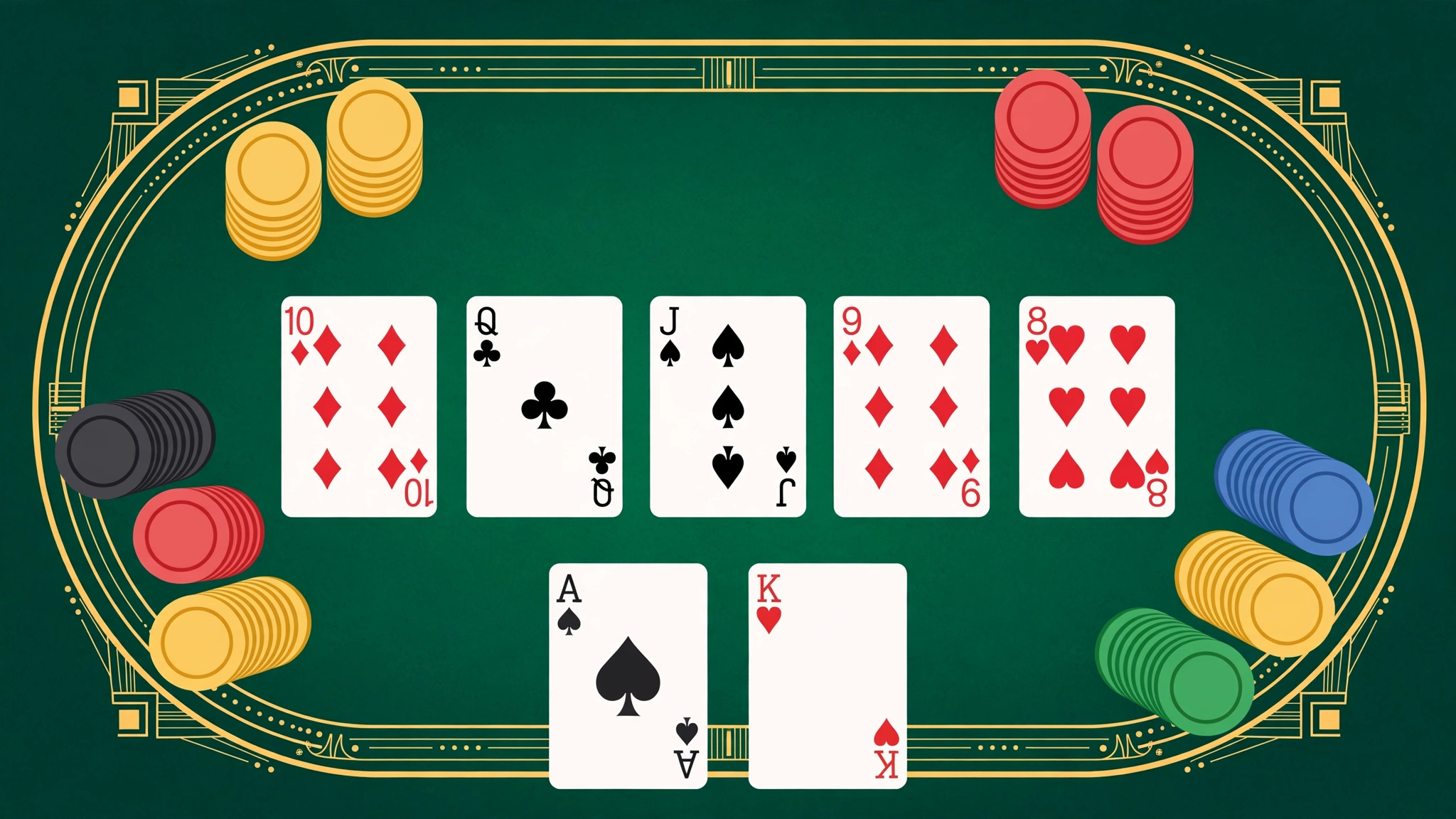
- Straight — five cards in a row in mixed suits, such as 4-5-6-7-8. An ace can count high (10-jack-queen-king-ace) or low (ace-2-3-4-5).
- Three of a kind — three cards of the same rank plus two unrelated cards.
- Two pair — two cards of one rank, two of another, plus one spare card.
- One pair — just two cards of the same rank.
- High card — none of the above. Your highest card decides, so ace-high beats king-high.
Two details catch beginners out. First, suits do not outrank each other — a flush in hearts is not stronger than the same flush in spades. Second, when two players have the same type of hand, the ranks decide: a pair of aces beats a pair of kings, and a full house with three jacks beats one with three tens. The standard rankings are also listed in the poker overview on Wikipedia if you want a reference to keep open.
How a Hand of Texas Hold’em Works
Texas hold’em is the version you will see almost everywhere, so it is the one worth learning. Each player receives two private cards, called hole cards. Five community cards are then dealt face up in the middle of the table in stages, and everyone uses any combination of their two cards and the five shared cards to make the best five-card hand.
A hand runs in four betting rounds:
- Pre-flop: After the hole cards are dealt, the two players to the left of the dealer button post forced bets called the small blind and the big blind. Betting starts, and you can fold (give up), call (match the current bet) or raise (increase it).
- The flop: Three community cards are dealt face up, followed by another round of betting.
- The turn: A fourth community card appears, then more betting.
- The river: The fifth and final community card is dealt. After the last betting round, anyone still in the hand shows their cards — the showdown — and the best hand takes the pot.
One more rule matters: if at any point everyone except one player folds, that player wins the pot without showing their cards. That is why bluffing exists. You can win either by holding the best hand at showdown or by being the last person willing to bet.
Position: The Quiet Advantage
Your seat at the table changes how strong your cards really are. Players who act later in a betting round have more information, because they have watched what everyone before them did. The dealer button is the best seat for this reason; the players posting the blinds act early and are at the biggest disadvantage.
Beginners usually ignore position completely and play the same cards the same way from every seat. A simple improvement is to play tight from the early seats — only strong starting hands — and loosen up slightly when you are on or near the button. It is not exciting advice, but it is the single habit that most reliably reduces beginner losses.
Basic Strategy That Actually Helps
Poker differs from most of the other games in our Casino Games collection in one important way: you play against other people, not against the house, and genuine decisions matter. That does not make it beatable for most people — operators take a cut of each pot, called the rake, and experienced players are waiting at the same tables — but sensible habits do change results.
- Start with strong hands. Pairs, high cards that share a suit, and cards that sit close together for straights are worth playing. Weak, unconnected low cards lose money over time no matter how lucky they feel.
- Fold more than feels natural. New players play far too many hands. Waiting for decent cards is not boring — it is the game.
- Respect big bets. A large bet from a quiet player usually means a strong hand. Calling out of curiosity is one of the most expensive habits in poker.
- Watch the pot odds in simple terms. If you are hoping to complete a draw, the possible reward should justify the price of calling. If it does not, fold and wait.
- Keep your bankroll separate and small. Money for poker, in places where it is legal, should be a fixed entertainment amount whose loss changes nothing about your week.
When you have finished this one, our sic bo guide for Thai beginners shows the opposite end of the spectrum — a pure-chance dice game where no decision changes the odds at all.
Common Beginner Mistakes
Three mistakes account for most beginner losses. The first is playing too many hands because folding feels like losing; in reality, folding weak hands is winning behaviour, because it saves money for spots where you are ahead. The second is falling in love with one pair. A pair of aces is a strong starting hand, but by the river it is often just one pair, and it loses to any two pair or better. The third is playing on emotion after a bad beat — a hand you played correctly but lost anyway. Increasing your bets to “win it back” quickly is exactly the loss-chasing pattern warned about above, and it turns one unlucky hand into a ruined session.
Frequently Asked Questions
Is online poker legal in Thailand?
No. Gambling is largely prohibited under Thailand’s Gambling Act B.E. 2478 (1935); the legal exceptions are the government lottery and licensed horse racing. Online casinos and poker sites are not licensed in Thailand, and sites targeting Thai players operate outside Thai law with no consumer protection.
What is the best hand in poker?
A royal flush — ace, king, queen, jack and ten of the same suit. It is the strongest possible hand, but it is extremely rare, so most pots are won with far more ordinary hands like two pair or a straight.
Is poker a game of skill or luck?
Both. Luck decides which cards are dealt in any single hand, which is why a beginner can win a pot against a professional. Over thousands of hands, decision-making matters and stronger players come out ahead — but the operator’s rake still comes out of every pot.
What does it mean to bluff?
Bluffing means betting or raising with a weak hand so that opponents fold stronger hands. It only works if you use it occasionally and against players capable of folding; bluffing every hand is just giving money away.
Where can I get help if gambling becomes a problem?
Free, confidential support is available from BeGambleAware and Gamblers Anonymous, wherever you live.
Conclusion
Poker rewards patience and honest self-assessment more than cleverness: learn the ten hand rankings until they are automatic, understand how the four betting rounds flow, respect position, and fold far more often than your instincts suggest. It is also a game that, in Thailand, exists only outside the law — there is no licensed online poker for Thai players and no protection if an offshore site keeps your money. Treat this guide as knowledge, not an invitation. Browse more explainers in our Casino Games section, or return to the Stylish Namees homepage.