Caribbean Stud Poker Guide for Thai Beginners: Rules, Bets and Strategy
Caribbean Stud Poker looks like poker, plays a little like blackjack, and sits in a category of its own. You are not playing against the other people at the table. You are not bluffing anyone. You are playing one five-card hand against the dealer’s hand, with a simple decision in the middle: fold and lose your ante, or raise and see whether your hand beats the dealer’s. That simplicity is exactly why the game appeals to beginners, and it is also why so many beginners lose money at it: the simple decision is not always an easy one, and the side bet on the table tempts almost everyone who sits down.
This guide explains Caribbean Stud Poker from the very beginning. You will learn the layout of the table, the order of play, what each bet does, how hands are ranked, how the dealer qualifies, what the progressive jackpot pays, and the basic strategy that most experienced players follow. No prior poker knowledge is needed. If you can read five cards and compare them, you can play this game.
What Is Caribbean Stud Poker?
Caribbean Stud Poker is a casino table game based on five-card stud poker. It was designed for casino play, which means it takes the hand rankings of poker and rebuilds the game around a single decision against the house. There is no betting round after betting round, no reading of opponents, and no bluffing, because you are never betting against another player. The dealer is your only opponent, and the dealer follows fixed rules, so there is nothing to read and nothing to outsmart. Your job is to make the best decision you can with the cards you can see.
The game is played with a standard 52-card deck, shuffled before every hand. You place an ante to start, receive five cards face down, and the dealer receives five cards with one of them turned face up. You look at your cards, compare them with the dealer’s visible card, and decide whether to fold or to raise by placing twice your ante in the raise spot. Then the dealer reveals the rest of their hand. If the dealer’s hand qualifies and beats yours, you lose both bets. If your hand beats a qualifying dealer’s hand, you win. If the dealer’s hand does not qualify, your raise is returned and your ante is paid.
That structure makes the game easy to learn and surprisingly tense to play. The single face-up dealer card gives you just enough information to feel clever, and just little enough to keep you guessing. A good hand can still lose. A weak hand can still win if the dealer fails to qualify. Understanding that balance is the whole game.
The Table Layout and the Bets
A Caribbean Stud table looks like a blackjack table with more betting circles. Each player position has an ante spot, a raise spot (sometimes marked “Bet”), and a small circle for the progressive jackpot side bet. The dealer stands on the other side, with a spot for the dealer’s own cards.
Before any cards are dealt, you place your ante in the ante circle. You may also place the progressive jackpot side bet, which is usually a fixed amount, commonly one unit of the table’s currency, in its small circle. This side bet is optional and completely separate from the main game. It pays only for strong hands, and its biggest prize is the progressive jackpot, which grows until someone hits a royal flush. The side bet is the most expensive part of Caribbean Stud for most players, and we will come back to it in detail.
You cannot change your ante once the cards are dealt. You cannot add to it, and you cannot take it back. The only choice the game gives you after the deal is the raise-or-fold decision, and that choice costs exactly twice your ante. So before you place an ante, you are really committing to a possible total bet of three times the ante: one unit to start, two more if you raise. A sensible player sizes the ante with that in mind.
How a Hand Is Played, Step by Step
The dealer shuffles the deck and deals five cards to each player and five to themselves, all face down except for one of the dealer’s cards, which is turned face up. The dealing order varies slightly between casinos, but the result is always the same: you hold five cards, and you can see one of the dealer’s.
You look at your own hand. You may not show your cards to other players, and you should not touch the cards more than necessary. Take your time. Beginners often rush this decision, but there is no penalty for thinking. Compare your hand with the dealer’s up card, and decide.
If you fold, you place your cards face down in front of you and the dealer collects your ante. The hand is over for you. Folding costs you exactly your ante and nothing more, which is why folding a bad hand is a good decision, not a defeat. Many beginners hate folding, because it feels like giving up. It is not giving up. It is paying the smallest possible price for a hand that was unlikely to win.
If you raise, you place a bet of exactly twice your ante in the raise circle, and you put your cards face down on top of it or slide them forward, depending on the table’s procedure. Then the dealer turns over their remaining four cards.
Now the dealer’s hand must qualify. The dealer qualifies with at least ace-king high, that is, a hand containing an ace and a king with no pair or better. If the dealer’s hand is worse than ace-king, the dealer does not qualify, and the hand ends simply: your ante is paid even money, your raise bet is returned to you without a win or loss, and you get your raise back. This is the best possible outcome for a weak hand that you raised with, because you win the ante without having to beat anything.
If the dealer qualifies, the two hands are compared, and the better five-card poker hand wins. If your hand wins, your ante pays even money and your raise pays according to the payout table for your hand, which is where the game’s big wins come from. If the dealer wins, you lose both the ante and the raise. If the hands tie exactly, it is a push, and both bets are returned.
Hand Rankings in Caribbean Stud
The game uses standard poker hand rankings, highest to lowest: royal flush, straight flush, four of a kind, full house, flush, straight, three of a kind, two pair, one pair, and high card. If you have never played poker, this list is worth learning properly, because everything in the game depends on it. Our guide to poker hand rankings and strategy for Thai beginners explains each hand with examples, and it is a good companion to this guide.
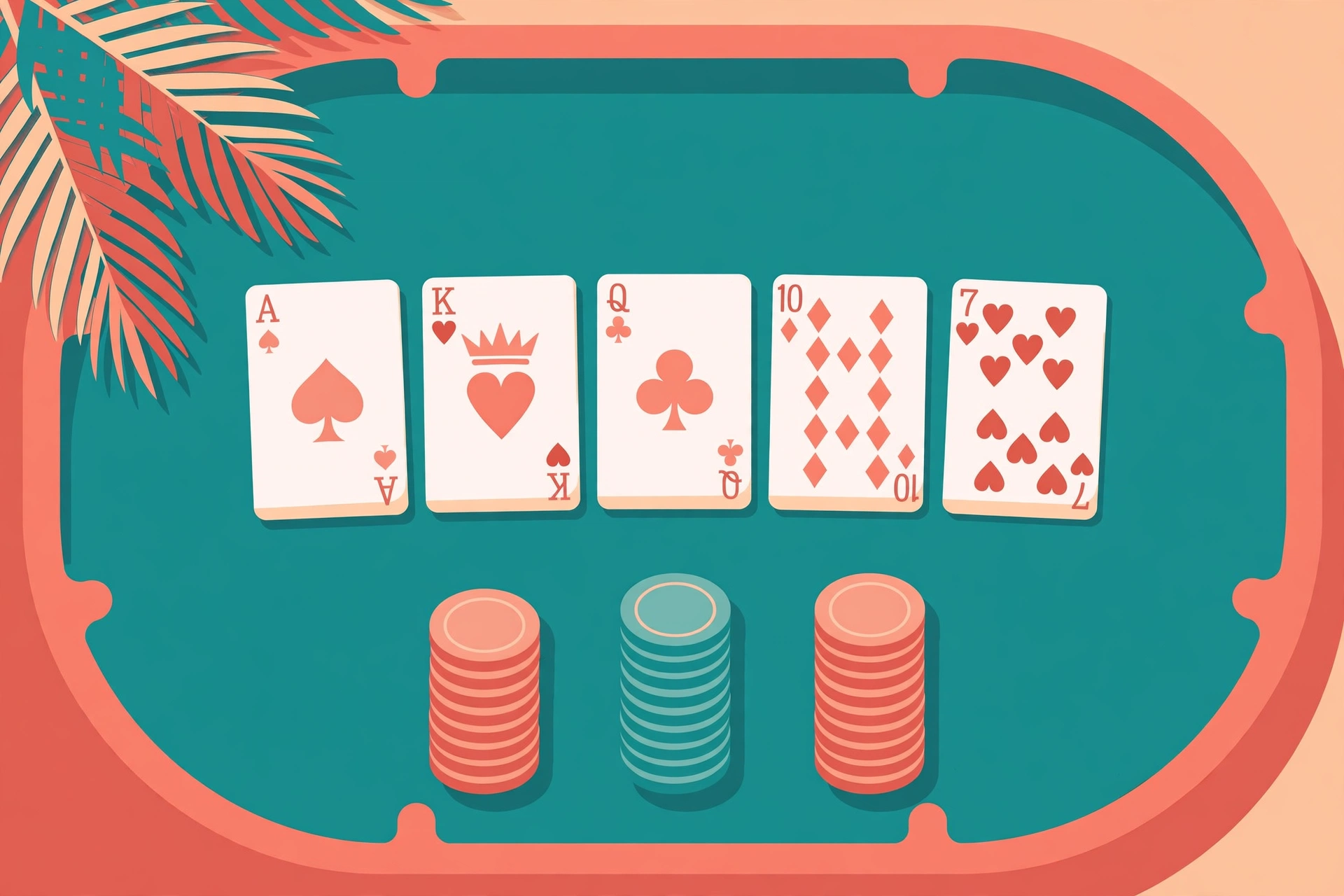
A royal flush is an ace, king, queen, jack, and ten of the same suit, and it is the strongest possible hand. A straight flush is five cards in sequence in the same suit. Four of a kind is four cards of the same rank. A full house is three of a kind plus a pair. A flush is five cards of the same suit that are not in sequence. A straight is five cards in sequence in mixed suits. Three of a kind, two pair, and one pair are what they sound like. High card means you have none of the above, and your hand is judged by its highest card.
When two hands have the same ranking, the tie is broken by the highest cards in each hand, and then by the next highest, and so on. Two pairs are compared by the higher pair first. A pair of aces beats a pair of kings. A flush is compared by its highest card. These tie-breaking rules matter more often than beginners expect, especially with one-pair hands, so it is worth knowing them before you sit down.
The Raise Payout Table
When you raise and beat a qualifying dealer, your ante always pays even money, one to one. Your raise bet pays according to the strength of your hand, on a fixed table that is printed on the table layout or on a small sign. A typical table looks like this: one pair or less pays even money, two pair pays two to one, three of a kind pays three to one, a straight pays four to one, a flush pays five to one, a full house pays seven to one, four of a kind pays twenty to one, a straight flush pays fifty to one, and a royal flush pays one hundred to one.
The exact numbers vary a little between casinos, so always read the table printed on the layout before you play. The important point is that the raise payout rewards strong hands, which is why a strong hand that you raised with can pay very well, and why a weak hand that you raised with and won still pays only even money on the raise. The game’s best moments come from raising with a strong hand and having the dealer qualify, so both bets pay.
The Progressive Jackpot Side Bet
The progressive jackpot side bet is a small optional bet that pays for strong hands regardless of whether you beat the dealer. It usually costs one unit, and it pays a fixed amount for a flush, a full house, four of a kind, and a straight flush, with the entire progressive jackpot, which grows from a share of every side bet placed, paid for a royal flush. Some tables pay a smaller share of the jackpot for a straight flush instead of a fixed amount.
This bet is tempting because the jackpot number on the display is large and always growing. It is also, in straightforward terms, a poor bet for the player. The chance of hitting a royal flush is roughly one in 649,740 hands, and the chance of hitting any of the paying hands is still small. The side bet has a much larger house edge than the main game, which means that over time, a player who places it on every hand gives up considerably more money than a player who does not. It is fun, and a royal flush would be a wonderful story, but it should be treated as the price of a lottery ticket, not as part of a strategy. If you place it, place it because you enjoy the thrill, not because you expect it to pay.
Basic Strategy: When to Raise and When to Fold
The standard basic strategy for Caribbean Stud is simple enough to remember, and it is the single most valuable thing in this guide. Raise with any pair or better, always. Fold with less than ace-king, always. With exactly ace-king high and no pair, the decision depends on the dealer’s up card, and the usual rule is to raise if the dealer’s up card is a two through queen and it matches one of the cards in your hand, or if your fourth-highest card is higher than the dealer’s up card, and otherwise fold.
Put more simply: a pair or better is always worth raising. A hand weaker than ace-king is never worth raising. Ace-king is the borderline, and the details above are how you play that borderline. Many casual players fold too many ace-king hands and raise too many weak hands, and both mistakes cost money. If you only remember one rule, remember the pair rule: any pair, raise.
The reason the strategy works is the dealer qualification rule. Raising with a weak hand is bad because you risk two more units to win a hand that will usually lose, or that will win only when the dealer fails to qualify, in which case your raise is returned anyway and you would have won the same ante by raising. Folding a hand that could have won when the dealer fails to qualify costs you only the ante, while raising a hand that usually loses costs you three units. The strategy balances those two costs.
Common Beginner Mistakes
The first mistake is raising with a weak hand because it “feels lucky” or because the dealer’s up card is low. The dealer’s up card matters, but not as much as your own hand. A queen-high hand against a dealer’s two is still a weak hand, and the correct play is usually to fold it.
The second mistake is always placing the progressive side bet. One unit per hand does not sound like much, but over a long session it adds up to a large extra cost, and it is the bet with the worst odds on the table. If you want the excitement, place it occasionally, not on every hand.
The third mistake is betting an ante that is too large for your budget. Remember that a raise costs twice the ante, so your real exposure per hand is three times the ante. Choose an ante that lets you play many hands at three times its value without worry, and you will make better decisions, because you will not be frightened into folding good hands or raising bad ones to “get your money back”.
The fourth mistake is showing your cards to other players or discussing your hand during play. Casinos prohibit this because it can change other players’ decisions, and it can also change the dealer’s outcome in ways that affect the table. Keep your cards to yourself, make your own decision, and enjoy the game.
Legal Status in Thailand — Read This First
Gambling in Thailand is governed by the Gambling Act B.E. 2478 (1935), and under that law most forms of gambling are prohibited. The only major exceptions are the government lottery and licensed horse racing. Online casinos are NOT licensed in Thailand, and playing at offshore casino sites sits outside any Thai licensing or consumer protection framework. This guide is educational only: it explains how a game works so that readers can understand it, not so that readers will seek out a place to play it.
If you are reading this from Thailand, treat any casino content as information, not as an invitation. You must be 18+ (18 or older) to gamble anywhere it is legal, and even where it is legal, there are no guaranteed winnings in any casino game. The house edge exists precisely because, over time, the casino expects to come out ahead. Do not gamble to recover losses — never chase losses by increasing your bets after a bad run, and never gamble with money needed for rent, food, bills, or family obligations. If gambling stops feeling like entertainment, help is available from BeGambleAware and Gamblers Anonymous, both of which offer free, confidential support and self-assessment tools.
Frequently Asked Questions
What is the house edge in Caribbean Stud Poker?
With correct basic strategy, the house edge on the main game is around five percent, which is higher than blackjack played well but lower than many other table games. The progressive side bet has a much higher house edge, which is why it should be treated as entertainment rather than strategy.
Should I always place the progressive jackpot bet?
No. It is optional, and the odds of hitting a paying hand are low. Place it only if you enjoy the thrill and can afford it as a separate entertainment cost, not as part of your main game plan.
What happens if the dealer does not qualify?
Your ante is paid even money, your raise bet is returned to you, and the hand ends. This is why raising with a marginal hand is less costly than it looks, and why folding a hand weaker than ace-king is still correct.
Can I play Caribbean Stud Poker against other players?
No. You play only against the dealer’s hand. Other players at the table have their own hands and their own decisions, and your result does not depend on theirs.
Is a pair always worth raising?
Yes. With any pair or better, the basic strategy says to raise. The only borderline decision is with ace-king high and no pair, where the dealer’s up card decides.
How do I learn the hand rankings quickly?
Play a few practice hands with a deck of cards at home, dealing five cards to yourself and five to an imaginary dealer, and ranking each hand. After a dozen hands, the rankings will feel natural. Our poker hand rankings guide is a useful reference while you learn.
Conclusion
Caribbean Stud Poker is one of the friendliest table games for a beginner. There is no bluffing, no opponent to read, and only one decision per hand: raise or fold. Learn the hand rankings, follow the basic strategy, and size your ante so that a raise is comfortable, and you will play the game about as well as it can be played. Treat the progressive jackpot as a lottery ticket rather than a plan, fold weak hands without regret, and remember that the game is entertainment with a price, not a way to make money. If you want to understand how the house advantage works across casino games generally, our guide to how the casino house edge works explains the mathematics in plain language. And if you enjoy poker-style games, three card poker is a faster cousin of Caribbean Stud that uses the same raise-or-fold idea with three cards instead of five.