Omaha Poker Guide for Thai Beginners: Rules, Hands & Strategy
Omaha Poker Guide for Thai Beginners: Rules, Hands & Strategy
If you already know Texas Hold’em, Omaha poker will feel familiar at first glance and then surprise you. The table looks the same, the betting rounds look the same, and the hand rankings are the same. But one rule changes everything: in Omaha you are dealt four hole cards instead of two, and you must use exactly two of them, together with exactly three community cards, to make your hand. That single rule creates bigger hands, bigger pots, more action, and more ways to make an expensive mistake.
This guide explains Omaha from scratch for Thai beginners. You will learn the rules step by step, how Pot-Limit Omaha betting works, which starting hands are worth playing, how to read the board, and the common mistakes that catch new players. No prior Omaha experience is assumed, and where Hold’em knowledge helps, this guide will point out both the similarities and the differences that matter.
Legal Status in Thailand — Read This First
Before you read any further, understand the legal position clearly. Gambling in Thailand is governed by the Gambling Act B.E. 2478 (1935). Under that law, most forms of gambling are prohibited. The only legal exceptions are the government lottery and licensed horse racing. Online casinos are NOT licensed in Thailand, and playing at them is not a legal activity under Thai law.
This article is educational only. It explains how Omaha poker works so you can understand the game, not as an encouragement to play for money in Thailand. The content is for readers aged 18 and over only. There are no guaranteed winnings in poker, or in any casino game, and no strategy can remove the element of chance or the risk of losing money. Never chase losses, never play with money you cannot afford to lose, and if gambling ever stops feeling like entertainment, stop and seek help. Support is available at BeGambleAware (https://www.begambleaware.org/) and Gamblers Anonymous (https://www.gamblersanonymous.org/ga/).
What Is Omaha Poker?
Omaha is a community-card poker game, just like Texas Hold’em. Each player receives private cards that only they can see, five community cards are dealt face up in the middle of the table, and players bet across four rounds, trying to make the best five-card hand or to win the pot by making everyone else fold.
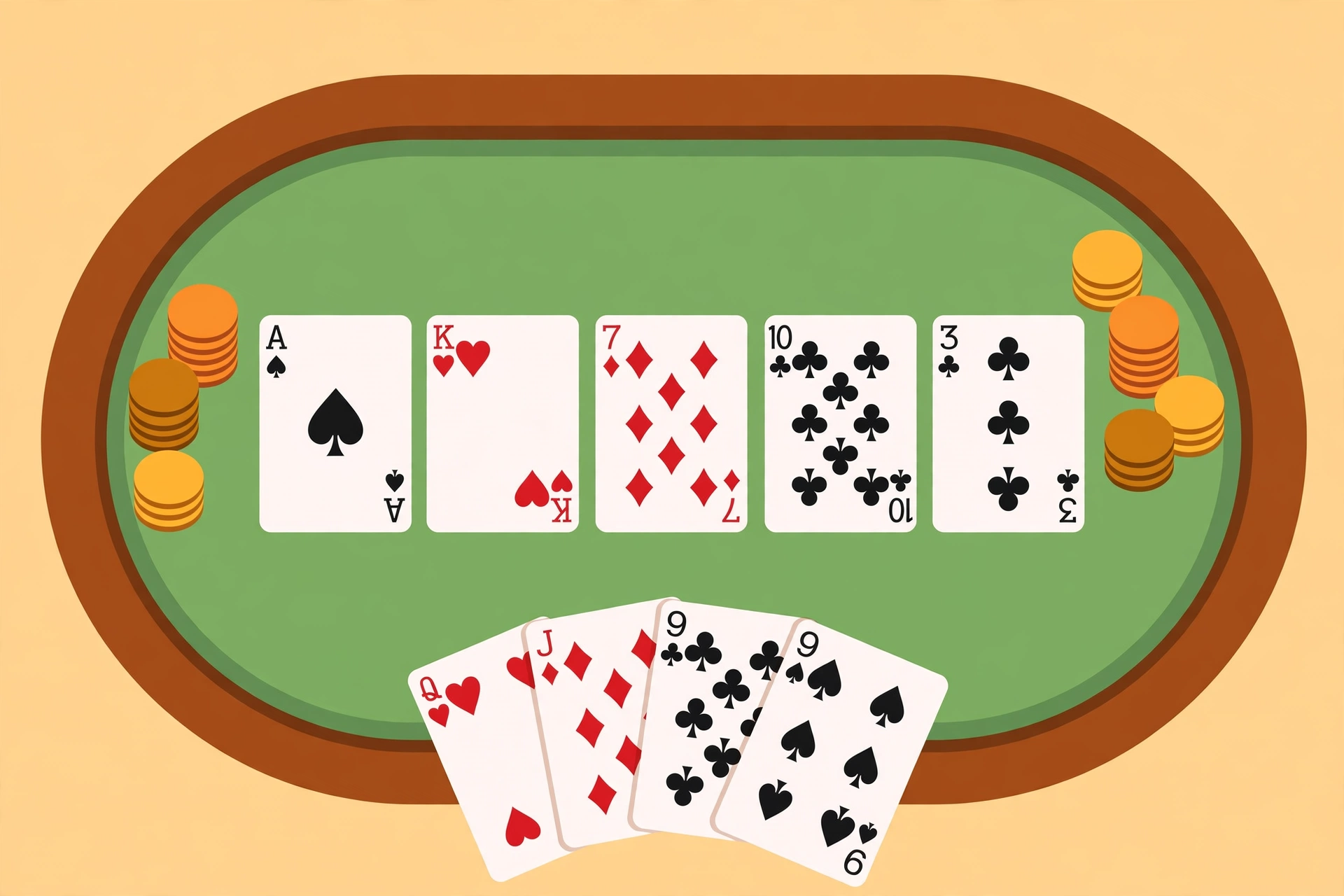
The difference is in the number of private cards and in how you must use them. In Hold’em you get two hole cards and you may use one, both, or neither of them with the community cards. In Omaha you get four hole cards, and you must use exactly two of them and exactly three community cards. You cannot use one hole card, you cannot use three or four, and you cannot play the board alone. Exactly two from your hand, exactly three from the board, every time.
That rule sounds small, but it changes the maths of the game completely. With four hole cards you have six different two-card combinations in your hand. That means you hold many more possible hands at once, and so does everyone else. Strong hands appear far more often in Omaha than in Hold’em, and a hand that would be a monster in Hold’em can be second best in Omaha. Learning to respect that difference is the first step to playing Omaha well.
The Main Variants You Will See
Most Omaha games you encounter will be one of two variants, and it is important to know which one you are playing before you sit down.
Pot-Limit Omaha (PLO)
Pot-Limit Omaha is by far the most common form of Omaha, and when people say “Omaha” without qualifying it, they usually mean PLO. In this variant, the maximum bet or raise is the size of the pot, including any calls you would need to make first. This limits how much you can bet at any moment, but pots still grow quickly because so many hands are playable and so many players stay in.
Omaha Hi-Lo (Omaha 8 or Better)
In Omaha Hi-Lo, the pot is split between the best high hand and the best qualifying low hand, if one exists. A low hand must be made from five cards ranked eight or lower, with no pairs. This variant rewards a completely different way of thinking, because a hand can win half the pot even when it is not the best high hand. Beginners should learn standard Pot-Limit Omaha first, because Hi-Lo adds a layer of complexity that is easy to get wrong.
There are also less common variants, including fixed-limit Omaha and no-limit Omaha, but Pot-Limit Omaha is the standard starting point, and this guide focuses on it.
How a Hand of Omaha Is Played
A hand of Omaha follows the same structure as Hold’em, with one extra card in each player’s hand.
First, the two players to the left of the dealer post the small blind and the big blind, forced bets that start the pot. Each player is then dealt four hole cards, face down. A round of betting follows, starting with the player to the left of the big blind.
Next, three community cards are dealt face up in the middle of the table. This is the flop. Another round of betting follows, starting with the first active player to the left of the dealer.
Then a fourth community card is dealt, the turn, followed by another round of betting. Then a fifth community card, the river, followed by the final round of betting.
If two or more players remain after the final betting round, there is a showdown. Each player makes the best five-card hand they can using exactly two of their hole cards and exactly three community cards, and the best hand wins the pot. If all but one player folds at any point, the last remaining player wins the pot without showing their cards.
The dealer button moves one seat clockwise after each hand, so the blinds and the order of play rotate around the table, just as in Hold’em.
Hand Rankings in Omaha
Hand rankings in Omaha are exactly the same as in Texas Hold’em, from high card at the bottom to a royal flush at the top. What changes is how often the strong hands appear, and therefore how much they are worth.
A pair of aces, the best starting hand in Hold’em, is a good hand in Omaha but it is not the dominant favourite it is in Hold’em, because every opponent holds four cards and many combinations that can beat it. A full house is a strong hand in Hold’em and often wins a large pot, but in Omaha full houses appear regularly, and they are often beaten by a better full house or by four of a kind. A flush, which is a powerful hand in Hold’em, is much more vulnerable in Omaha, because with so many cards in play, someone else is far more likely to hold a better flush.
This is the central adjustment a Hold’em player must make. In Omaha, the winning hand at showdown is usually much stronger than the winning hand in Hold’em. Two pair is rarely good enough. A low straight can be beaten by a higher straight. A small flush can be beaten by a bigger flush. The habit of overvaluing a decent hand is the single most expensive habit a beginner brings from Hold’em to Omaha.
Our guide to poker hand rankings and strategy for Thai beginners (https://stylishnamees.com/poker-guide-thai-beginners-hand-rankings-strategy) covers the rankings in detail, and it is worth reading alongside this guide if you are still learning which hands beat which.
The Exactly-Two Rule, Explained With Examples
The exactly-two rule is the rule beginners get wrong most often, so it deserves careful attention.
Suppose the community cards are Ace of hearts, King of hearts, Queen of hearts, Jack of hearts, and Ten of hearts. In Hold’em you would have a royal flush, because you can play the board. In Omaha you do not. You must use exactly two of your hole cards and exactly three community cards. If you hold no hearts, you cannot make a flush at all, because you need two hearts from your hand. If you hold two hearts, you can make a flush using those two hearts and three hearts from the board, but the hand you make depends on which hearts you hold.
Here is another example. Suppose you hold Ace of spades, Ace of hearts, King of spades, and King of hearts, and the board shows Ace of diamonds, Ace of clubs, and three low cards. You might think you have four of a kind, aces. You do not, in the way you think. You can only use two of your hole cards, so you can use one ace from your hand with two aces from the board to make three of a kind, and your second hole card must be one of your other cards, which gives you a full house, aces full of kings. That is still a strong hand, but it is not four aces, and understanding the difference matters when you are deciding how much to bet.
A third example shows the trap in the other direction. Suppose you hold four cards to a flush, say four hearts, and the board has three hearts. You might think you have a flush. You do, but only if you use two of your hearts, and the strength of your flush depends on which two hearts you choose. If your hearts are low, someone holding higher hearts will beat you. In Hold’em, holding two hearts with three hearts on the board gives you a flush of a fixed strength. In Omaha, holding four hearts gives you choices, and the wrong choice can cost you, but the right choice is always the best two hearts you hold.
The practical lesson is simple: always count your hand as two from your hand and three from the board, and never assume a card in your hand counts unless it is one of the two you are using.
Pot-Limit Betting, Explained Simply
Pot-limit betting confuses beginners because the maximum raise is not a fixed number. It is the size of the pot, and the pot changes as players bet and call.
The rule works like this. If no one has bet yet, you may bet up to the size of the pot. If someone has bet, you may call that bet first, and then raise by up to the size of the pot after your call is included. In practice, the dealer or the software will usually tell you the maximum, and in a live game you can ask. You do not need to calculate it perfectly in your head, but you should understand the idea: the pot limits the bet, so bets grow in proportion to the pot, and pots in Omaha grow fast.
A useful habit is to think in terms of pot-sized bets rather than money amounts. A pot-sized bet is a strong bet. A half-pot bet is a medium bet. A small bet is a probing bet. Thinking in these terms helps you compare situations across different stakes, and it helps you avoid the beginner mistake of betting an amount that is too small to matter or too large for the situation.
Starting Hands: What to Play and What to Fold
Starting hand selection is more important in Omaha than in Hold’em, because the cost of playing a weak hand is higher. In Hold’em you can sometimes win with a weak starting hand by hitting the flop hard. In Omaha, weak starting hands rarely become strong enough to win, and they often become second-best hands that lose a lot of money.
The best Omaha starting hands are coordinated hands, hands where the four cards work together. A hand like Ace of spades, King of spades, Queen of hearts, and Jack of hearts is strong because it can make a high pair, a straight, a flush in two suits, and several combinations of those. A hand like Ace of spades, Ace of hearts, King of spades, and Queen of hearts is strong because it has a high pair with strong supporting cards.
The worst Omaha starting hands are disconnected hands, hands where the cards do not work together. A hand like King of spades, Eight of hearts, Five of diamonds, and Two of clubs is weak because it can make only a few hands, and none of them are likely to be the best hand. A hand with a low pair and two unrelated low cards is also weak, because even if you make a set, someone else is likely to make a bigger set or a straight or a flush.
A simple rule for beginners is to play only hands where all four cards are connected in some way, either by rank, by suit, or by both. If two of your cards are doing nothing for the other two, fold. This rule will keep you out of many losing situations, and as you gain experience you can learn when to break it.
Double-Suited Hands
A double-suited hand is one where you hold two cards of one suit and two cards of another suit. For example, Ace of spades, King of spades, Queen of hearts, and Jack of hearts is double-suited in spades and hearts. Double-suited hands are valuable because they give you two chances to make a flush, and a flush is a hand that wins many pots in Omaha. A single-suited hand, where only two cards share a suit, is weaker, and a rainbow hand, where no two cards share a suit, is weakest of all in flush potential.
Pairs in Omaha
A pair in your hand is less valuable in Omaha than in Hold’em. A pair of aces is still the best pair, but it is not the huge favourite it is in Hold’em, and a low pair is often a trap. If you hold a pair of eights with two unrelated cards, you are hoping to make a set, but even if you do, someone else may make a higher set, a straight, or a flush. Pairs are most valuable when they are high and when the other two cards are connected to them or to each other, giving you more than one way to win.
Connected Cards and Wraps
Connected cards are cards close in rank, like Ten, Jack, Queen, and King. In Omaha, connected cards are valuable because they can make straights, and straights are common winning hands. A hand with four connected cards, sometimes called a wrap, can make a straight in many different ways, because you have many combinations of two cards from your hand that can complete a straight with three cards from the board. Wraps are one of the most powerful concepts in Omaha, and learning to recognise them is a major step towards playing well. A wrap draw, where you have many outs to a straight, can be stronger than a made hand in some situations, because you have so many cards that improve you.
Reading the Board in Omaha
Reading the board in Omaha means asking, for every possible hand, whether someone could hold it. Because each player has four cards, the answer is very often yes.
If the board has three cards of the same suit, assume someone has a flush, and ask whether your flush is the best possible flush. If you hold the ace of that suit, you have the best possible flush, sometimes called the nut flush, and you can bet with confidence. If you do not hold the ace, be careful, because someone else may hold it.
If the board has three connected cards, assume someone has a straight, and ask whether your straight is the highest possible straight. If the board is Ten, Jack, Queen, and you hold King and Ace, you have the best possible straight. If you hold Nine and King, you have a straight, but someone holding Ace and King has a better one.
If the board is paired, assume someone has a full house, and ask whether your full house is the best possible one. A paired board is dangerous in Omaha, because full houses are common and the difference between the best full house and the second-best full house is often the difference between winning and losing a large pot.
The habit to build is to always identify the best possible hand on the board, the nuts, and then ask whether you hold it or whether you are close to it. If you are not close to the nuts, be cautious about putting a lot of money in the pot. This habit alone will save a beginner more money than any other single adjustment.
Common Beginner Mistakes in Omaha
The first mistake is overvaluing a hand that would be strong in Hold’em. Two pair, a low straight, and a small flush are all hands that win often in Hold’em and lose often in Omaha. If you bring Hold’em values to Omaha, you will pay too much to see showdowns you should have avoided.
The second mistake is playing too many hands. Omaha is an action game, and it is tempting to play because every hand looks interesting with four cards. But most starting hands are losing hands, and playing them costs money over time. Tight starting hand selection is not boring in Omaha. It is profitable.
The third mistake is forgetting the exactly-two rule. Beginners regularly think they have a flush when they hold one card of the suit, or think they have a straight when they are using three hole cards, or think they have four of a kind when they are using the wrong combination. Count your hand carefully every time, especially when the pot is large.
The fourth mistake is chasing a draw without the right price. Omaha gives you many draws, and it is tempting to chase all of them. But a draw is only worth chasing if the pot offers you enough to justify the call, and if your draw is to the best possible hand. A draw to a second-best flush or a low straight is a losing draw, and chasing it is one of the most expensive habits in the game.
The fifth mistake is betting too much with a vulnerable hand. A hand that is currently best but can easily be beaten on the next card is a hand to play carefully, not a hand to build a huge pot with. In Omaha, the board changes the best hand more often than in Hold’em, and a hand that is best on the flop can be second best on the turn.
If you want to understand the maths behind pot odds and drawing decisions, our guide to how the house edge works (https://stylishnamees.com/how-casino-house-edge-works-beginners-thailand) explains why the maths always matters in casino games, even in a skill game like poker.
Omaha Strategy Basics for Beginners
Good Omaha strategy starts with position. Acting last is valuable in every form of poker, and it is especially valuable in Omaha, because you get to see what everyone else does before you decide, and because the information about who is strong and who is weak matters more when hands are close. Play more hands in late position and fewer hands in early position, and be especially careful when you are first to act.
Good Omaha strategy also means thinking about the nut hand. In Hold’em you can often win with a good hand that is not the best possible hand. In Omaha you should aim to make the best possible hand, or a hand close to it, and you should be suspicious of hands that are good but not great. If you are drawing, draw to the nuts. If you are betting, bet when you hold the nuts or close to it. If you are calling, ask whether the hand you are hoping to make will actually be good enough.
Another basic principle is to keep the pot small when your hand is vulnerable and to build the pot when your hand is strong and unlikely to be beaten. This sounds obvious, but beginners often do the opposite, building large pots with hands that are currently best but easily beaten, and keeping pots small with hands that are unlikely to be beaten. Reversing that habit is a major improvement.
Finally, learn to fold. Folding is not losing in Omaha. It is the decision that keeps you in the game for the hands that matter. A beginner who folds correctly will lose less than a beginner who calls too often, and over time that difference is what separates a player who enjoys the game from a player who keeps losing.
For the psychological side of poker, including when to bluff and when not to, our guide to poker bluffing basics for beginners in Thailand (https://stylishnamees.com/poker-bluffing-basics-beginners-thailand) is a useful companion, but remember that bluffing works differently in Omaha, because opponents hold more cards and are more likely to have a hand worth calling with.
Omaha Versus Texas Hold’em: A Clear Comparison
The two games share a structure, but they reward different skills. Hold’em rewards reading opponents and making thin value bets with good but not great hands. Omaha rewards hand selection, board reading, and discipline, because the hands are stronger and the margins are thinner.
In Hold’em, a single pair can win a pot. In Omaha, a single pair almost never wins at showdown. In Hold’em, a flush is a strong hand. In Omaha, a flush is a hand you need to check carefully. In Hold’em, you can sometimes win by representing a hand you do not have. In Omaha, bluffing is harder, because opponents are more likely to hold something worth calling with.
None of this means Omaha is better or worse than Hold’em. It means it is a different game, and a player who treats it as Hold’em with extra cards will lose. A player who learns Omaha on its own terms will find a game with more action, bigger pots, and more decisions that reward careful thinking.
Bankroll and Responsible Play
Poker is a skill game, but it is still gambling, and Omaha is a high-variance game, which means results swing more from session to session than in Hold’em. Even a good player can lose for a long stretch, and even a bad player can win for a short stretch. That variance makes bankroll management essential.
Set a budget for poker that you can afford to lose, keep it separate from money you need for living expenses, and never increase it to chase losses. Play at stakes where a normal losing run will not wipe out your budget, and stop when you reach the limit you set before you started. If you feel frustrated, tired, or desperate to win back losses, that is the moment to stop, not the moment to play another hand.
Our guide to casino bankroll management for beginners in Thailand (https://stylishnamees.com/casino-bankroll-management-guide-beginners-thailand) explains how to set limits and stick to them, and the principles there apply directly to Omaha.
Frequently Asked Questions
Is Omaha harder than Texas Hold’em?
In most ways, yes. You have more cards to consider, more combinations to calculate, and stronger hands to beat. The rules are simple to learn, but playing well takes more practice, because the decisions are more complex and the mistakes are more expensive.
What is the best starting hand in Omaha?
There is no single best hand in the way pocket aces is the best hand in Hold’em. The strongest starting hands are double-suited, connected hands with high cards, such as Ace-King-Queen-Jack double-suited, and high pairs with connected supporting cards, such as a pair of aces with a king and a queen of matching suits. The key is coordination, not just one high pair.
Can I use one hole card in Omaha?
No. You must use exactly two hole cards and exactly three community cards, every time. If you use one hole card, or three, or four, or none, you are not playing Omaha correctly, and in a real game your hand would be read according to the exactly-two rule, not according to the hand you thought you had.
Why do full houses lose so often in Omaha?
Because full houses appear much more often in Omaha than in Hold’em. With four hole cards per player and five community cards, many players can make a full house on the same board, and the winner is the player with the highest full house. A low full house is often a losing hand in Omaha, even though it would be a strong hand in Hold’em.
Should beginners play Pot-Limit Omaha or Omaha Hi-Lo first?
Pot-Limit Omaha first. Hi-Lo adds the low hand and the split pot, which changes every decision. Learn standard Omaha well before you add that complexity.
Is bluffing effective in Omaha?
Bluffing works less often in Omaha than in Hold’em, because opponents hold four cards and are more likely to have a hand worth calling with. Bluffing still has a place, especially when the board is frightening and your story is believable, but beginners should bluff less in Omaha than they would in Hold’em.
How much money should I bring to an Omaha game?
Only money you can afford to lose, at stakes where a normal losing session will not hurt your finances. Omaha pots grow quickly and variance is high, so a bankroll that feels comfortable in Hold’em may feel small in Omaha. Set a limit before you play and stick to it.
Conclusion
Omaha poker is Hold’em’s wilder, richer cousin. The rules are easy to learn, the action is constant, and the pots are bigger, but the game punishes the habits that work in Hold’em. A hand that would win in Hold’em often loses in Omaha. A draw that would be worth chasing in Hold’em is often a losing draw in Omaha. And a player who plays too many hands, overvalues decent hands, or forgets the exactly-two rule will pay for those mistakes again and again.
The path to playing Omaha well is straightforward, even if it is not easy. Learn the exactly-two rule until it is automatic. Play coordinated starting hands and fold the rest. Always ask what the best possible hand is and whether you hold it. Draw to the nuts, keep pots small with vulnerable hands, build them with strong hands, and fold when the price is wrong. Above all, treat poker as entertainment with a cost, set a budget you can afford, and never chase losses.
If you do those things, Omaha can be one of the most enjoyable poker games there is. If you skip them, it can be one of the most expensive. Start slowly, learn the game on its own terms, and let your understanding grow one hand at a time.