
Slot Volatility Explained: Low, Medium and High Volatility Slots for Beginners
Two slot machines can look almost identical and behave completely differently. On one, small wins land every few spins, your balance drifts down slowly, and the game feels steady. On the other, nothing happens for a long stretch, and then a single spin pays out a large amount. Both machines can have the same return to player, the same theme, and the same number of reels — and yet the experience of playing them is entirely different. The reason is volatility.
Slot volatility, also called variance, describes how a slot machine pays out over time: how often wins land, and how big those wins tend to be. It is one of the most useful things a beginner can learn about slots, because it tells you what kind of session to expect and how to manage your money for it. This guide explains low, medium and high volatility slots in plain language, shows how volatility relates to RTP, and helps you choose the kind of game that suits the way you like to play.
If you are new to slots in general, start with our guide to how slot machines work, which covers RTP, volatility and paylines together, and our guide to how slot paylines work. This article goes deeper on volatility itself, so it pairs well with both.
What Is Slot Volatility?
Slot volatility is a measure of risk in a slot game. A low volatility slot pays out often, but the wins are usually small. A high volatility slot pays out rarely, but the wins can be much larger when they do land. A medium volatility slot sits in between: wins come fairly often, and they are sometimes large enough to feel exciting.
Think of it like weather. A low volatility slot is like light rain: it happens often, and no single shower is dramatic. A high volatility slot is like a thunderstorm: long dry spells, and then a sudden downpour. Neither kind of weather is better in an absolute sense — it depends on what you are prepared for and what you enjoy. The same is true of slots.
Volatility does not change the long-term return of a game. Two slots can have the same RTP and very different volatility. Over a very large number of spins, both return the same share of money to players on average. What differs is the journey: how bumpy the ride is on the way there. A low volatility game gives you a smoother ride with many small wins. A high volatility game gives you a bumpier ride with long losing stretches and occasional large wins.
It is important to be clear about one thing: volatility does not tell you when a machine is about to pay out. A high volatility slot that has not paid for a hundred spins is not “due” to pay on the next one. Each spin is decided by a random number generator, independently of every spin before it. Our guide to how RNG works in slot machines explains why past results never change the odds of the next spin, and why ideas about hot and cold machines are among the most persistent casino myths.
Low Volatility Slots: Steady and Frequent
Low volatility slots are the steady games. Wins land often — sometimes every few spins — and your balance tends to move slowly rather than in sudden jumps. The wins are usually small, often close to the size of your bet or a little above it. Big wins are rare, and the largest payouts in the game are modest compared with high volatility slots.
These games suit players who want a long, relaxed session. If you have a small budget and you want it to last, a low volatility slot is the sensible choice, because frequent small wins keep topping your balance up and stretch your playing time. They also suit players who find long losing runs stressful. Losing is still possible — the house edge applies to every slot — but the experience is gentler, with fewer long stretches of nothing.
Low volatility slots are a good starting point for beginners. They let you learn how a game works — its bonus rounds, its features, its paylines — without your balance disappearing quickly while you are still learning. They are also the best choice if you are playing with a bonus that has wagering requirements, because steady small wins help you work through the requirements without large swings. Our guide to casino bonus wagering requirements explains how those requirements work and why game choice matters when you are clearing them.
The trade-off is excitement. If you are hoping for a single spin that pays many times your bet, a low volatility slot will probably disappoint you. The game is designed to pay often and small, not rarely and large, and no amount of wishing changes that design.
Medium Volatility Slots: The Middle Ground
Medium volatility slots are the most common kind, and they are the default choice for many players. Wins land fairly often, and the wins are sometimes large enough to feel meaningful. You will still have dry spells, but they are usually shorter than on a high volatility game, and the wins that break them are usually big enough to notice.
These games suit players who want a balance: enough action to stay interesting, without the long losing runs that high volatility games demand. They are a good choice if you are not sure what kind of player you are yet, because they give you a taste of both worlds. You will see small wins regularly, and you will occasionally see a win that is several times your bet.
Medium volatility is also a sensible choice for a moderate budget. Your money should last a reasonable session, and you have a realistic chance of a win that feels rewarding. If you find low volatility games boring and high volatility games stressful, medium volatility is probably where you belong — at least while you are learning what you enjoy.
High Volatility Slots: Rare Wins, Big Payouts
High volatility slots are the dramatic games. Wins are rare, and long stretches without a win are normal. But when a win does land, it can be large — sometimes very large, especially if the game has a big jackpot or a powerful bonus round. The largest payouts in slot gaming almost always come from high volatility games.
These games suit players who are chasing a big win and who are prepared for the cost of chasing it: long losing runs, a balance that falls quickly, and sessions that can end with nothing to show for them. They are not a good choice for a small budget, because a small budget can disappear before the game has had a chance to pay out. They are not a good choice for players who find losing runs stressful, because losing runs are the normal experience on these games, not the exception.
A common beginner mistake is to play a high volatility slot with a small budget and a large bet size, hoping for a quick big win. The mathematics of the game make that a fast way to lose the whole budget. If you want to play high volatility games, you need a budget that can survive many spins without a win, and a bet size small enough that those spins do not drain it. Even then, the big win is not guaranteed — it is possible, not promised, and many sessions on high volatility slots end without one.
High volatility games are also where you will find most of the big progressive jackpots and the most spectacular bonus rounds. That is part of their appeal. But it is worth remembering that the jackpot is funded by all the losing spins, including yours. The excitement of the chase is real, and so is the cost.
Volatility vs RTP: Two Different Things
Beginners often confuse volatility with RTP, but they measure different things. RTP — return to player — is the share of money a slot returns to players on average over a very large number of spins. A slot with an RTP of 96% returns 96 units for every 100 units wagered, on average, over the long term. Volatility describes how that return is spread out: in many small wins or a few large ones.
A low volatility slot and a high volatility slot can have exactly the same RTP. The difference is the shape of the payouts, not the total amount returned. That is why RTP alone does not tell you what a game will feel like to play. Two games with the same RTP can give you completely different sessions, and the only way to know which one suits you is to understand volatility as well.
It also helps to know that RTP is a long-term average, not a promise for your session. In a single session of a few hundred spins, your actual return can be far above or far below the RTP, especially on a high volatility game. The RTP tells you what happens on average over millions of spins. Your session is a tiny sample of that, and it can vary widely.
How to Tell a Slot’s Volatility
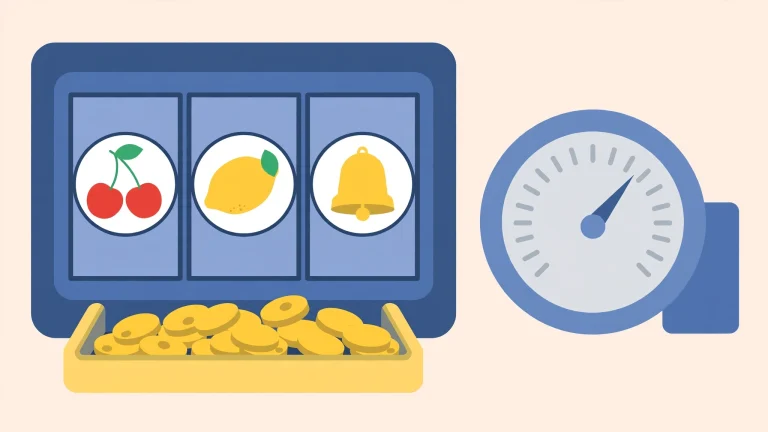
Slot makers do not always label volatility clearly, which is frustrating for beginners. Some games show a volatility rating — low, medium or high — in the game’s information or help screen. Some show it as a number of lightning bolts, stars, or a meter. Others do not show it at all, and you have to work it out from the game’s design.
There are clues. Look at the paytable: if the top payouts are very large compared with the smaller ones, the game is probably high volatility, because those large payouts have to be funded by many losing spins. If the payouts are close together and the top prize is modest, the game is probably low volatility. Look at the bonus features too: games with rare but powerful bonus rounds, multipliers, and jackpots tend to be high volatility, while games with frequent small features tend to be low or medium.
You can also learn from experience. Play a game in free or demo mode for a while and watch how it behaves. If wins come often and stay small, it is low volatility. If you go long stretches with nothing and then land a large win, it is high volatility. Demo play is a useful way to learn a game’s character without risking money, and it is the best way to find out whether a game suits you before you commit a budget to it.
Review sites and game descriptions sometimes mention volatility as well, though the information is not always accurate. Treat it as a guide, not as a guarantee, and trust your own experience in demo play over a description you read online.
Choosing the Right Volatility for You
The right volatility depends on three things: your budget, your temperament, and what you want from the session.
Start with your budget. A small budget suits a low volatility game, because frequent small wins help it last. A larger budget can handle a high volatility game, because it can survive the dry spells. A good rule of thumb: if your budget covers only a short session at your chosen bet size, do not play a high volatility game with that bet size. Either choose a lower volatility game, or lower your bet size until your budget covers enough spins to give the game a fair chance to pay.
Then think about your temperament. Do long losing runs bother you? If they do, avoid high volatility games, however tempting the jackpot looks. Do you get bored when wins are small? If you do, low volatility games will frustrate you, and a medium volatility game is a better fit. There is no right answer here — the best game is the one you enjoy playing, within a budget you can afford.
Finally, think about what you want from the session. If you want a long, relaxed session with friends or while you unwind, low volatility is the natural choice. If you want excitement and the chance, however small, of a large win, high volatility is the natural choice. If you want a bit of both, medium volatility is the natural choice. Be honest with yourself about which of those you actually want, rather than the one you think you should want.
Whatever you choose, set your budget before you start and stick to it. Our guide to casino bankroll management explains how to set a session budget, choose a bet size that fits it, and walk away when the budget is gone — which is the single most important skill in any casino game, and especially in slots.
Volatility and Bonus Features
Bonus features interact with volatility in ways that matter. Free spins, multipliers, expanding wilds and pick-a-prize rounds are often where the largest wins in a game are found, and on a high volatility game those features may trigger rarely but pay heavily when they do. On a low volatility game the same features may trigger often but pay modestly. The feature is not separate from the volatility — it is part of how the volatility is built.
That is why it is worth reading a game’s help screen before you play it. It will tell you how the features work, how often they are likely to trigger, and what the top payouts look like. A feature that triggers once in a hundred spins and pays a large amount is a high volatility feature. A feature that triggers every twenty spins and pays a small amount is a low volatility feature. Knowing that in advance helps you set your expectations, and it helps you decide whether the game suits your budget.
It is also worth knowing that some games let you buy a bonus round directly, paying a multiple of your bet to skip straight to the feature. That option is usually expensive and high volatility by nature, because you are paying a large amount for a single chance at a large win. Beginners are better off playing the game normally and letting the features trigger naturally, rather than paying to skip ahead.
Common Mistakes Beginners Make with Volatility
The first mistake is choosing a game by its theme or its jackpot and ignoring its volatility. A game with an attractive theme and a huge jackpot is usually a high volatility game, and playing it with a small budget is a recipe for a short session. Choose the game by its volatility first and its theme second.
The second mistake is raising your bet after a long losing run, in the belief that a win must be coming. It is not. Each spin is independent, and the odds on the next spin are the same as the odds on the last one. Raising your bet during a dry spell on a high volatility game is the fastest way to lose a budget, because the dry spell can continue for much longer than you expect.
The third mistake is the opposite: playing a low volatility game and expecting a life-changing win. Low volatility games are designed to pay often and small. If you want a large win, you need a high volatility game, and you need a budget that can survive the wait. Playing the wrong kind of game for your goal leads to disappointment either way.
The fourth mistake is confusing volatility with fairness. A high volatility slot is not rigged, and a low volatility slot is not generous. Both are designed to return the same share of money on average if they have the same RTP. The difference is the shape of the payouts, not the honesty of the game. A long losing run on a high volatility game is normal, not evidence that the game is cheating you.
Legal Status in Thailand — Read This First
Gambling in Thailand is governed principally by the Gambling Act B.E. 2478 (1935). Under that Act, gambling is generally prohibited in Thailand. There are only a small number of legal exceptions: the government lottery, and licensed horse racing. Those are the exceptions the law allows. Other forms of gambling, including casinos, are not legal in Thailand, and online casinos are NOT licensed in Thailand.
That has a direct consequence for Thai players: there is no licensed, regulated online casino market in Thailand that you can turn to with the protections that regulation provides elsewhere. If you come across a website offering online casino games to players in Thailand, it is not operating under a Thai licence, and it is not subject to Thai regulation. That does not necessarily mean every such site is a scam, but it does mean you have no regulator to complain to, no local consumer protection designed for gambling, and no straightforward way to recover money if something goes wrong.
This article is educational only. It explains how slot volatility works so that readers can understand the game and make informed decisions. It is not an encouragement to gamble, and it is not legal advice. If you are unsure about the law, you should seek proper legal advice rather than relying on claims made by a gambling website or an advertisement.
This content is for adults aged 18+ only. There are no guaranteed winnings in slots or in any casino game. Every hand/round/spin is random, the long-term average favours the operator, and no strategy, system or timing trick can change that. Never chase losses. If you lose money you set aside for play, do not try to win it back by betting more. That is one of the fastest ways to turn a small loss into a serious problem.
If gambling is affecting you or someone you know, help is available. You can find information and support at BeGambleAware and at Gamblers Anonymous. Reaching out is a sensible, practical step, and it is better to do so early than to wait until the problem has grown.
Frequently Asked Questions
What does slot volatility mean?
Slot volatility, also called variance, describes how a slot game pays out over time: how often wins land and how big they tend to be. Low volatility slots pay often with small wins. High volatility slots pay rarely with larger wins. Medium volatility slots sit in between. Volatility does not change the long-term return of a game — two slots can have the same RTP and very different volatility — but it changes what a session feels like.
What is the difference between low and high volatility slots?
Low volatility slots give you frequent small wins and a steady, gentle session, and your budget tends to last longer. High volatility slots give you long stretches without a win, followed by occasional large wins, and your budget can disappear quickly during the dry spells. Low volatility suits small budgets and relaxed play; high volatility suits players chasing a large win who can afford the wait.
What is the difference between volatility and RTP?
RTP is the share of money a slot returns to players on average over a very large number of spins. Volatility is how that return is spread out — in many small wins or a few large ones. Two slots can have the same RTP and different volatility. RTP tells you the long-term average; volatility tells you what the ride to that average looks like.
How can I tell if a slot is high volatility?
Check the game’s information or help screen, where some makers show a volatility rating. Look at the paytable too: if the top payouts are very large compared with the smaller ones, the game is probably high volatility. Games with rare but powerful bonus rounds, multipliers and jackpots also tend to be high volatility. You can also learn from demo play: long dry spells followed by large wins are the signature of a high volatility game.
Are high volatility slots better than low volatility slots?
Neither is better in an absolute sense — it depends on your budget, your temperament, and what you want from the session. High volatility slots offer the chance of a large win, but they demand a budget that can survive long losing runs. Low volatility slots offer longer, steadier sessions, but the wins are small. The best choice is the one that fits your money and your mood, not the one with the biggest jackpot on the screen.
Does a slot become due to pay after a long losing run?
No. Each spin is decided by a random number generator, independently of every spin before it. A high volatility slot that has not paid for a hundred spins has exactly the same odds of paying on the next spin as it had on the first. The idea that a machine is “due” is one of the most common casino myths, and believing it leads players to raise their bets at exactly the wrong time.
What volatility should beginners choose?
Most beginners should start with low or medium volatility slots. Low volatility games let you learn how a game works without your balance disappearing quickly, and medium volatility games give you a taste of larger wins without the long losing runs of high volatility games. Once you understand how volatility affects your session and your budget, you can try high volatility games with a bet size your budget can support.
Can volatility help me win at slots?
No. Volatility does not change the house edge, and it does not make a slot more likely to pay out overall. It only changes the pattern of wins and losses. The best use of volatility is to choose a game whose pattern suits your budget and your temperament, so that you enjoy the session and your money lasts as long as you planned. No choice of volatility can turn a slot into a winning game in the long run.
Conclusion
Slot volatility explained simply is this: low volatility means often and small, high volatility means rarely and large, and medium volatility means something in between. Volatility does not change how much a slot returns on average — that is the job of RTP — but it changes everything about what a session feels like, how long your money lasts, and how you should size your bets.
Choose the game that fits your budget and your temperament, not the game with the flashiest theme or the biggest jackpot. Play low volatility when you want a long, steady session, medium volatility when you want a balance, and high volatility only when you can afford the dry spells and you understand that the big win is possible, not promised. Set your budget before you start, keep your bet size small enough to survive the game you chose, and walk away when the budget is gone. That is the whole skill of playing slots well — and it starts with understanding volatility.