Layer 2 Scaling Solutions Explained: How They Make Crypto Faster and Cheaper
Risk disclaimer: Cryptocurrencies are volatile and can lose most or all of their value. Nothing in this article is financial advice. Never invest money you cannot afford to lose, and do your own research before buying any cryptocurrency.
If you have ever tried to send a transaction on Ethereum during a busy period, you may have been shocked by the fee. A simple transfer that costs very little on a quiet day can suddenly cost many times more when the network is crowded. Bitcoin has a similar problem: when lots of people want to transact at once, transactions get slower and more expensive. This is not a bug in these networks. It is a trade-off built into how they work, and it is one of the biggest obstacles to crypto being useful for everyday payments.
Layer 2 scaling solutions are the main answer the crypto world has developed to this problem. They are extra layers built on top of a blockchain that handle transactions faster and more cheaply, while still relying on the underlying blockchain for security. If you have heard names like Arbitrum, Optimism, Polygon, or the Lightning Network, you have heard of layer 2 solutions — even if nobody explained what they actually do.
This guide explains what layer 2 means, how the main types of scaling solutions work, how they differ from layer 1, and what beginners should know before using them.
What Is a Layer 1 Blockchain?
To understand layer 2, you first need a clear picture of layer 1. A layer 1 blockchain is the base network itself — Bitcoin, Ethereum, Solana, and similar networks are all layer 1s. The layer 1 is responsible for everything: recording transactions, reaching agreement about which transactions are valid, and keeping the whole system secure.
The security of a layer 1 comes from thousands of computers around the world checking each other’s work. That decentralisation is what makes blockchains trustworthy without a central authority. But it also creates a limit. Because every computer in the network needs to process every transaction, the network can only handle a certain number of transactions per second. Bitcoin processes a small number of transactions per second; Ethereum processes more, but still far fewer than a traditional payment network.
When demand exceeds that limit, a queue forms. Users who want their transaction processed quickly offer higher fees, and fees rise for everyone. This is why using Ethereum can feel cheap one day and very expensive the next. Our guide to Ethereum gas fees explains this fee system in detail.
The Scalability Problem in Plain Terms
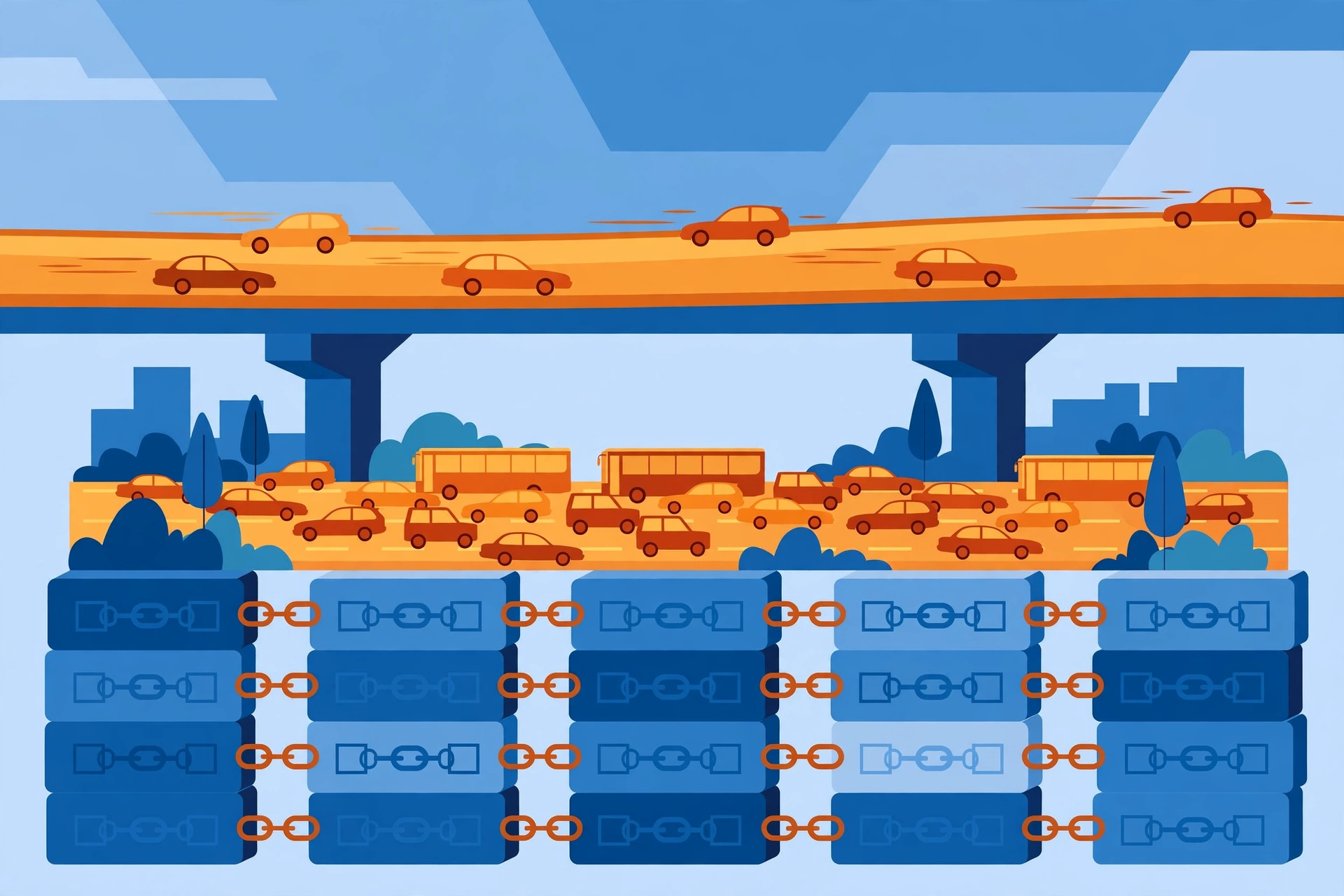
Imagine a single-lane road that leads into a city. When traffic is light, everyone drives through quickly. When traffic is heavy, cars queue up for hours. You could widen the road, but that is expensive and changes the character of the town. Or you could build a second road above the first — a highway that carries most of the traffic, with on-ramps and off-ramps connecting it to the original road. That second road is, roughly, what a layer 2 does.
The blockchain world calls this the scalability trilemma: a network can be decentralised, secure, and scalable, but improving one of these usually means weakening another. Layer 1 networks like Bitcoin and Ethereum prioritise decentralisation and security, which means they accept limited speed. Layer 2 solutions try to add speed without giving up the security of the layer beneath them.
This matters because crypto cannot become everyday money if a cup of coffee costs more in fees than the coffee itself. Scaling is not a luxury feature; it is a precondition for wider use.
What Is Layer 2?
A layer 2 is a separate system built on top of a layer 1 blockchain. It processes transactions off the main chain, then records a summary of those transactions back on the layer 1. The layer 1 acts as the final record and the source of security, while the layer 2 does the heavy lifting of actually handling the transactions.
The key idea is that not every transaction needs to be checked by every computer on the main network. If a group of transactions can be processed elsewhere and only the result is written to the main chain, the main chain stays secure and uncrowded while the overall system handles far more transactions.
Think of it like a restaurant. The layer 1 is the head chef who checks every dish before it leaves the kitchen. That is thorough but slow. A layer 2 is like a team of prep cooks who do most of the work and only bring finished dishes to the chef for a final check. The chef still guarantees quality, but the kitchen serves many more customers.
Moving funds to a layer 2 usually involves a step called bridging, where you lock tokens on the layer 1 and receive an equivalent amount on the layer 2. Moving back reverses the process. Bridges are convenient but they are also a known risk area in crypto, and several major hacks have targeted them. Never rush a bridge transaction, and always check you are using the official bridge for the network you want.
The Main Types of Layer 2 Solutions
Layer 2 is an umbrella term covering several different technologies. The main ones a beginner is likely to encounter are rollups, sidechains, state channels, and payment channels.
Rollups
Rollups are the most important layer 2 technology on Ethereum today, and the one you are most likely to use. A rollup takes many transactions, bundles them together off the main chain, and then posts a compressed summary to the layer 1. Instead of the main chain processing hundreds of individual transactions, it processes one bundle that represents all of them.
There are two main kinds of rollups, and the difference is in how they prove the bundled transactions are honest.
Optimistic rollups assume transactions are valid unless someone challenges them. There is a waiting period — often around a week — during which anyone can submit proof that a transaction was fraudulent. If fraud is proven, the bad transaction is reversed and the party that submitted it is penalised. Arbitrum and Optimism are the best-known examples. The trade-off is that withdrawing funds back to the layer 1 can take time because of the challenge period.
Zero-knowledge rollups, often called ZK-rollups, take the opposite approach. Every bundle comes with a cryptographic proof that the transactions inside it are valid. The layer 1 can verify that proof quickly without re-checking every transaction. This makes withdrawals faster, but the technology is more complex to build. Well-known examples include zkSync and Starknet.
For a beginner, the practical difference is simple: optimistic rollups are more established and widely used, while ZK-rollups are newer and in some ways more elegant. Both make transactions much cheaper than using the layer 1 directly.
Sidechains
A sidechain is a separate blockchain that runs alongside the main chain and is connected to it by a bridge. Sidechains have their own rules, their own validators, and their own level of security. They can process transactions quickly and cheaply because they are not bound by the main chain’s limits.
The best-known example is Polygon, which runs alongside Ethereum. Transactions on Polygon are fast and cost very little, which has made it popular for games, apps, and everyday payments.
The important thing to understand is that a sidechain is not as secure as a true layer 2 rollup, because its security depends on its own validators rather than on the main chain. If a sidechain’s validators misbehave, the main chain cannot automatically fix it. Sidechains are a practical and useful technology, but they involve a different trust assumption, and it is worth knowing that before you move significant funds onto one.
State Channels and Payment Channels
State channels let two or more parties transact privately off the main chain, and only record the final result on the layer 1. The most famous example is Bitcoin’s Lightning Network, which is a network of payment channels designed to make Bitcoin payments fast and cheap.
Here is how a payment channel works in simple terms. Two people lock some Bitcoin into a shared address on the main chain. Then they can send payments back and forth between themselves as many times as they like, instantly and almost for free, because those payments happen off the main chain. When they are finished, they close the channel, and only the final balance is recorded on Bitcoin itself.
The Lightning Network connects many such channels together, so you can pay someone you have no direct channel with by routing the payment through other people. It is clever technology, but it is also more complicated to use than a normal wallet, and it works best for small, frequent payments rather than large transfers.
Layer 2 vs Layer 1: The Key Differences
The distinction between layer 1 and layer 2 confuses many beginners, so here is a direct comparison.
A layer 1 is the base blockchain. It is the most secure and most decentralised part of the system, and it is where final settlement happens. Transactions on a layer 1 are slower and can be expensive when the network is busy, but they carry the strongest guarantee.
A layer 2 is built on top of that base. It is faster and cheaper, and it is where most everyday activity happens. Its security ultimately depends on the layer 1 beneath it, though the strength of that dependence varies: rollups inherit most of the layer 1’s security, while sidechains depend more on their own validators.
A useful way to think about it: the layer 1 is the vault, and the layer 2 is the checkout counter. You keep your savings in the vault, and you do your daily spending at the counter. Most of the time you never need to visit the vault at all.
It is also worth noting that some newer blockchains, such as Solana and Polygon, were designed to be fast at the layer 1 level, using different technical trade-offs. The crypto world has not settled on a single answer to scaling; layer 2s on Ethereum and fast layer 1s are competing approaches, and both are still evolving.
Why Layer 2 Matters for Ordinary Users
Layer 2 solutions matter for practical reasons, not just technical ones.
First, they make small transactions viable. If sending five dollars costs a dollar in fees, the system is useless for small payments. On a layer 2, that same transfer can cost a fraction of a cent, which opens the door to everyday uses like tipping, gaming, and micropayments.
Second, they make decentralised apps usable. Many decentralised finance applications involve several transactions — approving a token, depositing funds, claiming a reward. If each step costs a significant fee on the layer 1, using these apps becomes expensive and frustrating. Layer 2 brings those costs down to a level where experimenting with apps is affordable.
Third, they reduce congestion on the main chain. When activity moves to layer 2, the layer 1 has more spare capacity, which helps keep fees lower even for people who still transact directly on the main chain.
How to Use a Layer 2 as a Beginner
If you want to try a layer 2, the process is straightforward, but take it slowly and start with a small amount.
First, make sure you understand the basics of wallets. You will need a wallet that supports the layer 2 network you want to use, and you will need to know how to keep your recovery phrase safe. Our guide on choosing a crypto wallet covers the essentials, and our guide to storing your seed phrase explains the single most important security habit in crypto.
Second, choose a layer 2. For Ethereum users, Arbitrum and Optimism are the most widely supported, and most major apps and exchanges work with them. Polygon is also well supported and very cheap to use.
Third, bridge a small amount. Use the official bridge or a well-known bridging service, double-check the website address, and start with a test amount you can afford to lose. Bridges are a common target for scams and phishing sites, so never click a bridge link from a random message or advertisement.
Fourth, add the network to your wallet if it is not there already, and check that you have a small amount of the network’s gas token for fees. On most layer 2s, fees are paid in the same token as the layer 1 — for example, ETH on Ethereum rollups — but some networks have their own fee token.
Finally, try a small transaction first. Send a tiny amount, confirm it arrived, and only then move larger amounts. This habit will save you from expensive mistakes.
Risks and Limitations of Layer 2
Layer 2 solutions are powerful, but they are not risk-free, and beginners should understand the trade-offs.
Bridges are the biggest single risk. Moving assets between chains involves smart contracts that hold large amounts of funds, and those contracts have been hacked repeatedly. Use established bridges, keep the amounts modest, and do not leave large sums sitting on a bridge.
Newer technology carries newer risks. Rollups and ZK-proof systems are complex, and bugs are possible. The most established layer 2s have been tested by millions of users, but smaller or newer networks have less of a track record. Our guide on how to spot crypto scams is useful background here, because many layer 2 scams are simply fake versions of real networks.
Fragmentation is another issue. Liquidity and apps are spread across many different layer 2 networks, which can make the ecosystem feel confusing. An app that works on one network may not exist on another, and moving funds between networks costs time and fees.
Withdrawal delays can also surprise beginners. On optimistic rollups, withdrawing funds back to the layer 1 can take around a week because of the fraud-challenge period. That is not a problem if you plan ahead, but it is a nasty surprise if you need your funds quickly.
Finally, layer 2 does not remove the underlying volatility of crypto. Cheaper transactions do not make the assets themselves any less risky. A token on a layer 2 can lose value just as fast as the same token on the layer 1.
The Future of Layer 2 Scaling
Layer 2 technology is developing quickly. Ethereum’s long-term plan treats rollups as the main way the network will scale, with the layer 1 focusing on security and data availability while rollups handle most transactions. ZK-rollups are improving rapidly, and the distinction between different rollup types may matter less over time as the technology matures.
At the same time, the user experience is improving. Wallets and apps are beginning to hide the complexity, so users may not need to know which layer they are on at all. That is the direction the industry is heading: scaling that is invisible to the end user.
For beginners, the practical takeaway is simple. You do not need to understand the cryptography to benefit from layer 2. You only need to know that it exists, that it makes transactions cheaper and faster, and that bridges and new networks deserve extra caution.
Frequently Asked Questions
What is layer 2 in crypto, in simple terms?
Layer 2 is a system built on top of a blockchain, like Ethereum or Bitcoin, that processes transactions faster and more cheaply than the main chain. It bundles or handles transactions off the main chain and then records the results back on it. The main chain provides security, while the layer 2 provides speed.
What is the difference between layer 1 and layer 2?
Layer 1 is the base blockchain itself, such as Bitcoin or Ethereum. It is the most secure and decentralised part of the system but has limited capacity. Layer 2 is built on top of it to handle more transactions at lower cost. Layer 2 depends on layer 1 for its final security, while layer 1 does not depend on layer 2.
Are layer 2 transactions safe?
Transactions on established layer 2 networks are generally considered safe, especially on rollups that inherit much of Ethereum’s security. But layer 2 is not risk-free: bridges between chains have been hacked, newer networks have less testing behind them, and scams exist. Start with small amounts, use official bridges, and never invest more than you can afford to lose.
What is an example of a layer 2 solution?
Arbitrum and Optimism are examples of optimistic rollups on Ethereum. zkSync and Starknet are examples of ZK-rollups. Polygon is a well-known sidechain for Ethereum. The Lightning Network is a layer 2 payment system built on Bitcoin. Each works differently, but all aim to make transactions faster and cheaper.
Why are Ethereum gas fees so high, and does layer 2 fix that?
Ethereum gas fees rise when many people want to use the network at once, because the network can only process a limited number of transactions. Layer 2 helps by moving most transactions off the main chain, so the main chain is less crowded and layer 2 transactions themselves cost much less. It does not eliminate fees entirely, but it reduces them dramatically for most uses.
Do I need a different wallet to use layer 2?
Most popular wallets support layer 2 networks, but you usually need to add the network to your wallet first, either manually or by following a prompt from an app or website. Your wallet address is usually the same across Ethereum and its layer 2 networks, since they share the same address format. Always confirm the network you are connected to before sending a transaction.
What is a crypto bridge, and is it risky?
A bridge is a tool that lets you move tokens from one blockchain to another, for example from Ethereum to Arbitrum. You lock tokens on one chain and receive an equivalent amount on the other. Bridges are useful but they are one of the riskiest parts of crypto, because they hold large amounts of funds and have been frequent targets for hackers. Use well-known bridges, verify the website address carefully, and move modest amounts.
Will layer 2 replace layer 1 blockchains?
No. Layer 2 needs layer 1 — it depends on the base chain for security and final settlement. The relationship is complementary: layer 1 provides trust, layer 2 provides speed. The future most developers expect is one where most everyday activity happens on layer 2 while the layer 1 quietly guarantees that everything is recorded correctly.
Conclusion
Layer 2 scaling solutions solve one of crypto’s oldest problems: how to make a decentralised network fast and cheap without giving up the security that makes it worth using. Rollups bundle transactions and post the results to the main chain. Sidechains run alongside it with their own rules. Payment channels like the Lightning Network let people transact instantly off-chain and settle later. Each approach makes different trade-offs, but they share the same goal — a crypto system ordinary people can actually afford to use.
For beginners, the key points are simple. Layer 1 is the secure foundation. Layer 2 is the fast, cheap layer built on top of it. The combination is what makes modern crypto usable for everyday transactions, apps, and payments. If you decide to try a layer 2, start small, use official bridges, double-check every address, and remember that cheaper transactions do not make the underlying assets any less volatile.
Scaling technology will keep improving, and the complexity will keep fading into the background. What will not change is the basic principle: security first, speed second, and never invest money you cannot afford to lose.