Crypto Staking Explained for Beginners: How It Works, Rewards and Risks
Risk disclaimer: Cryptocurrencies are volatile and can lose most or all of their value. Nothing in this article is financial advice. Never invest money you cannot afford to lose, and do your own research before buying any cryptocurrency.
Crypto staking is one of the most talked-about ways to earn from cryptocurrency, and also one of the most misunderstood. You will see it described as earning passive income, as crypto’s version of interest, or as a way to make your coins work for you while you hold them. Some of that is true. But staking is not interest, it is not guaranteed, and it is not risk-free. It is a specific job inside a specific kind of blockchain, and if you do not understand that job, you can lose money in ways that have nothing to do with the price going down.
This guide explains crypto staking from scratch. You will learn what proof of stake is, what validators do, how rewards are created, what lockups and slashing mean, how staking differs from lending, and what risks a beginner should weigh before locking up any coins.
What Is Staking, in Plain Language?
Staking means locking up some of your cryptocurrency to help secure a blockchain network, in return for rewards. The network uses your locked coins as a kind of deposit, a signal that you have something at stake in the network behaving honestly. In exchange, the network pays you new coins, or a share of transaction fees, over time.
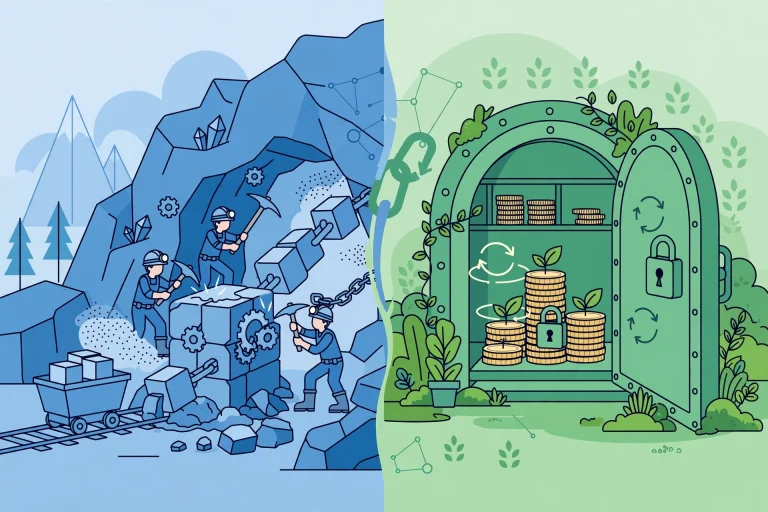
Think of it like this: a blockchain needs a way to decide who gets to add the next block of transactions, and to make sure the people who do that job act honestly. Older blockchains like Bitcoin solve this with mining, where computers compete to solve puzzles, and the winner gets to add the block. That works, but it uses a lot of energy. Newer blockchains solve it differently. They ask people to lock up coins as a stake, and then they choose validators from among those who have staked, roughly in proportion to how much they have staked. The more you stake, the more often you are chosen, and the more rewards you earn. But if you act dishonestly, or if your validator goes offline or makes mistakes, the network can punish you by taking some of your staked coins. That punishment is called slashing, and it is what gives staking its teeth.
The key idea is that staking is not just holding. Holding is passive. Staking is active participation in keeping a network running, even if you delegate the technical work to someone else. The rewards are payment for that participation, not interest on a deposit, and they come with conditions.
Proof of Stake: Why Staking Exists
To understand staking, you need to understand proof of stake, the system it belongs to. Proof of stake is a consensus mechanism, which is a fancy way of saying it is the set of rules a blockchain uses to agree on which transactions are valid and in what order they happened. Without a consensus mechanism, anyone could invent transactions, spend the same coin twice, or rewrite history, and the network would fall apart.
Proof of work, used by Bitcoin, reaches agreement through computing power. Miners spend energy to compete, and the longest chain of blocks, the one with the most work behind it, is accepted as the truth. That is secure, but it is expensive in energy terms, and it tends to concentrate power in the hands of those who can afford the most powerful mining equipment.
Proof of stake reaches agreement through economic stake. Instead of spending energy, validators lock up coins. The network chooses a validator to propose the next block, other validators check it, and if enough of them agree, the block is added. If a validator tries to cheat, the network can destroy part of their stake. The logic is that someone who has locked up a large amount of money in the network has a strong reason not to attack it, because an attack would destroy the value of their own stake.
Ethereum, the second-largest cryptocurrency by market size, moved to proof of stake in a major upgrade, and many other large networks, including Solana, Cardano, and others, use proof of stake or a variation of it. Our guide to what Ethereum is explains its move to proof of stake and what it changed, and our guide to what Solana is explains a high-speed network that also relies on staking. Not every cryptocurrency can be staked. Bitcoin, for example, uses proof of work and cannot be staked in the true sense, even though some platforms offer rewards for holding it, which is a different thing entirely, as explained later in this guide.
Validators: Who Does the Work?
A validator is a computer, run by a person or a company, that participates in a proof-of-stake network by staking coins and by proposing and checking blocks. Running a validator is a technical job. The computer needs to be online almost all the time, it needs to run the right software, it needs to stay updated, and it needs to respond quickly when it is chosen to validate a block. If it goes offline, or if it makes mistakes, the validator can be penalised.
Most beginners do not run their own validator. The minimum amount of coins needed to run one can be very large, for example a substantial amount of Ethereum, and the technical requirements are demanding. Instead, most beginners delegate their stake to an existing validator, or they stake through an exchange or a staking pool. Delegating means you choose a validator, you lock your coins with them, and they do the technical work on your behalf, taking a small commission from the rewards. You keep ownership of your coins, but you trust the validator to do its job properly.
That trust matters. A good validator is reliable, charges a fair commission, and does not get slashed. A bad validator may go offline often, charge a high commission, or make mistakes that cost you money. Choosing a validator is one of the most important decisions in staking, and it is worth taking time over. Look for validators with a long track record, a reasonable commission, and a clear reputation, rather than simply picking the one offering the highest advertised return.
Some networks let you stake directly from your own wallet, which is called self-custody staking. Others require you to use an exchange or a third-party service. Self-custody gives you more control, but it also gives you more responsibility. If you stake through an exchange, you are trusting the exchange with your coins, and if the exchange fails or freezes withdrawals, you may not be able to get them back. Our guide to crypto wallets explains the difference between keeping coins on an exchange and holding them in your own wallet, and our guide to cold storage explains how to keep crypto offline for maximum safety.
How Staking Rewards Work
Staking rewards are usually paid in the same cryptocurrency you staked. If you stake a coin, you earn more of that coin over time. The rate of return is often expressed as an annual percentage yield, or APY, which is the percentage you would earn in a year if the rate stayed the same and you reinvested your rewards. That rate varies widely by network, by how many people are staking, and by how the network is designed.
It is important to understand where the rewards come from. On many networks, new coins are created as rewards, which means the total supply of the coin is growing. If you stake, you earn new coins, which helps to offset the effect of that growing supply on your share of the total. If you do not stake, your share of the total supply slowly shrinks as new coins are created for stakers. In that sense, staking is partly a way to keep up, not just a way to get ahead.
On other networks, rewards come mainly from transaction fees paid by users of the network. When someone sends a transaction, they pay a fee, and a share of that fee goes to validators and to the people who staked with them. That kind of reward depends on how busy the network is. A busy network generates more fees. A quiet network generates fewer.
Either way, the return is not fixed. It can go up or down as more people stake, as the network changes its rules, or as usage changes. An advertised return of a certain percentage is a snapshot, not a promise. And the return is paid in the coin itself, which means its value in your own currency can fall even if the number of coins you hold is growing. Earning more coins that are worth less each is not a gain. A beginner should always think about staking returns in terms of the value of the coins, not just the number of them.
Lockups, Unbonding, and Why You Cannot Always Sell Quickly
One of the most important features of staking is the lockup. When you stake coins, you usually cannot sell them immediately. They are locked for a period of time, and to get them back, you have to unstake them, which starts a waiting period called unbonding. That period varies by network. On some, it is a few days. On others, it is several weeks. During that time, your coins are not earning rewards, and you cannot sell them, even if the price is falling sharply.
This is a real risk, and it catches beginners by surprise. Imagine you stake a coin, its price starts to fall, and you want to sell to limit your losses. You unstake, but you have to wait three weeks for your coins to become available. By the time they are, the price may have fallen much further. That is not a flaw in staking. It is part of how the system works, because the network needs to know that stakers are committed for a period of time, not just for a few minutes. But it means staking is not suitable for money you might need quickly, or for a coin you are not prepared to hold through a fall.
Some exchanges and services offer liquid staking, which gives you a token in return for your staked coins, and that token can be traded while your original coins remain staked. That sounds like a solution to the lockup problem, and in some ways it is, but it adds new risks. The liquid staking token may trade at a discount to the underlying coins, the service that issued it may fail, and the smart contract behind it may have bugs. Liquid staking is more complex than ordinary staking, and beginners should understand the extra risks before using it.
Before you stake any coin, find out the unbonding period, whether there is a minimum staking amount, whether rewards are paid automatically or need to be claimed, and whether there are any fees for staking or unstaking. Those details matter more than the advertised return, because they determine what you can actually do with your money when you need to.
Slashing and Other Ways Staking Can Lose You Coins
Slashing is the penalty a proof-of-stake network applies to a validator that misbehaves. Misbehaviour can mean signing two conflicting blocks, which is a sign of trying to cheat, or it can mean being offline for a long time, which disrupts the network. When slashing happens, a portion of the validator’s staked coins is destroyed or taken away. If you delegated your coins to that validator, you share in the loss, in proportion to how much you staked with them.
Slashing is rare on well-run networks, and it is designed to be rare, because validators have a strong incentive to behave. But it is not impossible, and it has happened. The risk is higher if you choose a validator with poor infrastructure, or if you stake on a new or experimental network where the rules are still being worked out. Choosing a reliable validator, and spreading your stake across more than one validator if the network allows it, can reduce the risk, but it cannot eliminate it entirely.
There are other risks too. A bug in the network’s software could cause problems. A change in the network’s rules could reduce rewards or change the lockup period. The staking service you use could be hacked, or could turn out to be dishonest. And, of course, the price of the coin itself can fall, which is usually the biggest risk of all. Staking does not protect you from a price fall. It only gives you more coins. If those coins lose most of their value, the extra coins do not make up for the loss.
That is why it is misleading to describe staking as low risk. It is lower risk than some other crypto activities, such as trading with borrowed money, but it is still a crypto investment, with all the volatility and uncertainty that implies. The rewards are real, but so are the risks, and a beginner should weigh both before staking.
Staking vs Lending: Not the Same Thing
One of the most common confusions in crypto is between staking and lending, and it is important to get this right, because they are very different. Staking, as described above, means locking coins to secure a proof-of-stake network, and earning rewards from the network itself. Lending means giving your coins to someone else, usually a platform or a borrower, who uses them and pays you interest in return. The two look similar, because both involve locking up coins and earning a return, but the risks are different.
When you stake, your main risks are the price of the coin, the lockup period, slashing, and the reliability of your validator. When you lend, your main risk is that the borrower or the platform fails to return your coins. That risk became very real in past crypto market downturns, when several large lending platforms collapsed and customers lost their funds, with little or no recovery. Lending can offer higher advertised returns than staking, but those returns come with higher counterparty risk, which is the risk that the other party will not pay you back.
Some platforms blur the line by calling lending staking, or by offering rewards for holding a coin that cannot actually be staked, such as Bitcoin. If a platform offers staking rewards for a proof-of-work coin, it is not staking in the true sense. It is almost certainly lending, or some other arrangement, and you should ask where the return comes from and what happens to your coins while they are locked. Our guide to staking vs lending explains the difference in more detail, and it is worth reading before you use any platform that offers a return on your coins.
The rule of thumb is simple: if you do not understand where the return comes from, do not put your coins there. A return that seems too good to be true usually is, and in crypto, the cost of learning that lesson can be the loss of your entire holding.
Which Coins Can Be Staked, and Which Cannot
Not every cryptocurrency can be staked. Only coins that run on a proof-of-stake network, or a variation of it, support staking. The largest examples are Ethereum, Solana, Cardano, and several others. Each has its own rules, its own minimum stake, its own lockup period, and its own reward rate. Some allow you to stake any amount, even a fraction of a coin. Others require a substantial minimum to run a validator, though they allow smaller amounts to be delegated.
Bitcoin cannot be staked, because it uses proof of work. XRP cannot be staked in the true sense, because its ledger uses a different consensus mechanism. Stablecoins cannot be staked either, though they can be lent, which is a different activity with different risks. If you see a platform offering staking for a coin that does not use proof of stake, be very sceptical, and ask what the platform is actually doing with your coins.
Before you stake a coin, learn the basics of that specific network. How does it choose validators? What is the lockup period? What is the slashing policy? How are rewards calculated? How many people are already staking, and what does that mean for your return? Those questions matter more than the headline return, because they determine how much control you keep over your money and what can go wrong.
A Beginner’s Checklist Before You Stake
If you are considering staking, work through a simple checklist before you lock up anything. First, make sure you understand the coin itself. Do you know what it does, who uses it, and why it might be valuable in the future? If you would not be comfortable holding the coin without staking, you should not stake it, because staking does not make a bad coin into a good one.
Second, check the lockup and unbonding period, and make sure you can afford to have your money unavailable for that long. Do not stake money you might need in an emergency, and do not stake your entire holding. Keep some coins unstaked, so you have flexibility if the price moves or your circumstances change.
Third, choose your validator or staking service carefully. Look for a reliable validator with a good track record and a fair commission, or a reputable exchange with a clear staking policy. Read the terms, including what happens if the validator is slashed, whether the service covers any losses, and what fees are charged. Avoid services that promise guaranteed returns or unusually high rates, and avoid any service that asks you to send coins to an unknown address. Our guide to spotting crypto scams explains the red flags to watch for, including fake staking platforms and phishing sites.
Fourth, think about taxes. In many countries, staking rewards count as income when you receive them, and selling the coins later may trigger a further tax event. Keep records of when you received rewards and what they were worth at the time, because you will need that information later. Tax rules vary by country, so check the rules where you live, or speak to a qualified adviser.
Fifth, start small. Stake a modest amount first, go through the full process of staking and unstaking, and make sure you understand how it works in practice before you commit more. That way, if something goes wrong, the cost is limited, and you will have learned how the system works without risking a large sum.
Frequently Asked Questions
What is crypto staking in simple terms?
Staking means locking up cryptocurrency to help secure a proof-of-stake blockchain, in return for rewards paid in the same coin. Your locked coins act as a deposit that shows you have a stake in the network behaving honestly, and the network pays you for participating.
Is staking the same as earning interest?
No, although it is often described that way. Interest is paid by a bank or borrower for using your money. Staking rewards are paid by a blockchain network for helping to secure it. The risks are different, and staking rewards are not guaranteed in the way that interest from a regulated bank deposit may be.
How much can I earn from staking?
It varies widely by network, often in the low single digits to low double digits as an annual percentage, but the rate changes over time and is paid in the coin itself. The value of your rewards depends on the coin’s price, which can fall, so the return in your own currency may be much lower, or even negative.
Can I lose money by staking?
Yes. You can lose money if the coin’s price falls, if your validator is slashed, if the staking service fails, or if you cannot sell during a lockup period while the price is falling. Staking gives you more coins, but it does not protect you from a fall in their value.
What is slashing?
Slashing is a penalty that a proof-of-stake network applies to a validator that misbehaves, such as signing conflicting blocks or being offline for a long time. A portion of the validator’s staked coins is destroyed, and people who delegated to that validator share in the loss.
How long are my coins locked when I stake?
It depends on the network. Some have no lockup or a very short one, while others require you to wait days or weeks after unstaking before your coins become available. This waiting period is called unbonding, and during it your coins do not earn rewards and cannot be sold.
Can I stake Bitcoin?
No, not in the true sense. Bitcoin uses proof of work, not proof of stake, so it cannot be staked. Platforms that offer returns for holding Bitcoin are offering lending or a similar arrangement, not staking, and the risks are different.
Is staking better than just holding?
Staking can earn you more coins than holding alone, and on some networks it helps offset the effect of new coins being created. But it also locks up your coins, exposes you to slashing risk, and adds complexity. For some people, the simplicity and flexibility of just holding is better.
What is the difference between staking and lending?
Staking secures a proof-of-stake network and earns rewards from the network. Lending gives your coins to a borrower or platform and earns interest from them, with the risk that they may not return your coins. Lending generally carries higher counterparty risk, and several lending platforms have collapsed in the past.
Do I need a lot of money to start staking?
It depends on the network. Some allow you to stake a very small amount through delegation or a pool. Others require a large minimum to run your own validator, though you can usually delegate a smaller amount to an existing validator instead. Start small and learn the process before committing more.
Is staking taxable?
In many countries, staking rewards are treated as income when received, and selling the coins later may be a separate taxable event. Rules vary by country, so keep records of your rewards and check the rules where you live.
Conclusion
Crypto staking is a real and useful part of how proof-of-stake blockchains work, and for the right person, in the right circumstances, it can be a sensible way to earn rewards while holding a coin you already believe in. It is not a savings account, it is not guaranteed income, and it is not risk-free. Your coins are locked up, their price can fall, your validator can be penalised, and the service you use can fail. The rewards are paid in a volatile asset, and the return you actually receive depends on the price of that asset, not just on the number of coins you earn.
The beginners who do best with staking are the ones who start by understanding the coin, who choose a reliable validator, who stake only an amount they can afford to lock up, and who keep records and stay patient through price swings. Start small, learn the full process of staking and unstaking, and read our guide to staking vs lending before you use any platform that offers a return on your coins. If you decide staking is not for you, that is also a reasonable choice. Simply holding a coin you believe in, in a wallet you control, is a perfectly valid approach, and sometimes the simplest one is the best.