What Is Web3? A Beginner’s Guide to the Decentralised Internet
Risk disclaimer: Cryptocurrencies are volatile and can lose most or all of their value. Nothing in this article is financial advice. Never invest money you cannot afford to lose, and do your own research before buying any cryptocurrency.
You have probably heard the term Web3. It appears in headlines, in job adverts, in investment pitches, and in arguments on social media. Some people describe it as the future of the internet. Others call it a marketing slogan with no clear meaning. Both sides have a point, because Web3 is a real set of technologies wrapped in a lot of hype, and separating the two is the first step to understanding it.
At its simplest, Web3 is an idea about how the internet should work: instead of a small number of large companies controlling the platforms, the data, and the rules, users would control their own identity, their own assets, and their own data, using blockchains and cryptography. Whether that vision will ever fully arrive is an open question. But the technologies behind it — wallets, decentralised apps, tokens, and smart contracts — are real, they are being used today, and they are worth understanding even if you are sceptical about the grand claims.
This guide explains Web3 in plain language: where the term comes from, how it differs from the internet we use today, what its building blocks are, and what a beginner should know before getting involved.
A Short History: Web1, Web2, and Web3
To understand Web3, it helps to know what came before it.
Web1 was the early internet of the 1990s and early 2000s. Websites were mostly static pages that you read, like an online newspaper or brochure. A small number of people created content, and everyone else consumed it. There was very little interaction, no social media, and no easy way for ordinary users to publish anything.
Web2 is the internet most of us use today. It began in the mid-2000s with social media, blogs, video platforms, and online marketplaces. Suddenly anyone could create and share content, and that was a genuine revolution. But Web2 also centralised power. A handful of large companies came to run the platforms where everyone spends their time, and those companies control the rules, collect the data, and earn most of the money. You do not own your social media account in any real sense — the platform can suspend it, change its rules, or use your data in ways you never agreed to in practice.
Web3 is a proposal for a third stage. Its supporters argue that blockchains let us keep the openness and creativity of Web2 while removing the centralised control. Instead of logging in with an account owned by a company, you would connect with a crypto wallet that you control. Instead of a company holding your data on its servers, your data and assets would live on a decentralised network. Instead of a platform deciding what you can do, the rules would be written into code that anyone can inspect.
That is the vision. The reality, as we will see, is messier.
What Is Web3, in Simple Terms?
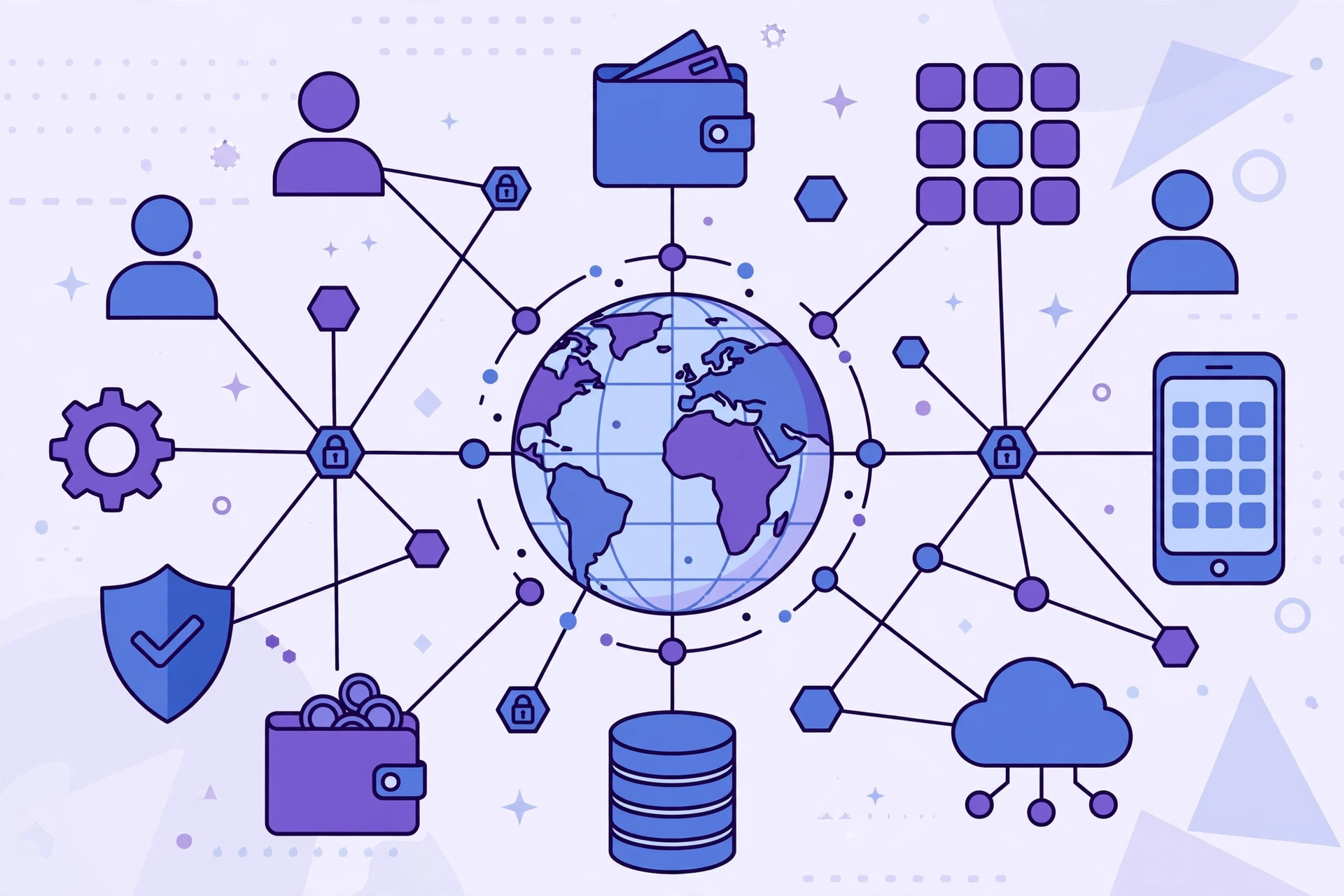
Web3 is an umbrella term for a set of technologies and ideas built around blockchains, with the goal of making the internet more decentralised. The most useful definition is this: Web3 is the internet built on blockchains, where users interact through wallets rather than company-owned accounts, and where ownership of digital assets is recorded on a public ledger instead of in a company’s private database.
Three ideas sit at the centre of Web3. The first is decentralisation: no single company or server controls the system. The second is ownership: users hold their own assets and identity, rather than renting them from a platform. The third is permissionlessness: anyone can build or join without asking a gatekeeper for approval.
None of these ideas is absolute in practice. Many Web3 services still depend on centralised companies, many users still trust exchanges and apps with their assets, and many projects are controlled by small teams. Web3 is best understood as a direction of travel rather than a finished destination.
The Building Blocks of Web3
Web3 is not one technology. It is a stack of pieces that fit together, and understanding the pieces is more useful than memorising a slogan.
Blockchains
The foundation of Web3 is the blockchain: a public, shared record of transactions that no single party controls. Blockchains are where ownership is recorded and where the rules of a system are enforced. Bitcoin was the first blockchain, and Ethereum was the first to support general-purpose programs. Layer 2 scaling solutions help these networks handle the problem of speed and cost.
Wallets
In Web3, your wallet is your identity. Instead of creating a username and password for every website, you connect a crypto wallet — a piece of software that holds your cryptographic keys — and that wallet proves who you are. The same wallet can hold your coins, your tokens, and your digital collectibles, and it can sign transactions on any app that supports it.
This is a powerful idea, but it comes with a serious responsibility. If you lose your wallet’s recovery phrase, nobody can reset it for you. There is no password-reset email and no customer support line that can restore your access. Our guide to choosing a crypto wallet and our guide to storing your seed phrase safely cover the basics every beginner needs before creating a wallet.
Smart Contracts
A smart contract is a program that runs on a blockchain and executes automatically when its conditions are met. For example, a smart contract can hold funds and release them only when both parties to a deal have done what they promised. No human intermediary is needed, and no one can change the rules after the contract is deployed.
Smart contracts are what make decentralised apps possible. They handle lending, trading, voting, and many other functions that used to require a company in the middle. They are also a source of risk: if a smart contract contains a bug, that bug can be exploited, and there may be no way to undo the damage.
Decentralised Apps (dApps)
A dApp is an application that runs on a blockchain rather than on a company’s servers. Decentralised exchanges, lending platforms, games, and social networks are all examples. You access them through your wallet, and your interactions are recorded on the blockchain. Many of the most popular dApps are part of decentralised finance, or DeFi, which tries to rebuild financial services without banks.
The user experience of dApps is still rough compared to ordinary apps. Transactions can be slow, fees can be confusing, and mistakes can be costly. That is one of the main reasons Web3 has not yet reached a mainstream audience.
Tokens
Tokens are digital assets created on a blockchain. Some tokens act like currencies. Others represent ownership in a project, access to a service, or a vote in a decision. Non-fungible tokens, or NFTs, are tokens that represent a unique item, such as a piece of digital art or a collectible.
Tokens are one of the most misunderstood parts of Web3. Owning a token does not always mean what people assume it means. An NFT of a piece of art, for example, does not usually give you the copyright to that art, and it may not even guarantee that the image will stay available online. Before buying any token, understand exactly what it is and what rights, if any, it gives you.
Web3 vs Web2: The Key Differences
The contrast between Web2 and Web3 is easiest to see in everyday situations.
In Web2, you log in with an account that a company controls. In Web3, you connect with a wallet that you control. In Web2, the platform holds your data and decides how it is used. In Web3, the aim is for you to hold your own data and choose who can access it. In Web2, the platform earns the money from your content and attention. In Web3, the aim is for creators and users to capture more of that value directly.
Payments show the difference clearly. In Web2, sending money online means going through a bank, a card network, or a payment company, each of which takes a fee and can block a transaction. In Web3, you can send cryptocurrency directly from one wallet to another, anywhere in the world, without asking anyone’s permission. That is genuinely different — and it is also why Web3 payments attract both legitimate users and criminals, and why regulators are paying close attention.
It is worth being honest about the gaps between the vision and the reality. Most Web3 apps today still rely on centralised services for parts of their operation. Most users still buy their crypto through centralised exchanges. And most of the data that Web3 apps display still comes from ordinary servers. The decentralisation of Web3 is real in some places and aspirational in others.
What Can You Actually Do in Web3 Today?
Behind the hype, there are real things people do in Web3 every day. Understanding them helps you judge the space for yourself.
People trade on decentralised exchanges, where they swap tokens directly from their wallets without creating an account. People lend and borrow through DeFi protocols, earning interest or taking out loans secured by crypto. People buy, sell, and create NFTs, though that market is far smaller and more volatile than it was at its peak. People play blockchain-based games where in-game items are tokens they can own and trade. And people participate in decentralised organisations, often called DAOs, where token holders vote on decisions about a project.
None of these uses is free of problems. Decentralised exchanges can be confusing and expensive to use. DeFi lending carries real risks, including smart contract bugs and sudden price crashes. NFT markets are full of speculation and fraud. And DAOs often turn out to be less democratic in practice than they sound in theory.
For a beginner, the sensible approach is to treat Web3 as something to learn about before spending money on. Read, experiment with small amounts if you choose to, and be deeply sceptical of anything that promises easy profits.
The Criticisms of Web3
Web3 has serious critics, and a fair guide should present their arguments honestly.
The first criticism is about usability. Web3 is hard to use. Wallets, gas fees, seed phrases, and transaction confirmations are confusing for ordinary people, and a single mistake can mean losing your funds permanently. Until the experience becomes as simple as using an ordinary app, Web3 will struggle to reach a mass audience.
The second criticism is about speculation. Much of the money in Web3 has come from people buying tokens in the hope that prices will rise, rather than from people using the technology for a practical purpose. Critics argue that this makes Web3 more like a casino than a new internet, and that the focus on token prices distracts from building useful products.
The third criticism is about decentralisation itself. Critics point out that many Web3 projects are controlled by small teams, that a few large holders often own most of the tokens, and that the infrastructure Web3 depends on — from exchanges to hosting services — is often centralised. The promise of decentralisation, they argue, is more marketing than reality.
The fourth criticism is about scams and crime. Web3’s openness makes it easy for scammers to create fake projects, fake tokens, and fake websites. Rug pulls, phishing attacks, and hacked wallets are common. Our guide on how to spot crypto scams covers the warning signs, and it is essential reading before you connect a wallet to any new app.
Finally, there is an environmental and regulatory dimension. Some blockchains still use large amounts of energy, although the shift to proof of stake has reduced this significantly on Ethereum. Regulators around the world are also still deciding how Web3 should be treated under the law, which creates uncertainty for users and builders alike.
None of these criticisms means Web3 is worthless. But they are a reminder to approach it with clear eyes rather than enthusiasm alone.
How to Explore Web3 Safely as a Beginner
If you want to learn about Web3 first-hand, do it carefully and cheaply.
Start by learning the fundamentals. Make sure you understand what Bitcoin is, what Ethereum is, and how wallets work before you touch a dApp. The technology underneath Web3 is the same technology underneath crypto, and the same safety rules apply.
Set up a wallet with a small amount of funds that you can afford to lose, and keep it separate from any wallet where you hold significant savings. Learn how to check the address of a website before you connect your wallet, and never connect to a site from a link in a random message. Before you approve any transaction, read what it says — a wallet approval can give an app permission to move your tokens, and that permission can be abused.
Be especially careful with airdrops and free tokens. A common scam is to send tokens to random wallets and then direct the recipients to a fake website to claim more. If something arrives in your wallet that you did not expect, do not interact with it until you have verified it through a trusted source.
Keep records of everything you do. Web3 activity creates tax obligations in many countries, just like any other crypto activity, and a small experiment can generate a surprising number of transactions, so track dates, amounts, and fees from the start.
Most importantly, never invest money you need, never borrow money to buy crypto, and never trust a project just because it uses the word Web3. The label is not a guarantee of quality.
Is Web3 the Future?
The honest answer is that nobody knows. Some of the ideas behind Web3 — user-controlled identity, digital ownership, and open financial systems — are likely to matter for a long time, whether or not they end up being called Web3. Some of the specific projects and tokens being promoted today will disappear, as happens in every technology wave.
A useful way to think about it is to compare Web3 to the early internet. In the 1990s, it was obvious that the internet would change the world, but nobody could predict which companies would survive or which ideas would work. Many early internet companies failed, and some of the most confident predictions were wrong. Web3 is at a similar stage: the underlying technology is real, the use cases are still being discovered, and the winners have not been decided yet.
What you can do as a beginner is learn the fundamentals, stay sceptical of hype, and avoid putting money at risk before you understand what you are doing. The technology will still be there tomorrow. There is no rush, and there is no reward for being early to something you do not understand.
Frequently Asked Questions
What is Web3 in simple terms?
Web3 is a vision of the internet built on blockchains, where users connect with crypto wallets instead of company-owned accounts, and where ownership of digital assets is recorded on a public ledger. Its goals are decentralisation, user ownership, and open access — though in practice many Web3 services still rely on centralised parts.
What is the difference between Web2 and Web3?
Web2 is the current internet, dominated by large platforms that control accounts, data, and revenue. Web3 aims to replace that model with decentralised systems where users control their identity and assets through wallets and blockchains. The key difference is who holds the control: in Web2 it is the platform, in Web3 it is meant to be the user.
Do I need cryptocurrency to use Web3?
In most cases, yes. Interacting with Web3 apps usually requires a crypto wallet and a small amount of cryptocurrency to pay transaction fees. Some apps are beginning to hide this complexity, but for now, a basic understanding of crypto and wallets is a practical requirement for using Web3.
What is a dApp?
A dApp, or decentralised application, is an app that runs on a blockchain rather than on a company’s servers. You access it through a crypto wallet, and its rules are enforced by smart contracts. Examples include decentralised exchanges, lending platforms, and blockchain games. dApps can be powerful, but they are often harder to use than ordinary apps.
What is a DAO?
A DAO, or decentralised autonomous organisation, is a group organised around a blockchain, where decisions are made by token holders voting rather than by a traditional management structure. DAOs are used to govern DeFi protocols, investment groups, and online communities. In practice, many DAOs are still heavily influenced by their founders and largest token holders.
Is Web3 safe?
Web3 carries real risks. Smart contracts can have bugs, wallets can be hacked or phished, and scams are common. There is usually no customer support to reverse a mistaken transaction. Web3 can be used safely if you learn the basics, start with small amounts, verify every website before connecting your wallet, and never invest more than you can afford to lose.
Is Web3 just about NFTs and crypto trading?
No, although NFTs and trading are the most visible parts. Web3 also includes decentralised finance, blockchain gaming, digital identity, and decentralised social networks. The trading and speculation get the most attention, but the underlying ideas — ownership, open access, and programmable money — are broader than any single use.
Will Web3 replace the current internet?
Probably not entirely, and not soon. Web3 is more likely to exist alongside the current internet, handling some uses — like payments, digital ownership, and open finance — while ordinary websites and apps continue to handle most everyday activity. The most realistic expectation is a gradual blending, not a sudden replacement.
Conclusion
Web3 is best understood as an idea and a toolkit, not as a finished product. The idea is that the internet should give users more control over their identity, their data, and their assets. The toolkit is the set of technologies that make that possible: blockchains, wallets, smart contracts, decentralised apps, and tokens.
Some of that toolkit is already useful. You can send money across the world from a wallet, trade without an account, and own digital items in a way that was not possible before. Some of it is still rough, confusing, and risky. Scams are common, the user experience is difficult, and the promise of decentralisation is only partly fulfilled.
If you take one thing from this guide, let it be this: learn before you spend. Understand wallets, understand the risks, and be sceptical of anyone who tells you Web3 is a guaranteed path to wealth. The technology is real, the vision is interesting, and the future is uncertain — and that is exactly why it is worth understanding properly before you get involved.