What Is Cosmos (ATOM)? A Beginner’s Guide to the Internet of Blockchains
Risk disclaimer: Cryptocurrencies are volatile and can lose most or all of their value. Nothing in this article is financial advice. Never invest money you cannot afford to lose, and do your own research before buying any cryptocurrency.
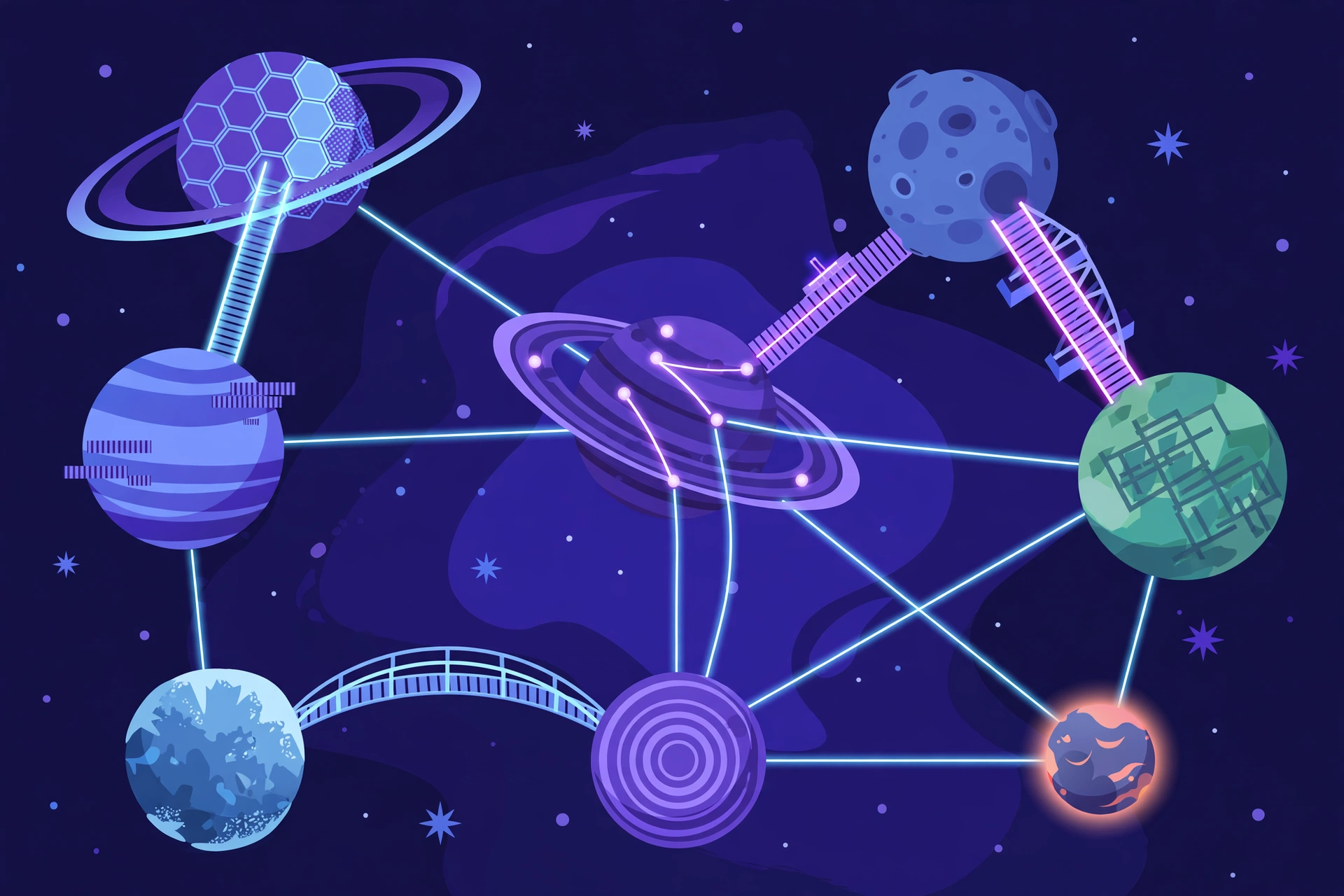
Cosmos calls itself the internet of blockchains, and the phrase is more than a slogan. It describes a specific vision: a world of many independent blockchains, each sovereign and specialised, connected by a shared communication standard so that they can exchange value and information freely. Where some projects imagine one chain for everything, Cosmos imagines thousands of chains, each doing its own job, talking to each other like websites on the internet. It is a compelling idea, and it has attracted serious builders, including some of the largest projects in crypto. It also faces real challenges, and a beginner should understand both the vision and the doubts.
This guide explains Cosmos from scratch. You will learn what the Cosmos Hub is, how zones work, what IBC does, what ATOM is for, how staking and governance work, and how Cosmos compares with Polkadot and Ethereum. No technical background is needed.
The Problem Cosmos Tries to Solve
The problem is the same one that Polkadot addresses, but Cosmos answers it differently. Blockchains are isolated. Bitcoin cannot easily talk to Ethereum. Ethereum cannot easily talk to a smaller chain. Moving assets between them usually means using a bridge or a centralised exchange, and bridges have been the site of some of the largest hacks in crypto history, while exchanges introduce a middleman and a point of failure.
Cosmos’s answer is to make it easy to build a blockchain, and to give all those blockchains a common language. If building a chain is cheap and connecting chains is standard, then the future does not need to be one giant chain or a handful of large ones. It can be many chains, each optimised for its purpose, all interoperable. That is the internet-of-blockchains idea: not one network, but a network of networks.
There is a philosophical point underneath the technical one. Cosmos values sovereignty. Each chain in the Cosmos ecosystem governs itself, secures itself, and makes its own rules. No central chain decides for the others. That independence is attractive to projects that want control over their own future, and it is the sharpest difference between Cosmos and systems where chains share security.
The Cosmos Hub and Zones
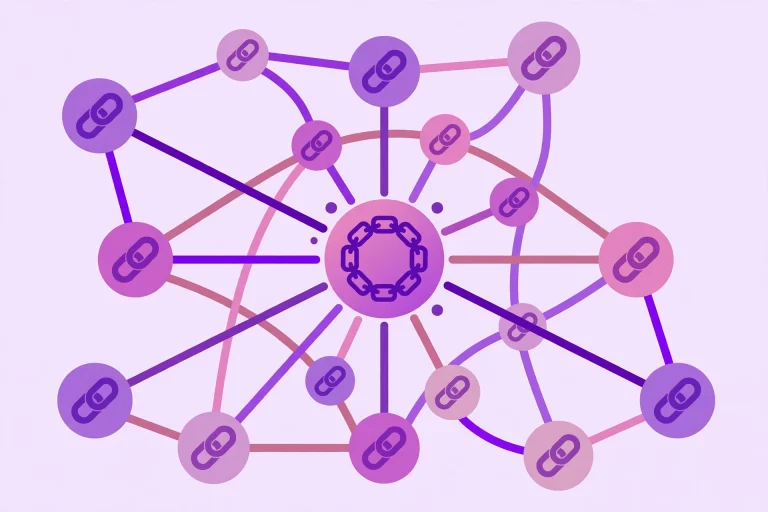
The Cosmos network has a centre, but it is a light one. The Cosmos Hub is the first blockchain built on Cosmos, and its job is to act as a meeting point for other chains. Chains in the ecosystem are called zones. A zone is an independent blockchain, built with the Cosmos software development kit, with its own validators, its own tokens, and its own governance. A zone can be a decentralised exchange, a lending platform, a gaming chain, a privacy chain, or anything else.
Zones connect to the Hub, and through the Hub they can connect to each other, but they are not required to. A zone can connect directly to another zone, or it can remain independent. The Hub does not control the zones, and it does not secure them. Each zone is responsible for its own security, which is the price of sovereignty. The Hub provides a place to meet and a token, ATOM, that helps coordinate the network, but it does not rule the zones.
This structure is deliberately loose. Cosmos is not a single system with a centre that commands it. It is a standard and a set of tools that anyone can use to build a chain, plus a Hub that makes it easier for those chains to find each other. That looseness is a strength and a weakness at the same time, and it is worth keeping in mind as you read on.
IBC: How Blockchains Talk to Each Other
The most important piece of Cosmos technology is the Inter-Blockchain Communication protocol, known as IBC. IBC is a standard for how one blockchain sends a message to another and proves that the message is genuine. It works a little like the way websites communicate over the internet: there is a shared protocol, and any chain that speaks it can talk to any other chain that speaks it.
In practice, IBC lets a token move from one chain to another. A token on one chain can be locked, and a representation of it can be created on the destination chain, where it can be used in that chain’s applications. When it returns, the representation is destroyed and the original is unlocked. The same mechanism can carry more than tokens: it can carry data, instructions, and the results of computations. The result is that applications on different chains can work together, and users can move assets without a centralised exchange or a risky custom bridge.
IBC’s importance extends beyond Cosmos itself. Other blockchains have adopted it, and it has become one of the most widely used interoperability standards in crypto. That adoption is arguably Cosmos’s greatest achievement, because it means the technology is useful even to people who do not care about the Cosmos Hub or the ATOM token at all. A standard that other projects adopt is a standard that matters.
What Is the ATOM Token For?
ATOM is the native token of the Cosmos Hub, and it has three main jobs. The first is staking: ATOM holders stake their tokens to validators who secure the Hub, and earn rewards for doing so. The second is governance: ATOM holders vote on proposals affecting the Hub, including upgrades and spending. The third is fees: ATOM pays transaction fees on the Hub.
ATOM’s role is narrower than the role of some other platform tokens, and this is a deliberate consequence of the Cosmos design. Because zones are sovereign and secure themselves, ATOM does not secure them. A zone has its own token and its own validators, and ATOM plays no part in that. This means ATOM’s value depends on the Hub specifically, not on the whole Cosmos ecosystem, and that distinction has been a source of long debate. Supporters of ATOM argue that the Hub’s role as a meeting point, and proposals to give it more functions, make ATOM valuable. Critics argue that the Hub is not essential to the zones, and that ATOM captures too little of the value created in the ecosystem.
New ATOM is created to pay staking rewards, so the supply grows over time. The rate of creation adjusts depending on how much ATOM is staked, with the goal of keeping a healthy proportion staked. Like DOT in Polkadot, holding ATOM without staking it means your share of the total supply shrinks over time, which is a deliberate design choice to encourage participation in securing the network.
If you are new to crypto generally, our guide to how to buy crypto safely covers the practical steps and the safety checks that matter, and our guide to crypto wallets explains how tokens like ATOM are stored.
Staking ATOM: How It Works and What to Watch
Staking ATOM means delegating your tokens to a validator who runs a node securing the Cosmos Hub. You choose a validator, delegate your tokens, and earn a share of the rewards the validator earns. If the validator misbehaves, for example by going offline for a long time or by signing two conflicting blocks, a portion of the delegated stake can be lost, a penalty called slashing. Choosing a reliable validator matters, and most wallets and staking dashboards show a validator’s uptime, commission, and history.
Staked ATOM is locked for an unbonding period, currently twenty-one days, before it can be withdrawn and sold. That means you cannot react quickly to a price movement, and you should only stake tokens you do not expect to need soon. Rewards are paid in ATOM, and they vary with the staking rate and the network’s parameters. As with all staking, the reward percentage tells you nothing about the price of the token itself, and a ten percent reward means little if the token falls by more.
Staking through a centralised exchange is simpler, and it usually removes the unbonding wait, but it introduces the risks of that exchange holding your tokens. After several high-profile exchange failures, many holders prefer to stake from their own wallet, accepting the lock-up in exchange for keeping control. Our guide to crypto staking versus lending explains these trade-offs in more detail.
Governance and the ATOM Debate
ATOM holders vote on proposals for the Cosmos Hub, and those votes can change real things: the parameters of the network, the funding of projects, and the direction of development. Proposals are discussed publicly, often for weeks, before a vote, and anyone can submit one, although a deposit of ATOM is required to bring a proposal to a vote. This is genuine on-chain governance, and it means ATOM holders have a direct say in how the Hub develops.
Governance has also been the site of the community’s most difficult arguments. The most prominent was a proposal known as ATOM 2.0, which suggested a new economic model for the Hub, including a changed issuance schedule and new functions for ATOM. The proposal was rejected, but the debate it started has continued. Should the Hub do more, and should ATOM capture more value from the ecosystem? Or should the Hub stay minimal, leaving value to the zones? Different parts of the community answer differently, and there is no consensus.
For a beginner, the practical lesson is that ATOM is not a settled investment in the way some other tokens present themselves. It is a token whose purpose is still being argued over by the people who hold it. That is not necessarily a weakness. It means the community is engaged and the project is honest about open questions. But it does mean you should understand what you are buying into, and not assume that ATOM’s role today is the role it will have in five years.
Cosmos vs Polkadot and Ethereum
Polkadot and Cosmos share the goal of connecting blockchains, but they solve the problem in opposite ways. Polkadot offers shared security: parachains lease security from the relay chain, and they must meet Polkadot’s requirements to connect. Cosmos offers sovereignty: zones secure themselves, and they can choose how much or how little to connect. Polkadot’s approach is more controlled and arguably more secure for small chains that could not protect themselves. Cosmos’s approach is more open and flexible, but it asks more of each chain.
Ethereum takes a different path again. Ethereum is a single, general-purpose platform on which applications are built as smart contracts, sharing the same chain, the same security, and the same token. Layer two networks extend it, but the centre remains Ethereum itself. Cosmos, by contrast, is a network of many centres, each with its own chain. The trade-off is between the simplicity and shared security of a single platform and the independence and specialisation of many chains.
There is no single right answer, and the three approaches are not mutually exclusive. Many projects use more than one of them, and the lines between them blur as each ecosystem borrows ideas from the others. Our guides to what Polkadot is and what Ethereum is cover those two approaches in the same plain language as this one, so you can compare them for yourself.
The Honest Risks and Criticisms
The strongest criticism of Cosmos is that its looseness is also its weakness. Because zones secure themselves, a small zone can be attacked more easily than a chain protected by a large network. Because IBC connects chains, a failure or an exploit on one chain can affect others, and the history of bridge exploits in crypto gives reason for caution. And because there is no single centre, there is nobody to coordinate a response when something goes wrong across the network. Cosmos’s defenders would say that this is the price of decentralisation, and that the alternative is a single point of failure. Both sides have a point.
A second criticism concerns ATOM itself. As described above, ATOM captures only a fraction of the value created across the Cosmos ecosystem, and the Hub’s role is genuinely uncertain. If the Hub becomes less important over time, ATOM could underperform other crypto assets even while Cosmos technology succeeds. This is the central risk for anyone considering ATOM as an investment, and it is worth understanding clearly before buying.
A third risk is simpler and applies to all crypto: the price of ATOM is volatile, and it has fallen sharply in past market downturns. Technology does not protect a token’s price, and a good project can be a poor investment at the wrong price or the wrong time. Anyone considering ATOM should be comfortable with the possibility of large losses.
Finally, like every corner of crypto, Cosmos has its share of scams: fake tokens, fake airdrops, and phishing sites that imitate real Cosmos projects. Our guide to how to spot crypto scams explains the warning signs to watch for before you trust any project, token, or website.
Frequently Asked Questions
What is Cosmos in simple terms?
Cosmos is a network of independent blockchains that can communicate with each other. It provides the tools to build a blockchain and the IBC protocol that lets those blockchains exchange tokens and data, while each chain keeps control of its own security and governance.
What is the difference between Cosmos and ATOM?
Cosmos is the ecosystem and the technology: the software development kit, the IBC protocol, and the network of chains. ATOM is the token of the Cosmos Hub, the first chain in the network, used for staking, governance, and fees on the Hub. ATOM does not secure the other chains in the ecosystem.
Is ATOM the same as Cosmos?
No, although the two are often confused. ATOM is one token in the Cosmos ecosystem, belonging to the Cosmos Hub. The ecosystem includes many other chains, each with its own token, and many of them have nothing to do with ATOM.
How does Cosmos compare with Polkadot?
Both aim to connect blockchains. Polkadot offers shared security, with parachains leasing security from the relay chain. Cosmos offers sovereignty, with each zone securing itself. Polkadot is more controlled; Cosmos is more open. Neither is clearly better, and they serve different priorities.
Can I stake ATOM?
Yes. You can delegate ATOM to a validator through a wallet, earning staking rewards in return. Staked ATOM is locked for a twenty-one-day unbonding period, and a portion can be lost if your validator misbehaves, so choosing a reliable validator matters.
Is Cosmos a good investment?
That depends on what you mean by investment, and no honest guide can answer it for you. ATOM is volatile, its role in the ecosystem is still being debated, and its price can fall sharply. Understand the technology, the risks, and your own tolerance for loss before deciding.
Conclusion
Cosmos is an ambitious answer to a real problem. Blockchains cannot talk to each other, and the world needs more than one of them. Cosmos’s solution is to make blockchains easy to build and easy to connect, while leaving each one in charge of itself. The Cosmos Hub, the zones, and IBC are the pieces of that answer, and ATOM is the token that coordinates the Hub. Whether you find the approach convincing depends on what you value most: the security of a single shared system, or the freedom of many independent ones. If this way of thinking about blockchains appeals to you, our guide to what Polkadot is covers the alternative approach in the same plain language, and our guide to what DeFi is explains what all of these connected chains are actually used for.