Baccarat Banker, Player and Tie Bets Explained for Beginners
Baccarat Banker, Player and Tie Bets Explained for Beginners
Baccarat looks like the most intimidating game in the casino. It is played at a large table, often roped off, with serious-looking players tracking results on scorecards and dealers handling the cards with ceremony. It has a reputation as a game for high rollers and secret agents. The reality is much simpler: baccarat is one of the easiest casino games to learn, because you only have to make one decision — which of three bets to place. After that, the dealer does everything.
Those three bets are banker, player, and tie. They sound simple, and they are. But they are not equal. One of them is one of the best bets in the entire casino. One of them is perfectly reasonable. And one of them is a trap that beginners should avoid. This guide explains all three in plain language: how each bet works, what it pays, what the odds are, and which one you should choose.
How Baccarat Works: The Basics
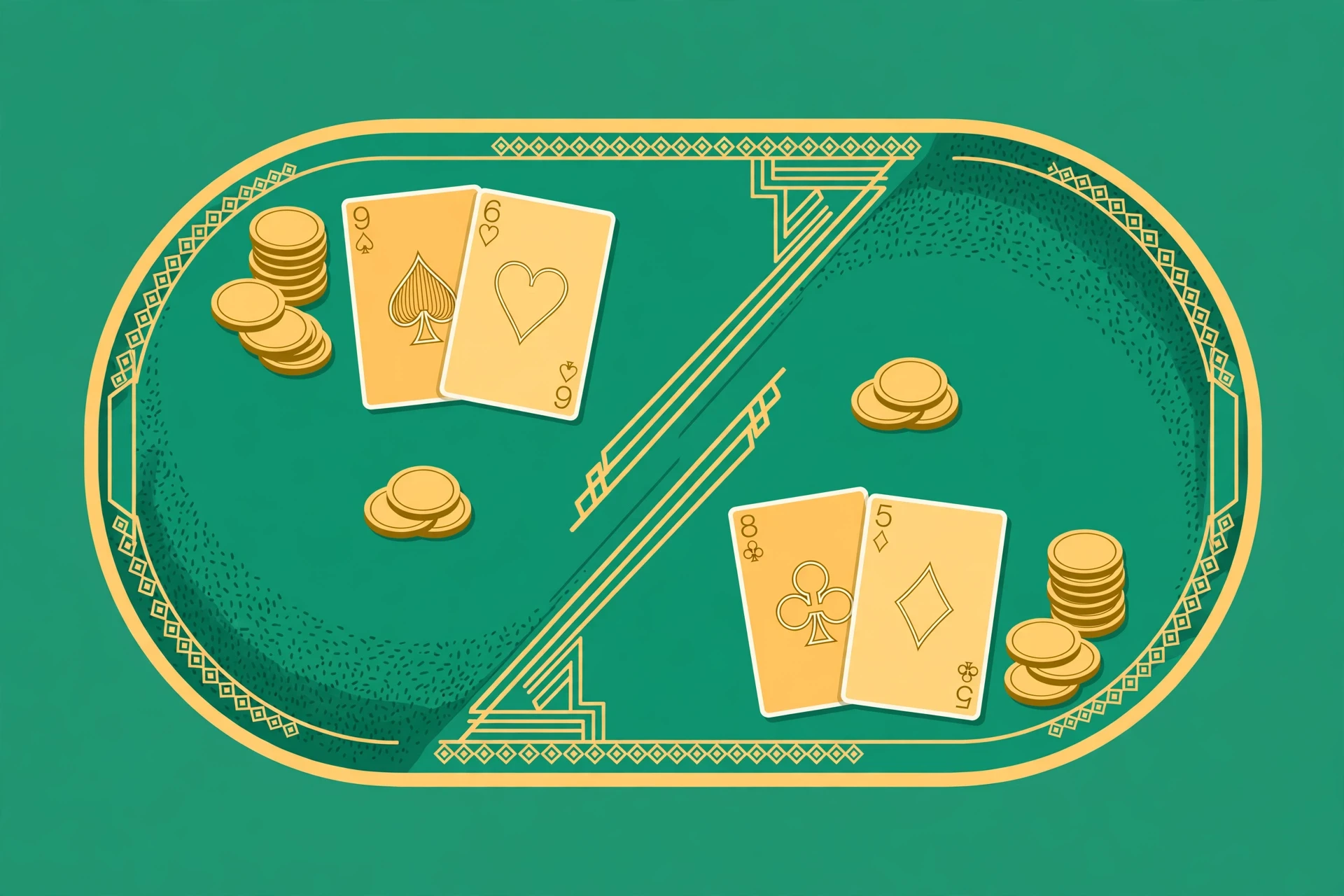
Before we look at the bets, you need to understand the game itself, because the bets only make sense in context. Baccarat is a comparing card game. Two hands are dealt: one called the “player” hand and one called the “banker” hand. Despite the names, neither hand belongs to you or to the casino. They are simply two hands of cards, and your job is to bet on which one will finish closer to 9 — or whether they will tie.
Cards are valued simply. Aces are worth 1. Cards from 2 to 9 are worth their face value. Tens, jacks, queens, and kings are worth 0. If a hand totals more than 9, only the last digit counts — so a hand of 7 and 8 totals 15, but it counts as 5. The hand closest to 9 wins. A hand of 8 or 9 on the first two cards is called a “natural” and usually ends the round immediately.
You do not make any decisions about the cards. The dealer follows strict, fixed rules about whether each hand takes a third card. You do not choose to hit or stand, as you do in blackjack. You simply place your bet before the cards are dealt and watch the result. That is why baccarat is so relaxing: there is nothing to get wrong, no strategy chart to memorise, and no pressure. The only decision that matters is which bet you choose, and that is what this guide is about.
If you want the full rules, including the third-card drawing rules, read our baccarat guide for beginners. It covers the dealing, the card values, and the table layout in detail.
The Banker Bet: The Best Bet in the Game
The banker bet is a bet that the banker hand will finish closer to 9 than the player hand. If the banker hand wins, you win. If the player hand wins, you lose. If the hands tie, your banker bet is returned to you — a push — unless you also bet on the tie.
The banker bet pays even money, 1 to 1, minus a 5% commission on winning bets. That commission is called the “vig” or “vigorish”. So if you bet 100 on banker and win, you receive 95 in winnings plus your 100 stake back. The commission exists because the banker hand wins slightly more often than the player hand, and without it the bet would actually favour the player.
Why does the banker hand win more often? Because of the drawing rules. The banker hand acts second and its third-card rules are slightly more favourable, which gives it a small mathematical edge. The banker hand wins about 45.86% of the time, the player hand wins about 44.62% of the time, and ties happen about 9.52% of the time. That small difference is why the casino charges the commission — and even after the commission, the banker bet has a house edge of only about 1.06%.
That makes the banker bet one of the best bets in the entire casino. It is better than roulette, better than most slot machines, better than the pass line in craps, and better than blackjack played by a beginner who has not learned basic strategy. It is the bet that experienced baccarat players choose most of the time, and it is the bet we recommend to beginners.
One practical note: the commission is usually collected at the end of the shoe or when you leave the table, not after every hand, so do not be surprised if the dealer tracks your winnings and settles up later. Some tables use a “no commission” version of baccarat, but those games usually change the payout on certain banker wins to compensate — for example, paying only half on a banker win with a total of 6. Always check the rules of the table before you play.
The Player Bet: Simple and Respectable
The player bet is a bet that the player hand will finish closer to 9 than the banker hand. If the player hand wins, you win. If the banker hand wins, you lose. If the hands tie, your bet is returned.
The player bet pays even money, 1 to 1, with no commission. So if you bet 100 on player and win, you receive 100 in winnings plus your 100 stake back. That sounds better than the banker bet, because there is no commission to pay. But the player hand wins less often, so the overall house edge is slightly higher: about 1.24%, compared with 1.06% for the banker bet.
The difference between 1.06% and 1.24% is small. Over a long session, betting on player instead of banker will cost you a little more, but not much. If you prefer the simplicity of no commission, or if you simply enjoy betting on the player hand, you are not making a serious mistake. The player bet is a perfectly reasonable choice, and many experienced players alternate between banker and player, or bet on player because they dislike paying commission.
What matters is that you understand the trade-off. The banker bet is mathematically the best bet, but only by a small margin. The player bet is a close second. Either one is a far better choice than the third bet on the table — the tie bet — which we will look at next.
The Tie Bet: The Trap to Avoid
The tie bet is a bet that the banker and player hands will finish with the same total. If they tie, you win. If either hand wins, you lose. The tie bet usually pays 8 to 1, and some tables pay 9 to 1, which sounds exciting. A 100 bet could win 800. That is the attraction, and it is also the trap.
Ties happen only about 9.52% of the time — roughly once in every ten hands. That means that even at 8 to 1, the payout does not fairly reflect the odds. The house edge on a tie bet at 8 to 1 is about 14.36%, which is enormous. At 9 to 1, it is still about 4.84%, which is worse than a slot machine. To put that in perspective: the banker bet takes about 1.06 from every 100 you wager, while the tie bet at 8 to 1 takes about 14.36. That is more than thirteen times as much.
Beginners are drawn to the tie bet for the same reason they are drawn to single-number bets in roulette: the big payout is exciting, and a win feels spectacular. But over time, the tie bet is one of the worst bets in the casino. It is the baccarat equivalent of a lottery ticket — fun occasionally, but a terrible way to play regularly.
Some baccarat tables also offer side bets, such as betting that the first two cards will be a pair. These side bets usually have even higher house edges than the tie bet, and they are best avoided by beginners. The simple rule for baccarat is this: bet on banker most of the time, bet on player if you prefer, and never bet on tie.
Banker vs Player: A Side-by-Side Comparison
Here is the comparison that matters:
The banker bet wins about 45.86% of the time, pays 1 to 1 minus a 5% commission, and carries a house edge of about 1.06%. It is the best bet on the table.
The player bet wins about 44.62% of the time, pays 1 to 1 with no commission, and carries a house edge of about 1.24%. It is a close second and a perfectly good choice.
The tie bet wins about 9.52% of the time, pays 8 to 1 (or 9 to 1 on some tables), and carries a house edge of about 14.36% at 8 to 1. It is a bad bet and should be avoided.
Those percentages are long-run averages. In a single session, anything can happen — you can win ten tie bets in a row, or lose twenty banker bets in a row. But over many sessions, the house edge is what decides how fast your money disappears, and the difference between 1% and 14% is the difference between a game that lasts all evening and a game that ends in an hour.
To understand how these numbers fit into the bigger picture, read our guide on how the house edge works and our explainer on casino odds and probability.
Why the Banker Hand Wins More Often
Beginners often ask why the banker hand wins more often than the player hand, when both hands are dealt from the same shoe and neither player makes any decisions. The answer is in the drawing rules.
The player hand acts first. If it totals 0 to 5, it draws a third card. If it totals 6 or 7, it stands. If it totals 8 or 9, it is a natural and the round ends. The banker hand then follows a more complex set of rules that depend on its own total and on the player’s third card. Because the banker hand acts with more information — it knows whether the player drew and what card the player received — its drawing rules are slightly more favourable.
That small advantage is worth about 1.24% in the banker’s favour before commission. The 5% commission on banker wins is the casino’s way of taking that advantage back, plus a little more. After commission, the banker bet still comes out ahead of the player bet, but only just. It is a finely balanced game, and that balance is part of what makes baccarat so popular: the house edge is low, the rules are simple, and the outcome is genuinely close to a coin flip.
Common Baccarat Myths
Baccarat attracts more superstition than almost any other casino game, and beginners should know which beliefs are myths.
The first myth is that you can predict the next hand by tracking past results. Many baccarat players keep detailed scorecards, marking every banker win, player win, and tie, and looking for patterns — a run of bankers, an alternating sequence, a “dragon” of repeated results. These patterns are meaningless. Each hand is dealt from a freshly shuffled shoe, and past results have no effect on future results. A run of five banker wins does not make a player win more likely. The cards have no memory.
The second myth is that some betting systems can beat baccarat. Systems like the Martingale, where you double your bet after every loss, are popular at baccarat tables, but they fail for the same reason they fail everywhere: table limits and your own bankroll run out before the system can recover your losses, and the house edge applies to every hand regardless of how you size your bets.
The third myth is that baccarat is a game for high rollers only. It is true that some baccarat tables have high minimums, especially in the roped-off VIP areas. But many casinos, and almost all online casinos, offer baccarat tables with low minimums that any beginner can afford. Mini-baccarat, played on a smaller table with lower limits, is the same game with the same rules and the same low house edge. You do not need a large bankroll to play baccarat well — you need a small bankroll and the discipline to bet on banker and avoid the tie.
Our guide to casino myths covers these misconceptions and others in more detail.
Baccarat Strategy for Beginners
Baccarat has no strategy in the blackjack sense, because you make no decisions about the cards. But there are still sensible ways to play, and they all come down to bet selection and money management.
First, bet on banker most of the time. It has the lowest house edge, and over a long session it will cost you the least. If you dislike the commission, bet on player — the difference is small. Never bet on tie, and never bet on side bets, because their house edges are far higher.
Second, ignore the scorecards. Tracking past results is entertaining, but it does not help you predict the future. Betting on a “pattern” is no better than betting at random, and it can be worse if it encourages you to increase your bets after a run of results.
Third, keep your bets flat. Bet the same amount on every hand, rather than raising your bet after a win or a loss. Flat betting is the simplest way to control your losses, and it works well in a game where every hand is close to a coin flip.
Fourth, set a budget before you play and stick to it. Decide how much you are willing to lose and how much you would be happy to win, and stop when you reach either limit. A bankroll management plan is not optional in baccarat — it is the only real strategy the game offers.
Finally, if you are playing online, consider a live dealer baccarat table. The pace is slower than a computer-dealt game, which means your money lasts longer, and the atmosphere is closer to a real casino. See our guide to live dealer casino games for how these tables work.
Legal Status in Thailand — Read This First
Before you play any casino game, it is important to understand the law where you live. In Thailand, gambling is governed by the Gambling Act B.E. 2478 (1935). Under this law, most forms of gambling are prohibited. The only widely recognised exceptions are the government lottery and licensed horse racing. Online casinos are NOT licensed in Thailand, and casino games are not legally operated inside the country.
This article is educational only. It explains how baccarat bets work so that you can understand the game, its odds, and its risks. It is not an invitation to gamble, and it does not recommend any casino, website, or operator. If you choose to learn more about these games, do so responsibly and within the law that applies to you.
Gambling should always be treated as entertainment, never as a way to make money. There are no guaranteed winnings in any casino game, and no strategy or system can overcome the house edge in the long run. Only play with money you can afford to lose, set a firm limit before you start, and never chase losses — increasing your bets to recover money you have already lost is the fastest way to turn a small loss into a serious one.
If gambling ever stops being fun, or if you feel you are losing control, help is available. You must be 18 or older to gamble anywhere it is legal. For free, confidential support, visit BeGambleAware or Gamblers Anonymous.
Frequently Asked Questions
Which baccarat bet is the best?
The banker bet. It has a house edge of about 1.06% after the 5% commission, which makes it one of the best bets in the entire casino. The player bet is a close second at about 1.24%. The tie bet is the worst, with a house edge of about 14.36% at 8 to 1, and should be avoided.
Why is there a commission on banker bets?
Because the banker hand wins slightly more often than the player hand, due to the drawing rules. Without a commission, the banker bet would actually favour the player. The 5% commission on winning banker bets brings the house edge to about 1.06%, which is still the lowest on the table.
What happens if I bet on banker and the hand ties?
Your bet is returned to you — a push. You neither win nor lose. The same applies to a player bet when the hands tie. Only a tie bet wins when the hands tie.
Should I ever bet on a tie in baccarat?
Almost never. The tie bet pays 8 to 1, which sounds attractive, but ties happen only about 9.52% of the time, and the house edge is about 14.36%. That is more than thirteen times the house edge of the banker bet. An occasional small tie bet for fun is harmless, but as a regular strategy it will drain your money quickly.
Is baccarat a game of skill or luck?
Almost entirely luck. You make no decisions about the cards — the dealer follows fixed rules. The only decision that matters is which bet you choose, and choosing banker over tie is the only “skill” in the game. That is why baccarat is so relaxing: there is nothing to get wrong.
Can I use a betting system to win at baccarat?
No. No betting system can overcome the house edge. Systems like the Martingale, where you double your bet after every loss, look clever but run into table limits and your bankroll long before they recover your losses. The house edge applies to every hand, no matter how you size your bets.
What is mini-baccarat?
Mini-baccarat is the same game as baccarat, played on a smaller table with lower minimum bets and a faster pace. The rules, the odds, and the house edge are identical. It is the best version for beginners, because the lower minimums let you learn the game without risking large amounts.
Do scorecards and pattern tracking help in baccarat?
No. Each hand is independent, and past results have no effect on future results. A run of banker wins does not make a player win more likely. Scorecards are entertaining, but they do not improve your odds, and betting on patterns can encourage you to increase your bets for no good reason.
Conclusion
Baccarat is a simple game with one decision that matters: which bet to choose. The banker bet is the best bet on the table, with a house edge of about 1.06% after commission. The player bet is a close second at about 1.24%, and a perfectly reasonable choice if you prefer not to pay commission. The tie bet, despite its attractive 8 to 1 payout, carries a house edge of about 14.36% and should be avoided.
That is the whole strategy of baccarat: bet on banker, avoid the tie, keep your bets flat, ignore the scorecards, and set a budget before you play. It is not a complicated game, and that is its charm. You can sit down, place a bet, and enjoy the ceremony of the cards without worrying about strategy charts or difficult decisions. Just remember that the low house edge does not mean you will win — it means you will lose slowly, which is the best any casino game can offer. Play within your means, treat it as entertainment, and walk away when your budget is gone.