What Is Sui? A Beginner’s Guide to the SUI Blockchain
What Is Sui? A Beginner’s Guide to the SUI Blockchain
Risk disclaimer: Cryptocurrencies are volatile and can lose most or all of their value. Nothing in this article is financial advice. Never invest money you cannot afford to lose, and do your own research before buying any cryptocurrency.
Sui is a blockchain that was built to be fast. That is its whole pitch, in one sentence. Where older blockchains process transactions one after another, like a single-lane road, Sui processes many transactions at the same time, like a multi-lane motorway. The result, its creators claim, is a network that can handle far more activity, with lower fees and quicker confirmations, than the blockchains that came before it.
But speed alone does not make a blockchain useful, and a new network faces hard questions: is it genuinely decentralised, is it secure, does anyone actually use it, and does its token have a reason to exist? This guide explains what Sui is, how it works, what the SUI token does, and what a beginner should understand before getting involved — including the risks, which are real and significant.
Where Sui Came From
Sui was developed by Mysten Labs, a company founded by former engineers who had worked on Meta’s Diem blockchain project. When Meta abandoned Diem, the team took the technology they had built — including a programming language called Move — and used it as the foundation for a new blockchain. Sui launched its main network in May 2023.
That background matters, because it explains both Sui’s strengths and its criticisms. The team behind it is experienced, well funded, and technically strong. But the project is also young, and it comes from a corporate research background rather than from a grassroots community, which makes some crypto enthusiasts sceptical about how decentralised it really is.
Sui is often compared with Aptos, another blockchain built by former Diem engineers using the same Move language. The two projects are rivals in the same niche: fast, modern blockchains designed to compete with Solana and Ethereum for developers and users. Our guide to Aptos explains the other half of that story.
The Problem Sui Tries to Solve
To understand Sui, you need to understand the problem it was built to solve: the speed limit of traditional blockchains.
Most blockchains process transactions in order, one block at a time. Every transaction waits its turn, and the network can only handle a certain number of transactions per second. When demand is high, transactions queue up, fees rise, and confirmations slow down. This is the problem that layer 2 scaling solutions try to solve on Ethereum, and it is the reason some blockchains become expensive to use at busy times.
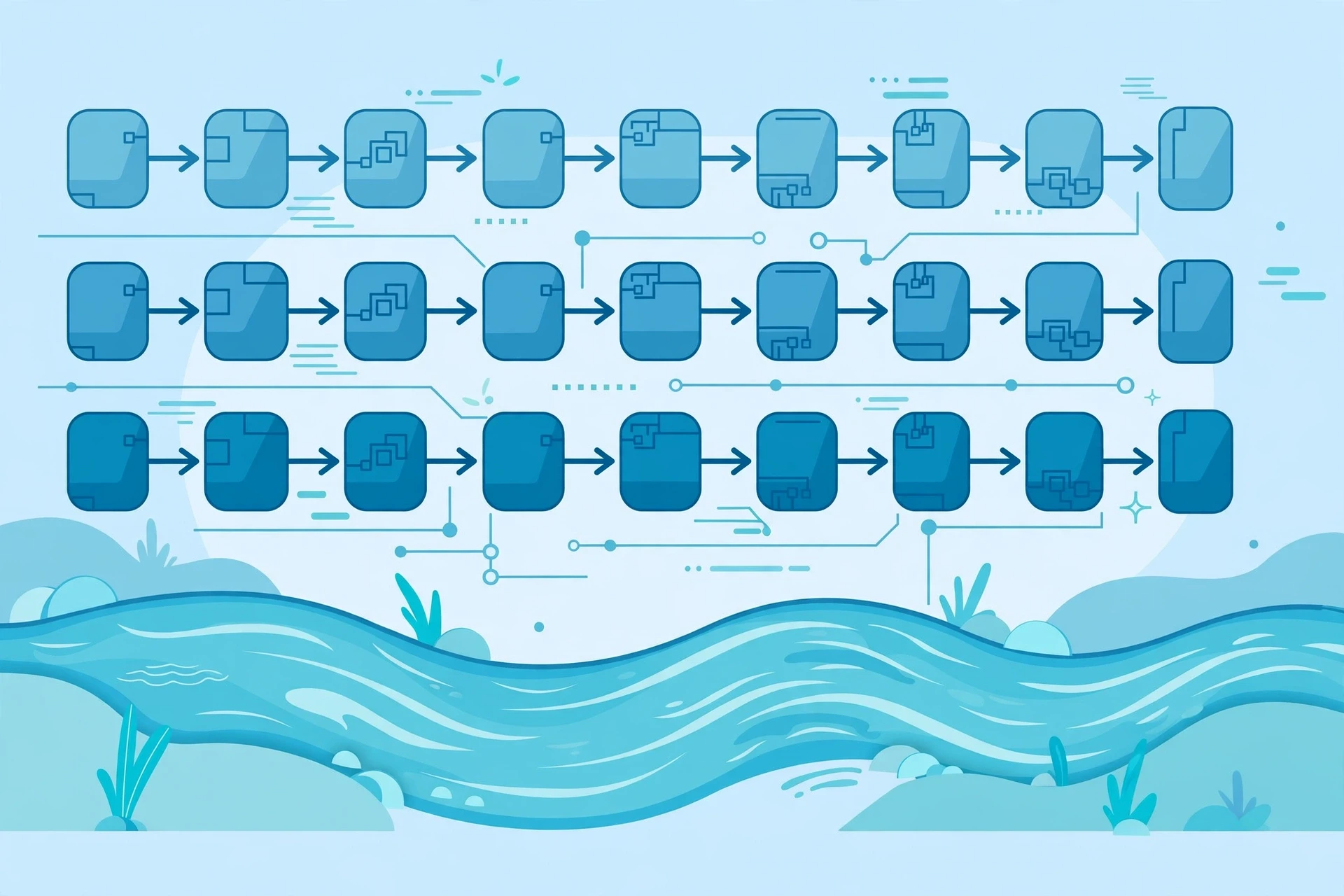
Sui takes a different approach. Instead of ordering every transaction and processing them one by one, it looks at whether transactions actually depend on each other. If two transactions involve different objects and do not interfere with each other, Sui processes them at the same time — in parallel. Only transactions that touch the same object need to be ordered relative to each other. This is called parallel transaction execution, and it is the core idea behind Sui.
The analogy is a supermarket. A traditional blockchain is like a supermarket with a single checkout: every shopper queues, no matter what they are buying. Sui is like a supermarket with many checkouts, where shoppers who are buying different things can check out at the same time. Only shoppers who want the same item need to wait for each other.
How Sui Works: Objects, Not Accounts
Most blockchains use an account model: your wallet is an account, and it holds a balance. Transactions move money from one account to another. Sui uses a different model, called an object-centric model. On Sui, everything is an object — a coin, a token, a digital item, a game character — and each object has an owner.
When you make a transaction on Sui, you are interacting with specific objects. If your transaction only touches objects that nobody else is using at that moment, the network can process it immediately, without waiting for other transactions. This is what makes parallel processing possible. The network does not need to agree on a global order for transactions that do not affect each other.
This design has practical consequences. Simple transactions, such as sending SUI tokens to a friend, can be confirmed very quickly, because they do not need to wait for the whole network to agree on their place in a sequence. More complex transactions, such as a trade on a decentralised exchange where many people are interacting with the same pool of funds, still need to be ordered, and they go through a slower consensus process. But the majority of everyday transactions can take the fast path.
The Move Programming Language
Sui is built using Move, a programming language originally developed at Meta for the Diem project. Move was designed specifically for blockchains, with safety as its central idea. In most programming languages, a bug can accidentally duplicate or destroy a digital asset. In Move, assets are treated as resources that cannot be copied or destroyed by accident — the language itself enforces the rules.
For developers, this means fewer of the catastrophic bugs that have cost users money on other blockchains. For users, it means that the apps built on Sui — wallets, exchanges, games, and marketplaces — are, in theory, less likely to contain the kind of error that lets someone drain funds. In practice, no language can prevent all bugs, and Move is still relatively new, so the safety benefits are promising rather than proven.
If you are a beginner, you do not need to learn Move. What matters is understanding that Sui’s choice of language is part of its pitch: a blockchain designed from scratch, with modern tools, rather than a blockchain built on older technology and patched over time.
What Is the SUI Token?
SUI is the native token of the Sui blockchain. It has four main uses.
First, it pays for transaction fees. Every transaction on Sui costs a small amount of SUI, which goes to the validators who run the network. This is the same role that ETH plays on Ethereum and SOL plays on Solana.
Second, it is used for staking. SUI holders can stake their tokens — locking them up to help secure the network — and earn rewards in return. Staking is how the network pays the people who run it, and it is also a way for holders to earn a return on tokens they are not using. But staking carries risks, including the risk that the value of your tokens falls while they are locked up. Our guide to crypto staking explains how staking works and what can go wrong.
Third, SUI is used for governance. Token holders can vote on decisions about the network, such as changes to fees or upgrades. In practice, governance on young blockchains is often dominated by large holders and the founding team, so the influence of a small holder is limited.
Fourth, SUI is used as a unit of account within the Sui ecosystem. Apps built on Sui — games, marketplaces, and exchanges — use SUI as their default currency, which creates demand for the token whenever the ecosystem grows.
What Can You Do on Sui?
Sui’s ecosystem is young but growing. The main uses are similar to those on other smart contract blockchains: decentralised exchanges where you can trade tokens, lending platforms where you can borrow and lend, NFT marketplaces, and games where in-game items are owned as objects on the blockchain.
Gaming is a particular focus for Sui. The object model fits games well, because game items — weapons, characters, land — are naturally objects with owners, and the fast confirmation times make gameplay feel responsive. Several games have been built on Sui, and the team has promoted gaming as one of the network’s main use cases. Whether those games attract lasting players, rather than short-term speculators, is still an open question.
For a beginner, the practical way to explore Sui is the same as for any new blockchain: start by learning, use a wallet with a small amount of funds, and do not invest money you cannot afford to lose. Our guide to choosing a crypto wallet and our checklist on how to buy crypto safely cover the basics.
Sui vs Solana vs Ethereum
Sui is most often compared with Solana and Ethereum, because all three are smart contract blockchains competing for the same developers and users.
Ethereum is the oldest and largest, with the most developers, the most apps, and the most users. It is also the slowest and most expensive to use directly, which is why layer 2 solutions have grown up around it. Ethereum’s strength is its ecosystem and its track record. Its weakness is speed and cost.
Solana is fast and cheap, with a large ecosystem and a strong community. It has suffered outages in the past, which raised questions about its reliability, but it has also attracted a huge number of users and developers. Solana’s strength is its speed and its momentum. Its weakness is its history of downtime.
Sui is newer and smaller than both. Its strength is its design: parallel processing and the object model are genuinely different from how other blockchains work, and they could allow Sui to scale in ways that older designs cannot. Its weakness is its youth. It has fewer users, fewer apps, and a shorter track record than its competitors, and it has not yet been tested by the kind of sustained high demand that would prove its design works at scale.
For a beginner, the comparison is less important than the principle: no blockchain has won yet, and new networks face an uphill battle against established ones. Sui’s technology is interesting, but technology alone does not guarantee success.
The Risks of Sui
Sui carries the same risks as any young cryptocurrency, plus a few of its own.
The first risk is volatility. SUI’s price can rise or fall sharply in a short period, and it has done so in the past. A token that doubles in a month can halve in the next one. Anyone who buys SUI should be prepared for the possibility of losing a large part of their investment.
The second risk is centralisation. Sui is run by a relatively small number of validators, and a significant share of the token supply is held by the founding team, investors, and the foundation. That concentration means that a small number of people have a large influence over the network. Critics argue that this makes Sui less decentralised than it claims to be. Supporters argue that decentralisation will increase over time as the network matures. Both points are worth taking seriously.
The third risk is competition. Sui competes with Ethereum, Solana, Aptos, and many other blockchains for developers and users. If developers choose other networks, Sui’s ecosystem could stall, and the token’s value could fall regardless of how good the technology is.
The fourth risk is the unlock schedule. A large portion of SUI tokens were allocated to investors, the team, and the foundation, and those tokens are released gradually over time. When large amounts of tokens are unlocked and become available to sell, it can put downward pressure on the price. Before buying any token, check its unlock schedule and understand how much supply is still to come.
The fifth risk is the usual one for any crypto project: scams, fake websites, and phishing. New and popular blockchains attract scammers who create fake wallets, fake airdrops, and fake websites. Our guide on how to spot crypto scams is essential reading before you interact with any new chain.
How to Learn More About Sui Safely
If you want to explore Sui, do it slowly and cheaply. Start by reading the project’s own documentation and by understanding the basics of how blockchains work. Our guide to Bitcoin and our guide to Ethereum will give you the foundations.
Set up a wallet, learn how to store your seed phrase safely, and practise with a tiny amount of SUI before you do anything else. Our guide to storing your seed phrase safely covers the rules that apply on every blockchain. Never share your seed phrase with anyone, never enter it on a website, and never trust a link sent to you in a message.
Keep records of everything you buy and sell. Crypto activity creates tax obligations in many countries, and a small experiment can generate a surprising number of transactions. Our guide to crypto taxes explains what to track from the start.
Frequently Asked Questions
What is Sui in simple terms?
Sui is a blockchain designed to be fast. It processes many transactions at the same time, rather than one after another, by checking whether transactions actually interfere with each other. It uses a programming language called Move and an object-based model where everything on the network is an object with an owner.
What is the SUI token used for?
SUI pays for transaction fees, is used for staking to secure the network, is used for governance voting, and acts as the default currency for apps built on Sui. Like all cryptocurrencies, its price is volatile and can fall sharply.
Is Sui better than Solana or Ethereum?
It is too early to say. Sui’s design is technically interesting, and its parallel processing could allow it to scale well. But it is younger and smaller than both Solana and Ethereum, with fewer users and fewer apps. Ethereum has the largest ecosystem, Solana has speed and momentum, and Sui has a newer design that has not yet been proven at scale.
How is Sui different from Aptos?
Sui and Aptos were both built by former Meta Diem engineers using the Move language, and they are direct competitors. They differ in their technical design: Sui uses an object-centric model with parallel processing, while Aptos uses a different approach to ordering transactions. Both are fast, modern blockchains competing for the same developers and users.
Can I stake SUI?
Yes. SUI holders can stake their tokens to help secure the network and earn rewards. Staking involves locking up your tokens, and it carries risks, including the risk that the token’s price falls while your funds are locked. Make sure you understand how staking works before you commit any funds.
Is Sui decentralised?
Sui is less decentralised than older blockchains like Bitcoin and Ethereum. It is run by a relatively small number of validators, and a significant share of the token supply is held by the team, investors, and foundation. Supporters say decentralisation will increase over time. Critics say the concentration of control is a fundamental problem. Both views deserve consideration.
Is Sui a good investment?
Nobody can answer that for you, and anyone who claims to know is not being honest. Sui is a young, volatile cryptocurrency on a new blockchain in a competitive market. It could grow significantly, or it could lose most of its value. Never invest money you cannot afford to lose, and do your own research before buying any cryptocurrency.
Where can I learn more about Sui?
Start with the project’s own documentation, then read independent guides and comparisons. Make sure you understand the basics of blockchains, wallets, and staking before you buy any token, and be sceptical of anyone who promises guaranteed returns.
Conclusion
Sui is one of the most technically interesting new blockchains, and its design — parallel processing, an object-based model, and the Move language — is a genuine attempt to solve the speed problem that has limited older networks. It has a strong team, a growing ecosystem, and a clear focus on gaming and fast, cheap transactions.
But it is also young, relatively centralised, and competing in a crowded market against larger and more established blockchains. Its token is volatile, its track record is short, and its success is far from guaranteed. For a beginner, the right approach is the same as for any new crypto project: learn first, start small, understand the risks, and never invest more than you can afford to lose. The technology is worth understanding. The investment is a decision only you can make, and only after your own research.