Poker Hand Rankings Explained for Beginners: From High Card to Royal Flush
Poker looks complicated from the outside. There are chips flying, players staring at each other, and a lot of talk about flushes and full houses. But underneath all of that, the game rests on one simple foundation: the hand rankings. Every decision in poker — whether to bet, raise, call, or fold — starts with knowing how strong your hand is compared with the hands other players might hold. If you do not know the rankings, you are guessing. If you do know them, the game starts to make sense.
This guide explains poker hand rankings for beginners, from the weakest hand, high card, all the way up to the strongest, the royal flush. It uses Texas Hold’em as the main example, because that is the version of poker most beginners meet first, but the rankings themselves are the same across most poker games, including Omaha and Seven Card Stud. By the end, you will be able to look at your cards, work out what you have, and understand exactly where it stands.
Why Hand Rankings Matter
Poker is a game of incomplete information. You can see your own cards, and in Hold’em you can see the community cards shared by everyone at the table. You cannot see your opponents’ cards. So every choice you make is a judgement about probabilities: how likely is it that someone else has a better hand than yours?
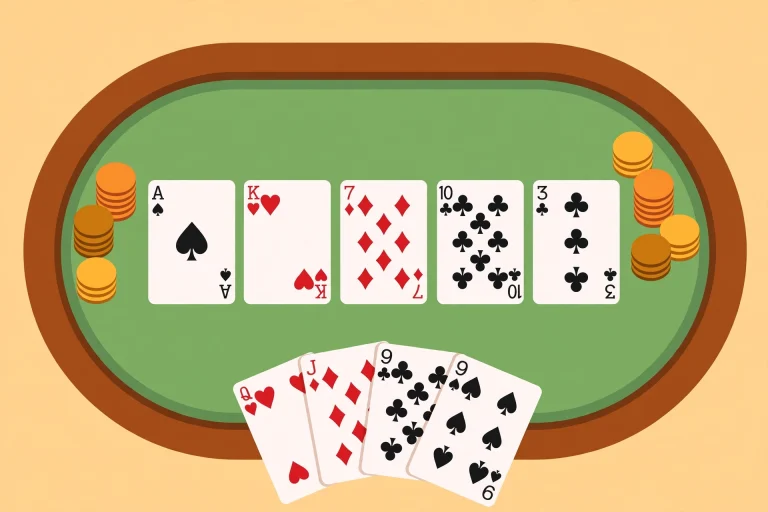
The rankings give you the framework for that judgement. A pair of aces is strong before the flop, but if the board shows three cards of the same suit, someone could be holding a flush that beats you. A hand that looks weak, like two low cards, can become very strong if the board pairs them into two pair or trips. None of this is guesswork once you know the order.
The rankings also decide the winner at showdown. When two or more players reach the end of a hand and turn their cards over, the player with the highest-ranking hand takes the pot. If two players hold the same type of hand — two pairs each, for example — the tie is broken by the strength of the cards within that hand, and then by the kicker, the extra card that does not form part of the main hand. Understanding kickers is one of the first things that separates a beginner who knows the list from a beginner who actually understands it.
The Poker Hand Rankings Chart
Here is the full list, from strongest to weakest. Memorise it in this order, and you will never be lost at a poker table again.
- Royal flush — Ace, King, Queen, Jack and Ten, all of the same suit. The best possible hand in poker.
- Straight flush — Five cards in sequence, all of the same suit, such as 9, 8, 7, 6, 5 of hearts.
- Four of a kind — Four cards of the same rank, such as four queens, plus any fifth card.
- Full house — Three cards of one rank and two cards of another, such as three kings and two fives.
- Flush — Five cards of the same suit, not in sequence, such as Ace, Jack, 8, 5 and 3 of spades.
- Straight — Five cards in sequence, of mixed suits, such as 10, 9, 8, 7, 6.
- Three of a kind — Three cards of the same rank, such as three jacks, plus two unrelated cards.
- Two pair — Two cards of one rank, two cards of another rank, and one unrelated card.
- One pair — Two cards of the same rank, plus three unrelated cards.
- High card — No made hand at all. Your best card decides your strength.
A useful way to remember the order is that the harder a hand is to make, the higher it ranks. A royal flush is rare because only four of them exist in a standard deck, one per suit. A pair is common because there are many ways to make one. The rankings follow the mathematics of the deck, not anyone’s opinion.
Legal Status in Thailand — Read This First
Before going any further, it is important to be clear about the law. Under the Gambling Act B.E. 2478 (1935), most forms of gambling are prohibited in Thailand. The only legal exceptions are the government lottery and licensed horse racing. Online casinos are NOT licensed in Thailand, and playing on them carries legal risk.
This article is educational only. It explains how poker works so you can understand the game, not as an invitation to gamble. Poker should only ever be played by adults aged 18 and over, and only where it is legal to do so. There are no guaranteed winnings in poker, or in any casino game. Even the best players lose hands, and even the best hand can be beaten by the cards that come next. Never chase losses, never play with money you cannot afford to lose, and if gambling ever stops feeling like entertainment, stop and get help. Support is available at BeGambleAware and Gamblers Anonymous.
Royal Flush and Straight Flush: The Hands You May Never See
The royal flush is the dream hand of every poker player, and also one of the rarest things in the game. It is an Ace, King, Queen, Jack and Ten, all in the same suit. There are only four possible royal flushes in a deck of 52 cards, and the odds of being dealt one in a five-card game are roughly one in 649,740. In Texas Hold’em, where you use seven cards, the odds improve, but it remains an event most players will only see a handful of times in their lives, if ever.
Because it is the highest possible hand, a royal flush cannot be beaten. If you hold one, you cannot lose the hand, no matter what your opponents have. The only question is how much you can win with it, which is a matter of betting skill and reading the table, not of hand strength.
A straight flush is any five cards in sequence and of the same suit, other than the royal combination. A 9, 8, 7, 6, 5 of hearts is a straight flush. So is a King, Queen, Jack, 10, 9 of clubs. When two players both hold a straight flush, the one with the highest top card wins. A straight flush topped by a King beats one topped by a 9. The lowest possible straight flush is 5, 4, 3, 2, Ace, sometimes called a steel wheel, where the Ace plays low.
Beginners sometimes confuse a straight flush with a royal flush, or think a royal flush is a separate category that outranks a straight flush by some special rule. It is simpler than that: a royal flush is simply the highest straight flush. It is listed separately because it has a name everyone recognises, but in the ranking order it sits at the top of the straight flush family.
Four of a Kind and Full House: The Monster Hands
Four of a kind, often called quads, is four cards of the same rank. Four aces is the strongest possible four of a kind, and four twos is the weakest. When two players both hold four of a kind, which is very rare, the higher set of four wins. The fifth card, the kicker, only matters if both players hold the same four cards, which can happen in Hold’em when the four of a kind is on the board. In that case, the player with the highest kicker wins.
A full house is three of a kind plus a pair. Three kings and two fives is a full house, kings full of fives. When two players both hold a full house, the player whose three of a kind is higher wins. Three queens and two twos beats three jacks and two aces, because the queens outrank the jacks. The pair only matters if both players have the same three of a kind, which is possible in Hold’em when the trips are on the board.
Full houses are the hand where beginners most often make expensive mistakes, and the reason is simple: a full house feels unbeatable. It is a very strong hand, and most of the time it wins. But it can be beaten by a higher full house, by four of a kind, and by a straight flush. If the board is paired and there are three cards of the same suit showing, a cautious player will at least consider the possibility that someone holds a flush or a bigger full house. Strong does not mean invincible, and poker rewards the player who keeps asking what better hand could be out there.
Flush and Straight: The Drawing Hands
A flush is five cards of the same suit, not in sequence. Any five spades, any five hearts, and so on. When two players both hold a flush, the winner is decided by comparing the cards from highest to lowest, until one hand is stronger. An Ace-high flush beats a King-high flush. If both players hold an Ace-high flush, the second-highest card decides, and so on down the line.
A straight is five cards in sequence, of mixed suits. The Ace can play high, as in 10, Jack, Queen, King, Ace, which is called a broadway straight, or low, as in Ace, 2, 3, 4, 5, which is called a wheel. It cannot do both at once: Queen, King, Ace, 2, 3 is not a straight, because the Ace cannot wrap around. When two players both hold a straight, the one with the highest top card wins. A straight to the King beats a straight to the 10.
Flushes and straights are often called drawing hands, because you frequently start with four cards towards one and need a fifth to complete it. Four cards of the same suit is a flush draw, and an open-ended straight draw, where you need one card at either end of a sequence, is one of the strongest draws in poker. Learning to recognise these draws, and to judge whether the price of chasing them is worth paying, is a core poker skill. Our poker guide for Thai beginners covers hand selection and basic strategy in more detail, and our guide to casino odds and probability explains how to think about the chances of completing a draw.
Three of a Kind, Two Pair and One Pair
Three of a kind, also called trips or a set, is three cards of the same rank. In Hold’em there is a useful distinction between a set, where you hold a pocket pair and a third card of that rank appears on the board, and trips, where two cards of the same rank are on the board and you hold a third in your hand. A set is stronger, because it is better hidden: your opponents are less likely to suspect it. Trips on a paired board are more obvious, and other players may be holding a full house.
Two pair is two cards of one rank, two cards of another, and a fifth card that does not match. When two players both hold two pair, the higher pair decides first. Aces and fives beats kings and queens, because the aces outrank the kings. If both players share the same top pair, the second pair decides. If both pairs are the same, the kicker decides.
One pair is the most common made hand in poker, and the one beginners play most often. A pair of aces in your hand, known as pocket aces, is the strongest starting hand in Texas Hold’em. But a pair is also a fragile hand. It can be beaten by any two pair or better, and by the time the river card arrives, a single pair has often been overtaken. The skill with one pair is knowing when it is still good and when the betting tells you someone has something better.
High Card and Kickers: When Nobody Has Anything
When no player has even a pair, the hand is decided by high card. The player with the highest card wins. If both players hold an Ace, the second-highest card decides, and so on through all five cards. This is where kickers matter most, and where beginners lose pots they could have won by paying attention.
Imagine you hold Ace and Queen, and your opponent holds Ace and 7. The board shows Ace, 9, 5, 3, 2, with no flush or straight possible. Both of you have a pair of aces, so the hand comes down to the kicker: your Queen beats their 7. That is the whole hand, and it is worth real money. Now imagine you hold Ace and 7 and the board pairs the 7 as well, giving you two pair, aces and sevens. Kickers stop mattering for the pair, but the principle is the same: the cards that do not make your main hand can still decide the pot.
A common beginner mistake is to overvalue a weak Ace. Ace and a low card looks good because it contains an Ace, but if another player also holds an Ace, your low kicker will lose. This is called being dominated, and it is one of the most expensive situations in poker. The lesson is simple: an Ace is only as good as the card next to it.
How to Practise Hand Rankings
The fastest way to learn the rankings is to practise them away from real money. Deal yourself hands and work out what you have. Use free poker apps or play-money games, where the only thing at stake is your time, and pay attention to the showdowns: look at the winning hand, work out why it won, and check whether you would have ranked it correctly. Most play-money apps highlight the winning hand, which makes this easier, but try to work it out yourself before looking at the answer.
Flashcards help too. Write a hand on one side and its ranking on the other, shuffle them, and test yourself. It sounds basic, and it is, but the goal is not to pass a test. The goal is to make the rankings automatic, so that when you are at a real table and the clock is ticking, you do not have to think about whether a flush beats a straight. You just know.
Another useful exercise is to practise reading the board. In Hold’em, your hand is the best five-card combination you can make from your two hole cards and the five community cards. That means the board itself can give you a hand, and it can also give your opponents a better one. Practise looking at a board and naming the best possible hand it could make, then the second-best, and so on. This builds the habit of thinking about what other players might hold, which is the foundation of all poker strategy.
Common Beginner Mistakes
The most common mistake is misreading your own hand. Beginners regularly miss a straight because the cards are not in order, or think they have a flush when they only hold four cards of a suit. Take your time. Lay the cards out, count the suits, and check the sequence. Speed comes later, and a slow correct read is worth far more than a fast wrong one.
The second mistake is overvaluing a hand because it looks good rather than because it is good. A pair of kings is a great starting hand, but if the board shows an Ace and heavy betting follows, someone may well hold an Ace. The hand that was strong before the flop is not automatically strong after it. Poker is a game of changing information, and your assessment of your hand should change as new cards appear.
The third mistake is forgetting that suits do not rank against each other in most poker games. A flush in spades does not beat a flush in hearts. If two players hold flushes, the cards decide, not the suit. The exception is in some home games or split-pot variations, but in standard Texas Hold’em and Omaha, suits are equal.
The fourth mistake is ignoring the kicker. Many pots are won and lost on kickers, and beginners who only look at their pair and stop thinking will lose money over time. Always ask yourself what your kicker is, and whether an opponent could hold the same pair with a better one. Our casino terms glossary explains kicker, dominated, and other poker vocabulary in plain language, which is worth reading alongside this guide.
Hand Rankings in Other Poker Games
The rankings above are standard across most poker variants, but there are exceptions worth knowing about. In Omaha, you hold four hole cards and must use exactly two of them with exactly three community cards. That changes the maths: full houses and flushes are far more common, and a hand that would be strong in Hold’em, like two pair, is often weak in Omaha.
In lowball games, the rankings are reversed, and the lowest hand wins. In split-pot games like Omaha Hi-Lo, the pot is divided between the best high hand and the best qualifying low hand. In Seven Card Stud, there are no community cards, but the rankings are the same as Hold’em. If you are learning poker, start with Hold’em, get the rankings solid, and only then branch out into other variants.
Frequently Asked Questions
What is the strongest hand in poker?
The royal flush is the strongest hand in poker. It is an Ace, King, Queen, Jack and Ten, all of the same suit. It cannot be beaten, and it is also the rarest hand in the game, with only four possible combinations in a standard deck.
Does a flush beat a straight?
Yes. A flush beats a straight in standard poker hand rankings. A flush is harder to make than a straight, which is why it ranks higher. The full order from strongest to weakest is royal flush, straight flush, four of a kind, full house, flush, straight, three of a kind, two pair, one pair, high card.
What beats a full house in poker?
A full house is beaten by four of a kind, a straight flush, and a royal flush. It beats a flush, a straight, and every hand below those. If two players both hold a full house, the player with the higher three of a kind wins.
What is a kicker in poker?
A kicker is a card that does not form part of your main hand but is used to break a tie. For example, if you and an opponent both hold a pair of aces, the player with the higher kicker wins. Kickers are also used when comparing high card hands and flushes.
Does a straight beat three of a kind?
Yes. A straight beats three of a kind. In the standard rankings, a straight sits above three of a kind, two pair, one pair, and high card, and below a flush, a full house, four of a kind, and the straight and royal flushes.
What happens if two players have the same hand?
If two players hold the same type of hand, the winner is decided by the cards within that hand, starting from the highest. If the hands are exactly equal, including the kicker, the pot is split between the players. This is called a chopped pot.
Can an Ace be low in a straight?
Yes, but only in one straight: Ace, 2, 3, 4, 5, known as a wheel. The Ace can also play high, as in 10, Jack, Queen, King, Ace. It cannot do both at once, so Queen, King, Ace, 2, 3 is not a straight.
Is a pair of aces the best starting hand in Texas Hold’em?
Yes. Pocket aces is the strongest starting hand in Texas Hold’em. It wins more often than any other starting hand before the flop. But it is not a guaranteed winner: it can be beaten by any hand that improves to two pair or better by the river, which is why even aces need careful play.
Conclusion
Poker hand rankings are the foundation of the whole game. From high card to royal flush, the order never changes, and once you know it, every other part of poker starts to make sense: which hands to play, when to fold, when a draw is worth chasing, and when a hand that looked strong has quietly become second-best.
Learn the list until it is automatic. Practise reading boards and spotting kickers. Play for free until the rankings feel natural, and remember that even the strongest hand can lose. Poker rewards patience, discipline, and clear thinking far more than it rewards luck, and knowing exactly where your hand stands is where that discipline begins.