Roulette vs Blackjack for Beginners: Which Game Suits You?
Roulette vs Blackjack for Beginners: Which Game Suits You?
Walk into any casino, real or online, and two games will catch your eye first. On one side there is the roulette wheel, spinning with a small white ball bouncing between red and black pockets while players lean in to watch where it lands. On the other side there is the blackjack table, quieter and more focused, where players study their two cards and decide whether to hit, stand, or double down. Both games are famous, both are easy to start, and both can eat a beginner’s money quickly if the beginner does not understand what they are playing.
So which one should you choose? The honest answer is that it depends on what you want from the experience. Roulette is a game of pure chance with a simple decision and a social, theatrical atmosphere. Blackjack is a game of decisions where what you do actually changes your odds, and where a little study goes a long way. Neither game is “better” in an absolute sense, but one of them will almost certainly suit your personality, your patience, and your budget better than the other.
This guide compares the two games side by side — how they work, what the house edge really is, how fast your money moves, how much skill matters, and what the experience feels like — so you can make an informed choice before you sit down.
How Roulette Works
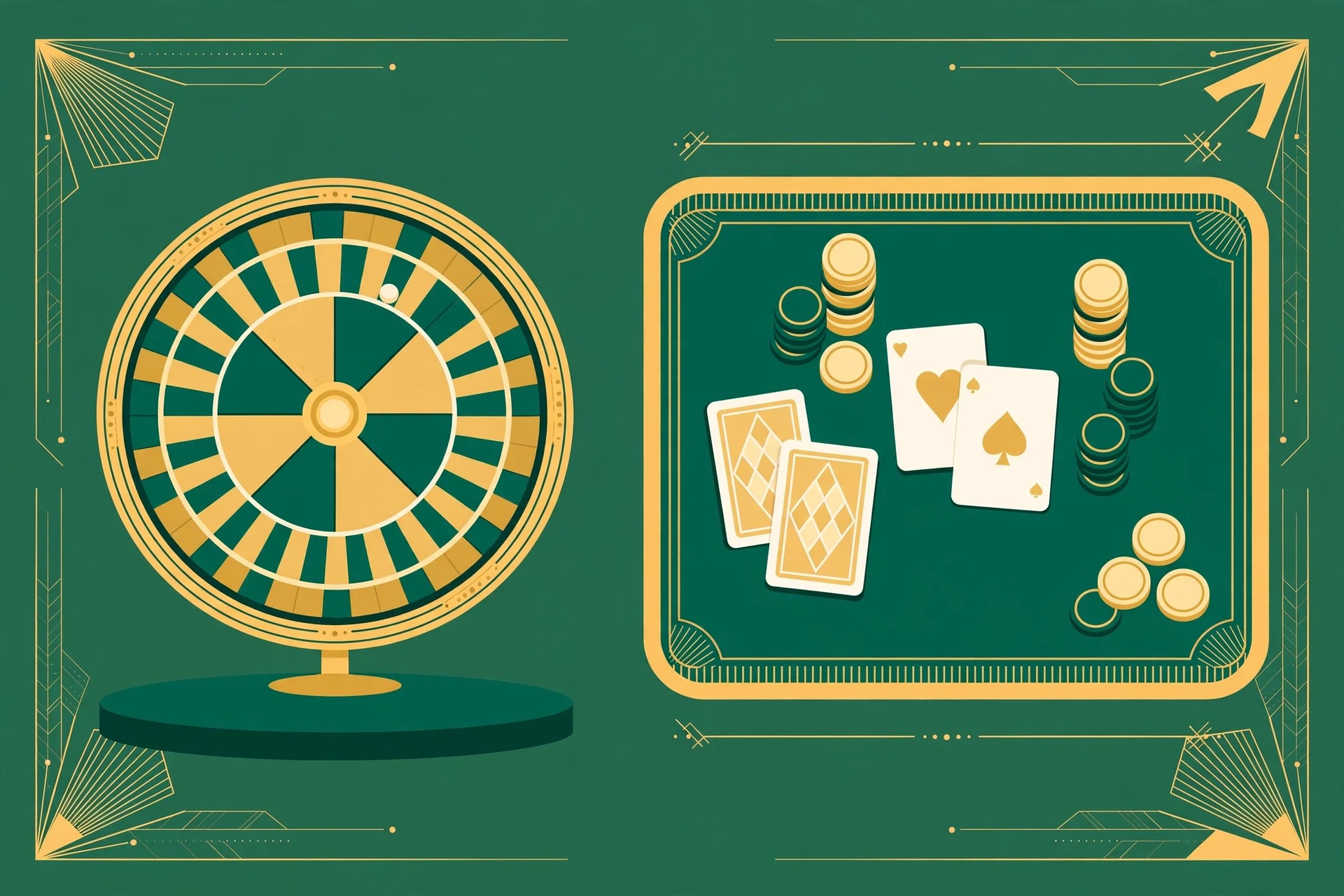
Roulette is one of the simplest casino games to understand, which is a big part of its appeal. A wheel is divided into numbered pockets, from 0 (and 00 in the American version) up to 36. Half the numbers are red, half are black, and the zero pockets are green. The dealer spins the wheel in one direction and launches a small ball in the opposite direction. Wherever the ball lands decides the winners.
Before the spin, players place chips on a betting layout. You can bet on a single number, on a group of numbers, on red or black, on odd or even, on high or low, or on a column or a dozen. Each type of bet pays differently. A bet on a single number pays 35 to 1, which sounds exciting, but your chance of winning it on a European wheel is 1 in 37. A bet on red or black pays even money, and your chance of winning is close to a coin flip — slightly less than half, because of the green zero.
That green zero is the whole business model of roulette. It is the reason the casino always wins in the long run. On a European wheel, with a single zero, the house edge is about 2.7%. On an American wheel, with both a zero and a double zero, the house edge roughly doubles to about 5.26%. That difference matters enormously over time, and it is one of the first things a beginner should learn: if you ever have the choice, always play European roulette rather than American roulette.
The pace of roulette is relaxed. A spin takes a minute or so, and you can bet as little or as much as the table allows. You do not need to make any difficult decisions. You pick your numbers, place your chips, and watch the wheel. That simplicity is the game’s greatest strength and its greatest weakness — it is relaxing, but it also means you have no way to improve your odds. No betting system changes the mathematics. Strategies like the Martingale, where you double your bet after every loss, look clever on paper, but they run into table limits and your own bankroll long before they beat the wheel. Our guide to roulette strategies explains why these systems fail in practice.
How Blackjack Works
Blackjack is a card game with a simple goal: get a hand total closer to 21 than the dealer’s hand, without going over 21. You are dealt two cards, the dealer is dealt two cards (one face up, one face down), and then you decide what to do. You can ask for another card (hit), keep your hand as it is (stand), double your bet and take exactly one more card (double down), or split a pair into two separate hands. If your hand goes over 21, you lose immediately. If the dealer goes over 21, every player still in the hand wins.
What makes blackjack different from roulette is that your decisions matter. The correct play in every situation has been worked out mathematically, and it is published as “basic strategy” — a chart that tells you exactly what to do with every possible hand against every possible dealer card. If you play perfect basic strategy, the house edge in a good game can fall to around 0.5%, which is far lower than roulette’s 2.7%. If you play by gut feeling, however, the house edge can climb to 2% or more, which is roughly the same as roulette.
That is the key point about blackjack: it rewards study and punishes guesswork. A beginner who learns basic strategy will lose money far more slowly than a beginner who plays by instinct. A beginner who plays roulette cannot improve their odds at all, no matter how much they study. So if you enjoy learning and making decisions, blackjack gives you something roulette cannot — a real sense of control over your results.
Blackjack is also faster than roulette. A hand can take less than a minute, and in online games it can take seconds. That speed matters, because the faster you play, the more hands you play per hour, and the more the house edge has a chance to work against you. A slow, thoughtful blackjack player can still lose less per hour than a roulette player, but a fast, careless blackjack player can lose more than either.
If you want to learn the decisions in detail, our blackjack strategy guide walks through basic strategy, splits, and doubling down step by step.
House Edge: The Numbers That Matter
The house edge is the percentage of each bet that the casino expects to keep over the long run. It is the single most important number in any casino game, and it is where blackjack has a clear advantage.
European roulette carries a house edge of about 2.7% on every bet. That means that, on average, you can expect to lose about 2.70 for every 100 you bet, over a long period. American roulette, with its extra zero, carries a house edge of about 5.26%, so you would expect to lose about 5.26 for every 100 you bet. The difference between the two wheels is the difference between losing your money slowly and losing it twice as fast.
Blackjack, played with perfect basic strategy, can have a house edge as low as 0.5% in a good game — though the exact figure depends on the rules of the table, such as whether the dealer stands on soft 17, how many decks are used, and whether doubling and splitting are restricted. A beginner who plays by instinct, however, will typically face a house edge of around 2%, which is similar to European roulette. A beginner who makes serious mistakes — such as always taking insurance, or never doubling down — can push the edge even higher.
What this means in practice is simple. A disciplined blackjack player loses money more slowly than a roulette player. A careless blackjack player loses money at about the same rate. And a roulette player on an American wheel loses money faster than either. The house edge does not decide who wins on a given night — luck does that — but over many sessions, the edge is the reason the casino stays in business.
To understand how the edge works across all games, read our guide on how the house edge works and our explainer on casino odds and probability.
Skill vs Luck: How Much Control Do You Have?
In roulette, you have no control at all. Once you place your chips, the outcome is decided by physics — the spin of the wheel and the bounce of the ball. No amount of study, experience, or intuition changes the odds. That is not a criticism; many people enjoy exactly that. Roulette is relaxing precisely because there is nothing to decide and nothing to get wrong. You place your bet, watch the wheel, and enjoy the suspense.
In blackjack, your decisions change the outcome. Choosing to hit on 16 against a dealer’s 7 is correct. Choosing to stand on 16 against a dealer’s 7 is wrong, and it costs you money over time. Splitting a pair of eights is correct. Splitting a pair of tens is a mistake. These are not matters of opinion — they are matters of mathematics, and they have been calculated precisely. That means a blackjack player can genuinely improve, and can genuinely make mistakes. Some people love that. Others find it stressful, because every decision carries the weight of being right or wrong.
There is also a social difference. At a roulette table, everyone is on the same side — everyone is betting against the wheel, and a win for one player is a win for the table. At a blackjack table, players sometimes blame each other for “taking the dealer’s bust card” or playing a hand badly. That is a myth — one player’s decisions do not change the long-run odds for anyone else — but it can make the atmosphere at a blackjack table tenser than at a roulette table, especially for a beginner who is still learning.
Pace and Cost: How Fast Does Your Money Move?
A beginner rarely thinks about pace, but it is one of the biggest factors in how much a session actually costs. The house edge is a percentage of each bet, so the more bets you place per hour, the more money you expose to that edge.
Roulette is slow. A spin every minute or so means perhaps 40 to 60 spins per hour in a live game, and often fewer. If you bet 10 per spin on a European wheel, you are putting about 500 per hour through a 2.7% edge, which works out to an expected loss of roughly 13.50 per hour. That is a slow, gentle drain, and it is one reason roulette feels relaxed.
Blackjack is faster. A live table might deal 50 to 80 hands per hour, and an online game can deal far more. If you bet 10 per hand with a 0.5% edge, your expected loss is only about 3 to 4 per hour — excellent value. But if you bet 10 per hand with a 2% edge because you are playing by instinct, your expected loss rises to about 12 to 16 per hour. And if you play online at 200 hands per hour, even a small edge adds up quickly. Speed is a double-edged sword: it lets a good player get more value from a low edge, and it lets a bad player lose money faster.
The practical lesson is to control your pace. In blackjack, take your time, think about each decision, and do not rush. In roulette, enjoy the slower rhythm and resist the temptation to cover the whole table with bets — every extra bet is another spin of the same edge. And in both games, a bankroll management plan — deciding in advance how much you are willing to lose and walking away when you reach it — matters far more than any betting system.
Atmosphere and Experience
Roulette is a spectator game as much as a gambling game. The wheel is the centre of attention, everyone watches the same ball, and a win feels like a shared event. It is the game people play when they want to enjoy the casino itself — the sounds, the crowd, the drama of the spin. You can talk to the people next to you, you can bet small, and you do not need to concentrate hard.
Blackjack is a thinking game. The table is quieter, the players are more focused, and the decisions require attention. It appeals to people who like puzzles, strategy, and the feeling of earning a win through good play. It can also be more intense: when you have a large bet on the table and you need to decide whether to hit on 16, the pressure is real.
Neither atmosphere is better than the other. They suit different moods. If you want a relaxed evening with friends, roulette is the easier choice. If you want a challenge and you enjoy studying a game, blackjack is more rewarding.
Which Game Suits Which Beginner?
Choose roulette if you want a simple, social game with no learning curve, if you do not want to study a strategy chart, if you enjoy the theatre of the casino, and if you are happy accepting that the outcome is entirely down to luck. Choose European roulette over American roulette, bet small, and treat the game as entertainment rather than a way to make money.
Choose blackjack if you enjoy making decisions, if you are willing to learn basic strategy before you play, if you want the lowest house edge available to a beginner, and if you like the idea that your skill genuinely affects your results. Learn the basic strategy chart, practise with free games before betting real money, and never take insurance — it is a side bet with a high house edge that basic strategy always rejects.
You can also play both. Many beginners start with roulette because it is easy, then move to blackjack once they want more involvement. There is no rule that says you must pick one game for life. The important thing is to understand what each game offers, what it costs, and what it demands from you — and then to play within a budget you can afford to lose.
Common Beginner Mistakes in Both Games
In roulette, the most common mistake is believing in patterns. After five reds in a row, beginners feel that black is “due”. It is not. Every spin is independent, and the wheel has no memory. Betting systems that promise to beat roulette are built on this misunderstanding, and they all fail for the same reason: the house edge applies to every spin, no matter how you size your bets.
In blackjack, the most common mistakes are playing by instinct instead of basic strategy, taking insurance, and splitting tens. Insurance looks like a sensible way to protect a good hand, but it is a separate bet with a house edge of over 7%, and basic strategy says never to take it. Splitting tens feels bold, but a pair of tens is already a strong hand worth 20, and splitting it usually makes your results worse. And playing by instinct — standing on 16 because you are afraid of busting, or hitting on 12 because you feel lucky — is the fastest way to hand the casino a bigger edge than it deserves.
In both games, the biggest mistake of all is chasing losses. Doubling your bets to win back what you have lost is how small losses become large ones. Set a limit before you start, and stop when you reach it, win or lose.
Legal Status in Thailand — Read This First
Before you play any casino game, it is important to understand the law where you live. In Thailand, gambling is governed by the Gambling Act B.E. 2478 (1935). Under this law, most forms of gambling are prohibited. The only widely recognised exceptions are the government lottery and licensed horse racing. Online casinos are NOT licensed in Thailand, and casino games are not legally operated inside the country.
This article is educational only. It explains how roulette and blackjack work so that you can understand the games, their odds, and their risks. It is not an invitation to gamble, and it does not recommend any casino, website, or operator. If you choose to learn more about these games, do so responsibly and within the law that applies to you.
Gambling should always be treated as entertainment, never as a way to make money. There are no guaranteed winnings in any casino game, and no strategy or system can overcome the house edge in the long run. Only play with money you can afford to lose, set a firm limit before you start, and never chase losses — increasing your bets to recover money you have already lost is the fastest way to turn a small loss into a serious one.
If gambling ever stops being fun, or if you feel you are losing control, help is available. You must be 18 or older to gamble anywhere it is legal. For free, confidential support, visit BeGambleAware or Gamblers Anonymous.
Frequently Asked Questions
Is blackjack or roulette better for beginners?
It depends on what you want. Roulette is easier to learn because there is no strategy to study — you place a bet and watch the wheel. Blackjack offers a lower house edge, but only if you learn basic strategy. A beginner who wants simplicity should start with roulette; a beginner who wants the best odds and is willing to study should learn blackjack.
Which game has a lower house edge?
Blackjack, when played with perfect basic strategy, has a house edge of around 0.5%, which is much lower than European roulette at about 2.7% or American roulette at about 5.26%. However, a blackjack beginner who plays by instinct will face a house edge of around 2%, which is similar to European roulette.
Can you win more at roulette or blackjack?
In a single session, you can win more at roulette, because a single-number bet pays 35 to 1. Blackjack pays at most 3 to 2 for a natural blackjack, and most wins are even money. But over many sessions, the lower house edge in blackjack means a disciplined player loses money more slowly. Big wins are more likely in roulette; slow, steady play is more likely in blackjack.
Is roulette purely luck?
Yes. Once you place your bet, the outcome is decided by the wheel and the ball. No decision you make changes the odds, and no betting system can overcome the house edge. The only real choice in roulette is which wheel to play (European over American) and how much to bet.
Does skill matter in blackjack?
Yes, genuinely. The decisions you make — when to hit, stand, double down, or split — change your expected results. Playing perfect basic strategy cuts the house edge to around 0.5%. Playing by gut feeling can push it to 2% or more. That is a real, measurable difference, and it is why blackjack is the only one of the two games where study pays off.
Can I play both games?
Absolutely. Many players enjoy roulette for its atmosphere and blackjack for its challenge. There is no reason to commit to one game. Just make sure you understand the rules, the house edge, and the pace of each game, and set a separate budget for each session.
What is the best first bet for a roulette beginner?
An even-money bet — red or black, odd or even, high or low — is the simplest place to start. It pays 1 to 1, wins nearly half the time, and lets you enjoy the game without risking large amounts. Avoid covering many numbers at once, because every extra bet adds to the total amount exposed to the house edge.
What should a blackjack beginner learn first?
Basic strategy. It is a simple chart that tells you the correct play for every hand, and it is the single most important thing a blackjack beginner can learn. Practise it with free games until the common decisions feel automatic, and never take insurance.
Conclusion
Roulette and blackjack are both great first games, but they offer very different experiences. Roulette is simple, social, and entirely luck-based — a game where you can relax, watch the wheel, and enjoy the casino without studying anything. Blackjack is a thinking game where your decisions matter, where a little study cuts the house edge to one of the lowest in the casino, and where the challenge itself is part of the fun.
If you want the easiest possible start, choose roulette — and choose a European wheel. If you want the best odds and you are willing to learn, choose blackjack — and learn basic strategy before you bet real money. Whichever you choose, keep your bets small, set a limit before you play, and treat the game as entertainment. The wheel and the cards will still be there tomorrow, and the best session is always the one you can afford.