Texas Hold’em Poker Guide for Thai Beginners: Rules, Hands and Strategy
Texas Hold’em Poker Guide for Thai Beginners: Rules, Hands and Strategy
18+ only — educational content: This guide explains how Texas Hold’em works so you can understand the game. It is not an invitation to gamble, and it does not promise winnings. Poker involves risk, and most players lose money over time. If you choose to play anywhere it is legal to do so, set a strict limit you can afford to lose, and never chase losses.
Texas Hold’em is the most widely played form of poker in the world, and it is the version you will see in almost every film, television show, and tournament broadcast about the game. If you have ever watched two players stare each other down over a pile of chips, with five cards lying face up in the middle of the table, you were almost certainly watching Texas Hold’em. It looks simple from the outside — two cards in your hand, five cards shared with everyone — but that simplicity hides a game of patience, maths, psychology, and discipline.
For a Thai beginner, Hold’em is a good place to start learning poker, because the rules are straightforward, the hand rankings are the same as in most other poker games, and there is a huge amount of free learning material available. It is also a good place to learn the habits that matter in every poker game: thinking about what your opponent might hold, managing your money, and knowing when to walk away from a hand. This guide explains the rules step by step, the hand rankings, the betting rounds, the role of position, and the beginner strategy that actually helps, along with the mistakes new players make most often.
Legal Status in Thailand — Read This First
Under the Gambling Act B.E. 2478 (1935), most forms of gambling are prohibited in Thailand. The only legal exceptions are the government lottery and licensed horse racing. Online casinos are NOT licensed in Thailand, and playing on them carries legal risk. This article is educational only. It explains how a card game works; it is not legal advice and it is not an encouragement to gamble.
This content is for readers aged 18 and over only. There are no guaranteed winnings in poker or in any casino game. Even skilled players have losing sessions, and luck plays a large role in the short term. Never chase losses, never borrow money to play, and never play with money you need for rent, food, bills, or family. If gambling stops being fun, or if you feel you cannot stop, help is available from BeGambleAware and Gamblers Anonymous.
What Is Texas Hold’em?
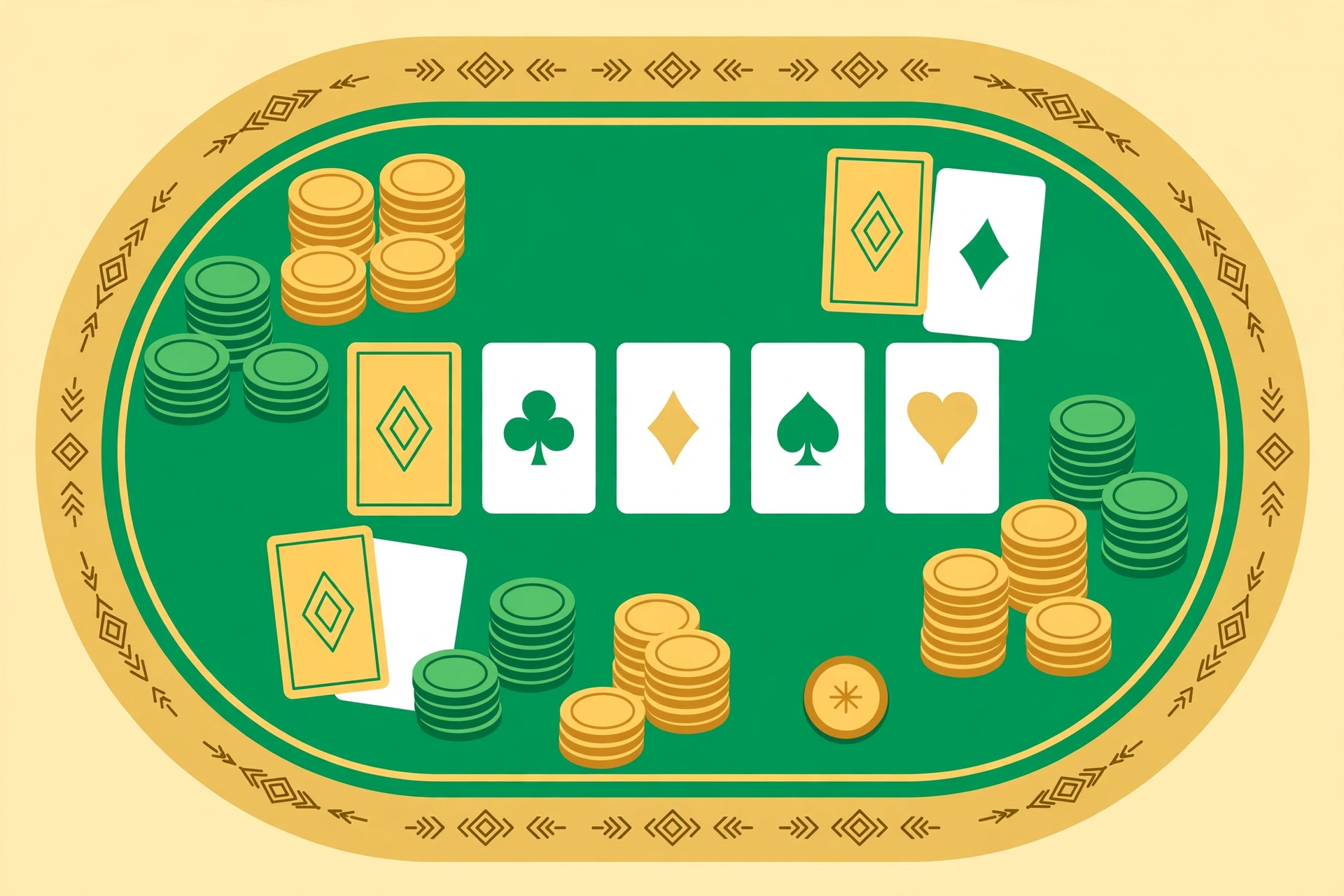
Texas Hold’em is a community-card poker game. Each player is dealt two private cards, called hole cards, that only they can see. Five community cards are then dealt face up in the middle of the table, in stages, and every player can use them. Each player makes the best five-card poker hand they can, using any combination of their two hole cards and the five community cards. You can use both hole cards, one hole card, or — in rare cases — none of them, playing the five community cards alone.
A standard 52-card deck is used, with no jokers. The game is usually played with between two and ten players at a table, although six-player and nine-player tables are the most common formats you will come across. The cards are ranked from ace high down to two low, and suits — hearts, diamonds, clubs, and spades — are equal in Hold’em. A flush in hearts beats no flush in spades; the suit never breaks a tie.
What makes Hold’em different from older poker games is the amount of shared information. Because five cards are visible to everyone, you can work out a great deal about what your opponents might have. If three hearts are on the board, anyone could be holding a flush. If the board shows a pair, anyone could have a full house. Learning to read the board, and to think about the hands your opponent could plausibly hold, is the heart of the game.
The Aim of the Game
The aim in each hand is to win the pot — all the chips that players have bet during that hand. There are two ways to win it. The first is to have the best hand at the showdown, when the remaining players reveal their cards after the final betting round. The second is to make every other player fold before the showdown, by betting in a way that convinces them their hand is not worth continuing with. That second way to win is why bluffing is part of poker, and why Hold’em is not just a game of cards.
It is worth understanding this from the start, because beginners often focus only on their own two cards. Good players think about the whole picture: their cards, the community cards, the size of the pot, how much it costs to continue, what their opponents have done so far, and how many chips everyone has left. Poker is a game of incomplete information, and the player who makes the best decisions with incomplete information, hand after hand, tends to do best over time. In a single hand, though, anything can happen, and a weaker hand can beat a stronger one when the cards fall the wrong way.
Texas Hold’em Hand Rankings
Hand rankings are the foundation of poker. If you do not know them cold, every other decision becomes guesswork. In Texas Hold’em, the rankings from strongest to weakest are:
Royal flush: Ace, king, queen, jack, and ten, all of the same suit. The best possible hand in poker, and extremely rare.
Straight flush: Five cards in sequence, all of the same suit, such as 9-8-7-6-5 of hearts. If two players hold straight flushes, the one with the highest top card wins.
Four of a kind: Four cards of the same rank, such as four queens, plus any fifth card, called the kicker.
Full house: Three cards of one rank and two cards of another rank, such as three sevens and two kings. When two players hold a full house, the higher three-of-a-kind wins first.
Flush: Five cards of the same suit, not in sequence. The highest card decides between two flushes, then the next highest, and so on.
Straight: Five cards in sequence, of mixed suits, such as 10-9-8-7-6. An ace can be high, as in A-K-Q-J-10, or low, as in A-2-3-4-5, known as the wheel, but it cannot be both at once.
Three of a kind: Three cards of the same rank, plus two unrelated cards.
Two pair: Two cards of one rank, two cards of another rank, and a fifth card as a kicker.
One pair: Two cards of the same rank, plus three unrelated cards.
High card: When no one has even a pair, the hand with the highest card wins, with kickers deciding ties.
Memorise this list before you play a single hand for real stakes, even low ones. Many beginners lose money simply because they misread their hand, or because they overvalue a weak hand such as a low pair on a board full of higher cards. If you want a slower introduction to the rankings, our poker guide for Thai beginners covers hand rankings and basic strategy in more detail, and our Omaha poker guide shows how the same rankings work in a game where you are dealt four hole cards instead of two.
Ties are common in Hold’em, and the kicker matters more than beginners expect. If you and your opponent both hold a pair of aces, the player with the highest side card wins. If the board itself makes the best hand for both players, the pot is split. Do not be surprised by split pots — they are a normal part of the game, and they are one reason why a hand that looks strong can still only win half the pot.
The Dealer Button and the Blinds
Hold’em is played with a dealer button, a small disc that marks the nominal dealer for that hand. After each hand, the button moves one seat clockwise, so every player takes turns being in the dealer position. The button matters because it decides who acts first and who acts last, and acting last is a real advantage, as explained in the position section below.
Before any cards are dealt, the two players to the left of the button must post forced bets called blinds. The player immediately to the left of the button posts the small blind, and the next player posts the big blind, which is usually twice the small blind. The blinds exist to make sure there is money in the pot to play for, and to give players a reason to act rather than folding every hand for free.
The player to the left of the big blind acts first before the flop, and the action then moves clockwise around the table. After the flop, the first player to act is the small blind, or the next active player to their left if the small blind has folded. The button always acts last after the flop, which is why the dealer position is the most valuable seat at the table.
How a Hand Plays Out: The Four Betting Rounds
Every hand of Hold’em follows the same structure, in four betting rounds separated by the dealing of community cards. Once you know this sequence, you can follow any Hold’em game.
Pre-flop
Each player receives two hole cards, face down. The player to the left of the big blind acts first. They can fold, call the big blind, or raise. The action moves clockwise. The big blind gets the final say before the flop: if no one has raised, they can check, meaning they stay in the hand without putting in more money, or raise. If someone has raised, they must fold, call the raise, or re-raise.
This is where most beginner money is lost. New players call too often before the flop with weak hands — hands such as a low unsuited jack and a seven, or a small suited pair of cards that rarely make a strong hand — because calling feels cheap. It is not cheap over hundreds of hands. The money you save by folding weak hands before the flop is just as real as the money you win with strong ones.
The flop
After the first betting round, three community cards are dealt face up in the middle of the table. This is the flop. Another round of betting follows, starting with the first active player to the left of the button.
Now you can see five of the seven cards you will eventually have available, so you can judge the strength of your hand much better. Have you made a pair? Two pair? A flush draw, where you need one more card of your suit? A straight draw? Or have you missed the flop entirely? Beginners often stay in the hand after missing the flop, hoping the next card will save them. Sometimes it will. More often it will not, and the cost of chasing adds up.
The turn
A fourth community card is dealt face up. This is the turn. Another round of betting follows. The pot is usually bigger now, and the bets are usually bigger too, so decisions get more expensive. This is the point where many hands are decided: a player with a strong hand bets to protect it and to build the pot, while a player with a weak hand has to decide whether the price of continuing is worth it.
The river
A fifth and final community card is dealt face up. This is the river. A final round of betting follows. If more than one player remains after this round, there is a showdown: players reveal their hole cards, and the best five-card hand wins the pot. The last player to bet or raise is usually expected to show their cards first, although the exact etiquette varies. If a player bets on the river and everyone else folds, that player wins the pot without showing their cards.
Betting Actions Explained
In each betting round, you will use the same small set of actions. Check means you pass the action to the next player without betting, which is only possible when no one has bet yet in that round. Bet means you put chips into the pot when no one else has bet. Call means you match the current bet to stay in the hand. Raise means you increase the current bet, forcing other players to match the new amount or fold. Fold means you give up your hand and any chips you have already put into the pot, and you sit out the rest of the hand.
Most Hold’em games played today are no-limit, which means a player can bet any amount up to all the chips they have in front of them, at any time. That is the format used in most tournaments and in the games you will see on television. There are also fixed-limit and pot-limit versions, where the size of bets is restricted, but no-limit is the standard for beginners to learn, because it is the most common.
Going all-in — betting all your remaining chips — is a dramatic moment, but it should not be a casual one. When you go all-in, you are putting your whole stack at risk on one decision. Sometimes that is correct, when you have a very strong hand or when the maths supports it. Often, for beginners, it is an emotional reaction to a bad beat or a losing session, and it is how a small loss becomes a large one.
Starting Hands: What to Play and What to Fold
Your two hole cards are called your starting hand, and choosing which starting hands to play is the most important beginner skill in Hold’em. The strongest starting hands are pairs of aces, kings, queens, and jacks, and ace-king, especially when both cards are of the same suit. Hands such as ace-queen, king-queen, and ace-jack suited are also strong. Medium pairs — tens down to sevens — are playable, and suited connectors — cards in sequence and of the same suit, such as 9-8 of hearts — can be worth playing in the right position, because they can make straights and flushes.
Most other hands are trouble. A king and a weak kicker, such as king-six offsuit, looks better than it is, because when you make a pair of kings you may still lose to a player with a better kicker, and when you do not make a pair you have little to fall back on. Low unsuited cards with a gap between them, such as 9-4 or J-6, are hands to fold in almost every situation. Suited cards tempt beginners because they dream of a flush, but a flush only comes about once in many hands, and two low suited cards often make a losing flush when a higher flush appears.
The honest rule for a beginner is simple: play fewer hands, and play the ones you do play more confidently. Folding is not a sign of weakness. The best players in the world fold most of their hands before the flop. They wait for good situations, and they let the impatient players hand them chips.
Position: The Advantage Beginners Ignore
Position means where you sit relative to the dealer button, and it matters more in Hold’em than in almost any other casino game. Players who act later in a betting round have more information: they have seen what everyone before them did. The button, the seats just before it, and the seats just after it are late position, and they are the best seats at the table. The seats under the gun — the first to act before the flop — and the blinds are early position, and they are the hardest seats to play from, because you must decide with the least information.
In late position, you can play more hands, because you can see whether your opponents look strong or weak before you commit chips. You can also bluff more credibly, because your opponents have already shown weakness by checking. In early position, you should play only your strongest hands, because several players still have to act after you, and any one of them could hold a better hand.
The blinds deserve a special note. Because you have already put money in, it is tempting to defend your blind with weak hands. Do not make a habit of it. The small blind is the worst position at the table after the flop, because you always act first, and the big blind is not much better. Calling a raise from the blinds with a weak hand is one of the most reliable ways beginners lose money.
Reading the Board
As the community cards appear, keep asking yourself what hands are now possible. Three cards of the same suit on the board mean a flush is possible. Cards in sequence mean a straight is possible. A pair on the board means a full house is possible. An ace on the board means someone could hold a pair of aces. These are not exotic situations — they happen in almost every session.
This matters for two reasons. First, it tells you how strong your hand really is. Top pair — a pair using the highest card on the board — is a decent hand when the board is dry, with no obvious flush or straight draws, but it is a much weaker hand when the board is coordinated, with three cards of the same suit or cards in sequence. Second, it tells you what your opponent might be representing when they bet. If a player who has been quiet suddenly bets strongly when a third heart appears, they may well have the flush, and your two pair may not be enough.
Beginners also need to watch for overcards — cards on the board higher than their pair. If you hold a pair of queens and an ace and a king appear on the flop, your queens are suddenly in trouble, because any player holding an ace or a king now has a higher pair. Learning to let go of a hand that was strong before the flop but is weak after it is one of the hardest and most valuable lessons in poker.
Simple Beginner Strategy That Actually Works
Good beginner strategy is not about clever tricks. It is about making fewer mistakes than your opponents. Start with tight, straightforward play: play strong starting hands, fold weak ones, bet when you have a strong hand, and fold when you are beaten. That sounds dull, and it is, but it is also how beginners stop losing money quickly while they learn.
Think about pot odds in simple terms. If the pot holds a large amount and it costs you a small amount to call, continuing can be reasonable when you have a chance of improving. If the pot is small and the bet is large, and your hand is weak, folding is usually correct. You do not need to do exact maths at the table on your first day, but you should build the habit of comparing the price of calling with what you stand to win, rather than calling because you hope your hand will improve.
Pay attention to your opponents, even when you are not in the hand. Notice who plays every hand, who only plays strong hands, who bluffs often, and who never bluffs. Most casual players fall into obvious patterns, and spotting those patterns costs nothing. If a player has only raised with very strong hands all evening, believe them when they raise again. If a player bets on every hand, wait for a strong hand and let them do the betting for you.
Control the size of the pot according to the strength of your hand. With a very strong hand, betting and raising to build the pot is usually right. With a medium-strength hand, such as a single pair on a dangerous board, keeping the pot small by checking or calling is often wiser. Beginners get into trouble by building a huge pot with a medium hand, and then feeling committed to it even when the evidence says they are beaten.
Finally, manage your money as seriously as you manage your cards. Decide in advance how much you are willing to risk in a session, and stop when you reach that limit, whether you are winning or losing. Our guide to casino bankroll management for beginners explains how to set limits and stick to them. That discipline matters more than any single poker tip, because poker rewards the player who can keep making good decisions, and a player who has lost more than they can afford cannot think clearly.
Bluffing: Less Than You Think
Bluffing is the most famous part of poker, and the most overrated by beginners. In films, players bluff constantly and win huge pots with nothing. In real games, successful bluffs are selective, and they depend on the story your betting tells, the board, and the player you are bluffing against.
A bluff works best when the board supports it — when the cards that have appeared could plausibly have given you a strong hand — and when your opponent is capable of folding. Bluffing a player who calls with almost any hand is a waste of chips. Bluffing into several opponents is also usually a mistake, because the more players in the hand, the more likely it is that one of them has a hand they will not fold.
For a beginner, the right approach is to bluff rarely, and only in spots where the story makes sense. Your profit in your early games will come from playing strong hands well and letting your opponents make mistakes, not from elaborate bluffs. If you do bluff and it fails, note what happened and move on. Do not chase the loss by bluffing again to win it back. For more on this, our guide to poker bluffing basics explains when a bluff has a chance and when it is simply throwing chips away.
Common Beginner Mistakes
The first mistake is playing too many hands. Almost every beginner does this. The excitement of being dealt cards makes folding feel like missing out, but in poker, folding is the default, and playing is the exception. Tighten up, and your results will usually improve quickly.
The second mistake is calling too much and raising too little. Beginners call because they want to see what happens next. Strong players raise when they have a good hand, because raising builds the pot, gives opponents a harder decision, and sometimes wins the pot immediately. If your hand is good enough to call, it is often good enough to raise.
The third mistake is falling in love with a hand. A pair of aces is the best starting hand in Hold’em, but it is still only one pair, and it can lose to two pair, a straight, a flush, or a better hand that develops on later streets. When the board turns against you, be willing to let go. The chips you save by folding a beaten hand are worth as much as the chips you win with a strong one.
The fourth mistake is ignoring position. Playing weak hands from early position, or calling raises from the blinds with hands that need a perfect flop, puts you in difficult spots after the flop, where you must act first with an uncertain hand. Respect position, and the game becomes noticeably easier.
The fifth mistake is playing when emotional. Poker has a word for this: tilt. After a bad beat — losing a hand you were favoured to win — or after a run of losses, players start making angry, reckless decisions. They play hands they would normally fold, they raise when they should call, they chase losses. If you feel that happening, stop. Take a break, walk away, and come back another day. No session is worth the cost of playing on tilt.
The sixth mistake is misunderstanding the maths of drawing hands. A flush draw or an open-ended straight draw is an exciting hand, but it still misses more often than it hits. Chasing a draw when the price is too high is a slow leak that drains a bankroll over time. Learn the rough chances — a flush draw after the flop completes about a third of the time by the river — and compare that with the price you are being asked to pay.
Texas Hold’em Tournaments vs Cash Games
Hold’em is played in two main formats, and they play very differently. In a cash game, chips represent real money, you can join or leave at any time, and the blinds stay the same. You can rebuy if you lose your chips. Decisions in cash games are mainly about the value of each hand, because every chip is worth the same amount.
In a tournament, everyone pays an entry amount and receives the same number of tournament chips, which have no cash value outside the tournament. The blinds increase at set intervals, players are eliminated as they lose their chips, and prizes go to the players who survive longest. As the blinds rise, the pressure to act grows, and short-stacked players must take more risks to survive. Tournament play rewards patience early on and aggression later, when the blinds are high relative to the stacks.
For a beginner learning the game, low-stakes cash games or free-play games are usually the better place to practise the fundamentals, because the structure is simpler and a single mistake does not end your session. Tournaments are exciting, and they are the format you will see on television, but they add a layer of strategy around survival and blind pressure that is easier to learn once the basic rules and hand rankings are automatic.
How to Practise Without Risking Much
The best way to learn Hold’em is to play a lot of hands in low-pressure settings. Free-play games, whether with friends or on a free app, let you practise the flow of the game — the betting rounds, the hand rankings, the position — without risking money. Play with friends using small stakes or no stakes at all, and talk through hands afterwards. Explaining why you folded or raised is one of the fastest ways to find the gaps in your thinking.
When you do move to games with money at stake, keep the stakes low enough that losing does not matter to you. The point of those games is to learn, not to win a meaningful amount. Keep a simple note of hands that confused you, and think about them later, away from the table. Did you play a hand you should have folded? Did you miss a bet with a strong hand? Did you call when the price was wrong? That review habit, more than any book or video, is what turns a beginner into a competent player over time.
It also helps to learn the other games in the poker family, because they sharpen different skills. Our video poker guide is a useful contrast: it is a single-player game against a pay table, with no bluffing and no opponents to read, so it teaches hand values without the psychology. Our Three Card Poker guide covers a faster, simpler casino poker variant, and our Pai Gow Poker guide explains a slower game where you split your hand in two. Comparing them with Hold’em helps you see what makes Hold’em distinctive: the shared cards, the position, and the bluffing.
Frequently Asked Questions
How do you play Texas Hold’em for beginners?
Each player gets two private hole cards, then five community cards are dealt in stages — three on the flop, one on the turn, one on the river — with a betting round after each stage. You make the best five-card hand from your two hole cards and the five community cards. You can win by having the best hand at showdown or by making everyone else fold.
What are the hand rankings in Texas Hold’em?
From strongest to weakest: royal flush, straight flush, four of a kind, full house, flush, straight, three of a kind, two pair, one pair, high card. Suits are equal, so a flush in hearts is no better than a flush in spades, and kickers decide ties when players hold the same kind of hand.
What is the difference between the flop, turn and river?
The flop is the first three community cards, dealt together. The turn is the fourth community card. The river is the fifth and final community card. There is a betting round after each of them, and the river is followed by the showdown if more than one player remains.
What does the dealer button do?
The button marks the nominal dealer for the hand and moves one seat clockwise after each hand. The player on the button acts last in the betting rounds after the flop, which is a real advantage because they have seen what everyone else did first. The two players to the left of the button post the small blind and big blind.
What is the best starting hand in Texas Hold’em?
A pair of aces is the best starting hand. A pair of kings, a pair of queens, and ace-king suited are the next strongest. That does not mean aces always win — they are still only one pair after the flop, and they can lose to two pair, a straight, a flush, or a full house if the board develops badly.
How many players can play Texas Hold’em?
Between two and ten players can sit at a table, with six and nine being the most common formats. With two players, called heads-up, the button posts the small blind and acts first before the flop, which changes the strategy considerably compared with a full table.
Is Texas Hold’em legal in Thailand?
Under the Gambling Act B.E. 2478 (1935), most gambling is prohibited in Thailand, with the government lottery and licensed horse racing as the only legal exceptions. Online casinos are not licensed in Thailand. This guide is educational only and is intended for readers aged 18 and over.
Can you win at Texas Hold’em with skill alone?
Skill matters a great deal over a large number of hands — good decisions, position, and bankroll management all help — but luck dominates in the short term. Even the best players lose sessions, and no strategy guarantees winnings. Treat poker as entertainment with a cost, not as a source of income.
What is a common beginner mistake in Texas Hold’em?
Playing too many hands, especially weak hands from early position, is the most common mistake. Beginners also call too often instead of raising with strong hands, chase draws when the price is wrong, and keep playing when they are angry or frustrated after a bad beat.
How should a beginner practise Texas Hold’em?
Start with free-play games or low-stakes games with friends, learn the hand rankings until they are automatic, play fewer hands, and review the hands that confused you afterwards. Keep the stakes low enough that losing does not affect your life, and set a firm limit before every session.
Conclusion
Texas Hold’em earns its popularity. The rules can be learned in an afternoon, the hand rankings are shared with most other poker games, and the mix of shared cards, position, and betting gives the game real depth. You can play it casually with friends for years and still find new situations to think about, which is why it has stayed the world’s most played poker game for decades.
That depth is also the reason to approach it with respect. Learn the hand rankings until they are automatic, play tight and patient poker while you are learning, respect position, compare the price of calling with the size of the pot, and fold when the evidence says you are beaten. Study the games around Hold’em too — our poker guide for Thai beginners, our Omaha poker guide, and our guide to casino bankroll management for beginners all build on the same fundamentals.
Above all, remember the limits. This guide is educational only, for readers aged 18 and over. Poker should be entertainment, played with money you can afford to lose, within limits you set before you start. If it stops being fun, or if you feel you cannot stop, step away and seek help from BeGambleAware or Gamblers Anonymous. The best poker decision you will ever make is knowing when to fold — and knowing when to walk away from the table entirely.