Crypto Day Trading vs Long-Term Investing for Beginners: Risks and Differences
Crypto Day Trading vs Long-Term Investing for Beginners: Risks and Differences
Risk disclaimer: Cryptocurrencies are volatile and can lose most or all of their value. Nothing in this article is financial advice. Never invest money you cannot afford to lose, and do your own research before buying any cryptocurrency.
Should you trade crypto every day, or buy it and hold it for years? It is one of the first questions a beginner faces, and it is also one of the most misunderstood. On social media, day trading looks exciting: screenshots of quick profits, charts full of green candles, and people who claim to make a living from a few trades a day. Long-term investing, by contrast, looks boring: buy a coin, wait, and do nothing for months or years. The boring option rarely gets posted about, but for most beginners, it is the one that deserves a closer look.
The truth is that day trading and long-term investing are not just two speeds of the same activity. They are different activities, with different skills, different risks, different costs, and different demands on your time and emotions. Many beginners lose money not because they chose the wrong coin, but because they chose an approach that did not suit them, and then discovered too late how hard it really is. This guide explains both approaches from scratch, compares them honestly, and helps you work out which one, if either, fits your time, your temperament, and your tolerance for risk. It does not promise profits, and it does not tell you which coins to buy. It gives you the information you need to make your own decision.
The Short Answer
Day trading means buying and selling crypto within a single day, often many times, trying to profit from small price movements. It requires constant attention, fast decisions, and a willingness to accept frequent losses. Most day traders, including most beginners, lose money, and it is one of the hardest ways to make money in crypto.
Long-term investing means buying crypto with the intention of holding it for months or years, because you believe its value will grow over time. It requires patience, a tolerance for large price swings, and the discipline to hold through falls without panicking. It is simpler and less time-consuming than day trading, but it is still risky, because crypto prices are volatile and many coins lose most of their value over time.
If you are a beginner with a job, a limited amount of time, and money you cannot afford to lose, long-term investing is usually the more sensible starting point. Day trading is a full-time skill that takes months or years to learn, and even experienced traders lose money regularly. The rest of this guide explains why, in detail.
What Is Crypto Day Trading?
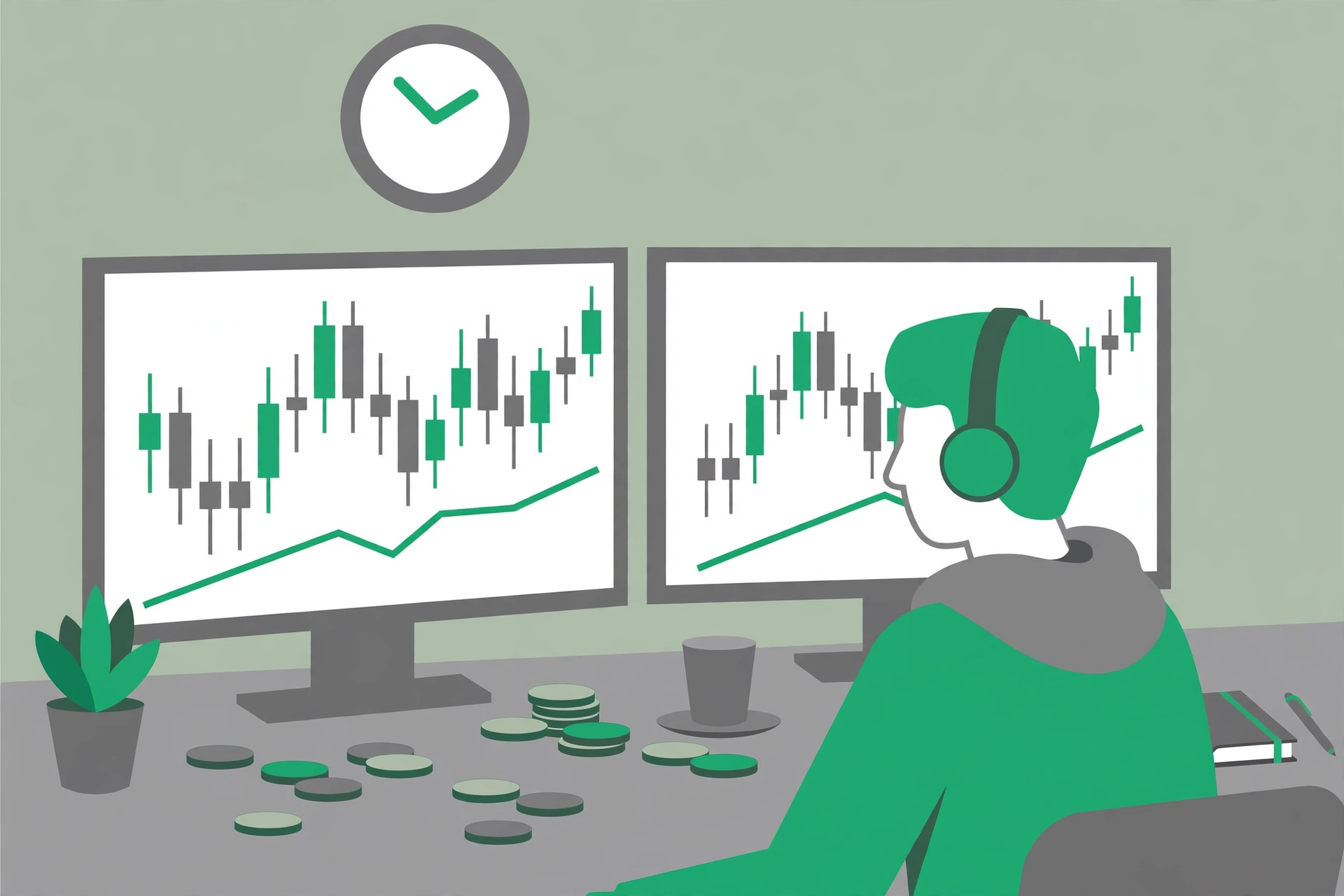
Day trading is the practice of buying and selling a cryptocurrency within the same day, with the aim of profiting from short-term price movements. A day trader might buy Bitcoin in the morning because they think it will rise by a few percent by the afternoon, and then sell it before the day ends. They might do this several times a day, trading different coins, and they usually close all of their positions before they go to sleep, so they are not holding anything overnight.
Day traders use tools and techniques that long-term investors rarely need. They study price charts, looking for patterns in how prices have moved in the past, and they use indicators, which are calculations based on price and trading volume, to help them decide when to buy and sell. They set stop-loss orders, which automatically sell a coin if its price falls to a certain level, to limit their losses, and take-profit orders, which automatically sell if the price rises to a certain level. They also pay close attention to news, because a single announcement, a regulatory decision, or a large sell-off can move prices sharply in minutes.
Some day traders use leverage, which means borrowing money to trade with more than they actually own. Leverage can multiply profits, but it can also multiply losses, and it can wipe out an entire account in minutes if the price moves against the trader. Beginners should treat leverage with extreme caution, and many experienced traders will tell you to avoid it entirely until you understand the risks. Our guide to how to read crypto price charts explains the basics of charts and candlesticks, which is a useful starting point if you want to understand what traders are looking at, even if you never trade yourself.
Day trading is also a matter of temperament. It requires making quick decisions under pressure, accepting losses without letting them affect your next decision, and sticking to a plan even when your emotions are telling you to do the opposite. Many people find that much harder than they expect, and it is one of the main reasons beginners lose money.
What Is Long-Term Crypto Investing?
Long-term investing, sometimes called holding, is the practice of buying a cryptocurrency and keeping it for months or years, because you believe its value will increase over time. A long-term investor might buy Bitcoin or Ethereum, store it in a secure wallet, and check the price occasionally, rather than watching it every hour. They are not trying to profit from the price movement of a single day. They are betting on the long-term future of the asset.
Long-term investors still need to do research, but the research is different. Instead of studying charts, they study the project behind the coin: what problem it solves, who is building it, how its token works, whether it has real users, and what its competition looks like. Our guide to how to read a crypto whitepaper explains how to look at a project’s own documents and ask the right questions. A long-term investor also needs to understand how the token’s supply works, who holds a large share of it, and what could go wrong over a period of years, not just days.
One common long-term strategy is dollar-cost averaging, which means buying a fixed amount of a cryptocurrency at regular intervals, such as every week or every month, regardless of the price. The idea is that you buy more when the price is low and less when the price is high, which smooths out the effect of short-term price swings, and it removes the need to try to time the market. It does not guarantee a profit, and it does not protect you if the coin loses most of its value over the long term, but it is a disciplined approach that suits people who do not want to watch prices every day.
Long-term investing is not risk-free, and it is not passive in the sense of doing nothing. It requires the discipline to hold through large falls, which crypto experiences regularly, and the willingness to review your investment from time to time and to sell if the reasons you bought it no longer hold. It also requires secure storage, because holding crypto for years means keeping it safe for years, and our guide to choosing a crypto wallet explains the options.
The Key Differences at a Glance
The simplest way to compare the two approaches is to look at them side by side. Day trading is about hours and minutes. Long-term investing is about months and years. Day trading requires constant attention and fast decisions. Long-term investing requires patience and the ability to ignore short-term noise. Day trading involves many trades, each with its own fees, and the costs add up quickly. Long-term investing involves few trades, and the fees are a much smaller part of the total return.
The risks are also different. A day trader can lose money quickly, through a series of bad trades in a single day, and the use of leverage can turn a small mistake into a large loss. A long-term investor can lose money slowly, by holding a coin that gradually loses value, or suddenly, by holding through a market crash and selling at the bottom in a panic. Both approaches can lead to losses, but the way those losses happen is very different.
The skills are different too. Day trading requires technical analysis, an understanding of market psychology, and the ability to manage risk on every trade. Long-term investing requires fundamental research, an understanding of how a project works, and the emotional discipline to hold through volatility. Neither set of skills is easy to learn, but day trading is generally considered harder, because it requires you to be right, repeatedly, in the short term, which is much harder than being right about a long-term trend.
Finally, the tax and record-keeping implications are different. In many countries, every trade you make is a taxable event, which means a day trader who makes hundreds of trades a year has a much more complicated tax situation than a long-term investor who buys once and sells once. Our guide to crypto taxes for beginners explains what to track and why it matters, and it is worth reading before you start trading frequently.
How Much Time Does Each Approach Take?
Time is one of the most practical differences between day trading and long-term investing, and it is often the one beginners underestimate. Day trading is a full-time activity. A serious day trader spends hours a day watching charts, reading news, and managing trades, and they need to be available during the hours when the market is most active. Crypto markets never close, which means there is always something happening, but it also means a day trader can feel as if they can never switch off. Many beginners start day trading in their spare time, and discover that they cannot keep up with the market, that they miss important moves, and that they make worse decisions when they are tired or distracted.
Long-term investing, by contrast, takes very little time once you have done your initial research. You might spend a few hours a month reviewing your holdings, reading news about the projects you own, and deciding whether to buy more or to sell. You do not need to watch prices every day, and you do not need to be available at a particular hour. That makes it far more realistic for someone with a job, a family, or other commitments, and it is one of the main reasons it is usually recommended as a starting point for beginners.
That does not mean long-term investing takes no time at all. You still need to do your research before you buy, and you still need to keep up with the projects you own, because a coin that looked promising two years ago may not look promising today. But the time commitment is measured in hours per month, not hours per day, and that difference matters more than most beginners realise.
The Costs: Fees, Spreads, and Slippage
Every trade costs money, and those costs matter more for day traders than for long-term investors. When you buy or sell crypto on an exchange, you usually pay a trading fee, which is a percentage of the trade. You may also pay a spread, which is the difference between the price at which you can buy and the price at which you can sell, and slippage, which is the difference between the price you expected and the price you actually got, because the price moved while your order was being processed.
For a long-term investor who buys once and sells once, these costs are a small part of the total return. For a day trader who makes many trades a day, they add up quickly. A trader who makes ten trades a day, each with a small fee, can easily pay more in fees over a month than they make in profits, even if many of their trades are successful. That is one reason why day trading is so hard: you need to make enough profit to cover your costs, as well as to cover your losses, before you make any money at all.
There are also other costs. A day trader may pay for charting tools, data feeds, or a faster internet connection, and they may spend money on courses or subscriptions that promise to teach them to trade. Some of those are legitimate, but many are not, and beginners should be sceptical of anyone who charges a large fee to teach a strategy that supposedly guarantees profits. If a strategy really worked that well, the person selling it would be using it to trade, not selling it to you.
The Emotional Side: Fear, Greed, and FOMO
Both day trading and long-term investing are emotional, but day trading is emotional in a more intense and more immediate way. A day trader watches prices move minute by minute, and every small movement feels important. When a trade goes well, the temptation is to risk more, to trade bigger, and to believe you have found a winning strategy. When a trade goes badly, the temptation is to chase the loss, to make a bigger trade to win the money back, and to abandon your plan in the hope of a quick recovery. This is known as revenge trading, and it is one of the most common ways beginners lose money.
Long-term investors face different emotions. The hardest part is holding through a crash, when the value of your investment has fallen sharply and everyone around you is selling. It is easy to say you will hold for years, and much harder to do it when your portfolio has lost half its value in a few weeks. Our guide to surviving a crypto bear market explains what a bear market is, why it happens, and how investors have coped with them in the past. It is worth reading before you invest, so you know what to expect.
Fear of missing out, or FOMO, affects both groups. A day trader sees a coin rising sharply and buys it, only to watch it fall. A long-term investor sees a coin rising sharply and buys it at the top, because they are afraid they will miss out on further gains. In both cases, the emotion is the same, and the result is often the same: buying high, and then watching the price fall. The best defence against FOMO is to have a plan before you buy, and to stick to it, rather than making decisions based on what you see on social media.
Why Most Day Traders Lose Money
It is a widely repeated claim in trading that most day traders lose money, and while the exact figures vary by market and by study, the general pattern is consistent: a large majority of people who try day trading do not make a profit, and many lose a significant amount. There are several reasons for this, and they are worth understanding before you start.
The first reason is that the market is hard to predict in the short term. Prices move for many reasons, including news, large trades by other participants, and random noise, and it is very difficult to know in advance which way a price will move in the next hour. Even professional traders with years of experience and access to sophisticated tools get many of their trades wrong. A beginner, with limited experience and limited tools, is at a significant disadvantage.
The second reason is that day traders are competing against professionals. The crypto market includes hedge funds, trading firms, and experienced individuals who trade full time, with faster systems, better data, and more capital than a beginner. When you place a trade, you are, in effect, betting that you know something they do not, or that you can act faster than they can. That is possible, but it is not easy, and it is not a fair fight.
The third reason is costs. As explained above, every trade costs money, and a day trader who trades frequently needs to make a profit that covers those costs before they make any money at all. That is a significant hurdle, and it is one that many beginners do not factor into their calculations.
The fourth reason is psychology. Day trading requires discipline, emotional control, and the ability to accept losses without letting them affect your next decision. Most people find that much harder than they expect, and they make mistakes when they are tired, stressed, or emotional. Those mistakes compound, and they are often the difference between a trader who breaks even and a trader who loses money.
None of this means day trading is impossible, or that no one makes money from it. Some people do, and they usually have years of experience, a clear strategy, and strict risk management. But for a beginner, the honest message is that day trading is one of the hardest ways to make money in crypto, and you should not expect to be profitable quickly, if at all.
What Long-Term Investing Gets Wrong
Long-term investing is often presented as the safe option, but it has its own risks, and beginners should understand them. The biggest risk is that the coin you buy may never recover. Crypto history is full of coins that were popular for a while, and then faded away, losing most of their value and never coming back. Bitcoin and Ethereum have survived multiple market cycles, but most other coins have not, and many have disappeared entirely. Our guide to crypto vs stocks explains how crypto differs from traditional investments, and why its long-term risks are different.
Another risk is that long-term investing can become passive in a bad way. Some investors buy a coin, stop paying attention, and only discover years later that the project has failed, the team has left, or the technology has been overtaken. Long-term investing does not mean buying and forgetting. It means buying and reviewing, from time to time, whether the reasons you bought still hold.
A third risk is volatility. Even if a coin eventually rises in value, it may fall sharply in the meantime, and many investors sell at the bottom because they cannot bear the loss. That is not a failure of the investment, it is a failure of temperament, but it is a real risk, and it is one that affects long-term investors as much as day traders.
Finally, long-term investing does not protect you from scams. A coin that looks like a good long-term investment may turn out to be a fraud, and by the time you discover that, it may be too late. Our guide to spotting crypto scams explains the red flags to watch for, including unrealistic promises, anonymous teams, and pressure to buy quickly. Those red flags apply to long-term investments just as much as to short-term trades.
Risk Management: The Part Beginners Skip
Whether you trade or invest, risk management is the most important part of the process, and it is the part beginners most often skip. Risk management means deciding, in advance, how much you are willing to lose, and then sticking to that limit. For a day trader, that might mean setting a stop-loss on every trade, and deciding how much of your total capital you will risk on any single trade. For a long-term investor, it might mean deciding how much of your savings you will put into crypto in total, and how much you will put into any single coin.
A common rule, used by many traders and investors, is to never risk more than a small percentage of your total capital on a single trade or a single coin. That way, even if you are wrong several times in a row, you still have capital left to continue. Another common rule is to never invest money you cannot afford to lose. That sounds obvious, but many beginners ignore it, investing money they need for rent, bills, or emergencies, and then finding themselves in a difficult position when the price falls.
Risk management also means diversification, which is the practice of not putting all of your money into a single coin. A long-term investor might hold several different coins, or hold a mix of crypto and other assets, so that the failure of one coin does not wipe out their entire investment. Diversification does not eliminate risk, and it does not guarantee a profit, but it reduces the risk that a single bad decision will be catastrophic.
Finally, risk management means having a plan for when to sell. A day trader should know, before they enter a trade, at what price they will sell if they are wrong, and at what price they will sell if they are right. A long-term investor should know, before they buy, under what conditions they would sell, whether that is because the project has failed, because they need the money, or because they have reached a target. Having a plan in advance makes it easier to make a rational decision when emotions are running high.
Common Beginner Strategies, Explained Honestly
Beginners often come across named strategies, and it helps to know what they are and what their limits are. One is trend following, which means buying a coin when its price is rising, and selling it when it starts to fall. The idea is to ride the trend, rather than trying to predict when it will reverse. It sounds simple, but in practice, it is hard to know when a trend is starting and when it is ending, and many trend followers buy near the top and sell near the bottom.
Another is range trading, which means buying a coin when its price is low within a range, and selling it when its price is high within the same range. This works when a price is moving sideways, but it fails when the price breaks out of the range, either up or down, and the trader is caught on the wrong side.
Another is scalping, which means making many very small trades, each aiming for a tiny profit, and relying on volume to make the profits add up. Scalping requires speed, low fees, and constant attention, and it is one of the hardest strategies for a beginner to make work.
For long-term investors, a common strategy is dollar-cost averaging, which was explained above, and another is buy and hold, which means buying a coin and holding it for years, regardless of short-term price movements. Both are simpler than day trading strategies, but they still require discipline and patience, and they still carry the risk that the coin you hold loses value over the long term.
None of these strategies guarantees a profit, and anyone who tells you that a particular strategy is a sure thing is not telling you the truth. The value of understanding them is not to find a winning formula, but to understand what traders are doing, and to avoid being misled by claims that a simple strategy can make you rich.
Which Approach Suits You?
The right approach depends on your time, your temperament, and your goals. If you have a full-time job, limited time, and a low tolerance for stress, day trading is probably not a good fit. If you enjoy studying charts, you can spend hours a day on the market, and you are comfortable with frequent losses and fast decisions, day trading might suit you, but you should still start small, learn slowly, and expect to lose money while you learn.
If you are patient, you can tolerate large price swings, and you are interested in the long-term future of a project rather than the price movement of a single day, long-term investing is likely to be a better fit. It is simpler, less time-consuming, and less stressful, but it still requires research, discipline, and a willingness to accept that your investment may lose value.
A third option, which many beginners find useful, is to start with long-term investing, and to learn about trading slowly, without risking real money. Some exchanges offer practice accounts, sometimes called paper trading, where you can trade with virtual money and learn how the market works without risking your savings. That is a sensible way to learn, because it lets you make mistakes without paying for them, and it gives you a realistic sense of how hard trading really is before you commit real money.
Whatever you choose, start small. Do not put a large amount of money into crypto until you understand what you are doing, and do not borrow money to trade or invest. The most common mistake beginners make is not choosing the wrong approach, but choosing the right approach and then risking too much money on it, too soon.
Frequently Asked Questions
Is crypto day trading profitable for beginners?
For most beginners, no. Day trading is very difficult, most people who try it lose money, and it takes months or years of practice to become consistently profitable. Beginners should expect to lose money while they learn, and should never trade with money they cannot afford to lose.
Is long-term crypto investing safer than day trading?
Long-term investing is generally simpler and less time-consuming than day trading, and it avoids the costs of frequent trading, but it is not safe. Crypto prices are volatile, many coins lose most of their value over time, and a long-term investor can still lose a large amount if they buy the wrong coin or sell at the wrong time.
How much money do I need to start day trading crypto?
You can start with a small amount, and you should. Many beginners start with an amount they can afford to lose completely, and treat it as the cost of learning. There is no minimum that guarantees success, and starting with a large amount does not make you more likely to profit.
How much time does day trading take?
Serious day trading takes several hours a day, and requires you to be available during active market hours. It is a full-time activity for most successful traders, and it is difficult to do well in your spare time.
What is dollar-cost averaging?
Dollar-cost averaging means buying a fixed amount of a cryptocurrency at regular intervals, such as every week or month, regardless of the price. It smooths out the effect of short-term price swings, and it removes the need to try to time the market, but it does not guarantee a profit.
Do I pay tax on crypto day trading?
In many countries, every trade is a taxable event, which means a day trader who makes many trades has a much more complicated tax situation than a long-term investor. Tax rules vary by country, so check the rules where you live, and keep records of every trade.
Can I do both day trading and long-term investing?
Yes, some people do both, keeping a long-term portfolio that they rarely touch, and a separate, smaller amount for trading. If you do this, keep the two separate, and do not use money from your long-term portfolio to cover trading losses.
What is the biggest mistake beginners make?
The biggest mistake is risking too much money, too soon, on an approach they do not yet understand. Whether you trade or invest, start small, learn slowly, and never invest money you need for essential expenses.
Is leverage a good idea for beginners?
No. Leverage multiplies both profits and losses, and it can wipe out an account in minutes. Beginners should avoid leverage entirely until they fully understand how it works and have experience trading without it.
How do I learn to trade without losing money?
Use a practice account, sometimes called paper trading, where you trade with virtual money. Read guides to charts and risk management, study how the market works, and take your time. There is no shortcut to experience.
Conclusion
Crypto day trading and long-term investing are not two speeds of the same activity. They are different activities, with different skills, different costs, different time demands, and different risks. Day trading is fast, intense, and expensive, and most people who try it, especially beginners, lose money. Long-term investing is slower, simpler, and less time-consuming, but it is still risky, because crypto prices are volatile and many coins lose value over time.
For most beginners, long-term investing is the more sensible starting point, because it is easier to learn, easier to fit around a job and a life, and less likely to lead to the kind of rapid losses that day trading can produce. If you are drawn to day trading, start by learning, practise with virtual money, and only risk real money when you understand what you are doing, and only an amount you can afford to lose.
Whichever approach you choose, do your own research, manage your risk, and be honest with yourself about how much time and stress you are willing to take on. Read our guide to how to buy crypto safely before any purchase, learn how to read crypto price charts if you want to understand what traders are looking at, and remember that in crypto, as in any market, there are no shortcuts. The people who last are not the ones who make the fastest profits. They are the ones who manage their risk, learn from their mistakes, and stay in the market long enough to learn how it really works.