What Is Dogecoin? Meme Coins Explained, With the Risks Beginners Must Know
What Is Dogecoin? Meme Coins Explained, With the Risks Beginners Must Know
Important risk warning: cryptocurrency is highly volatile, and you can lose everything you invest. Meme coins are more volatile than most cryptocurrencies, and many of them lose almost all of their value. Nothing in this article is financial advice. Never invest money you cannot afford to lose, and never borrow money to buy crypto. That warning is not boilerplate here — it is the single most important thing in this article, because meme coins are the corner of crypto where beginners lose money fastest, and usually for reasons that were visible in advance.
Dogecoin is the original meme coin, and its story is genuinely funny — which is part of the problem. It began as a joke, became a cultural phenomenon, made some early holders a great deal of money, and then taught a very large number of later buyers a painful lesson about hype. Understanding Dogecoin means understanding both halves of that story: why people love it, and why loving something is not a reason to invest in it.
The Origin Story: A Joke That Escaped
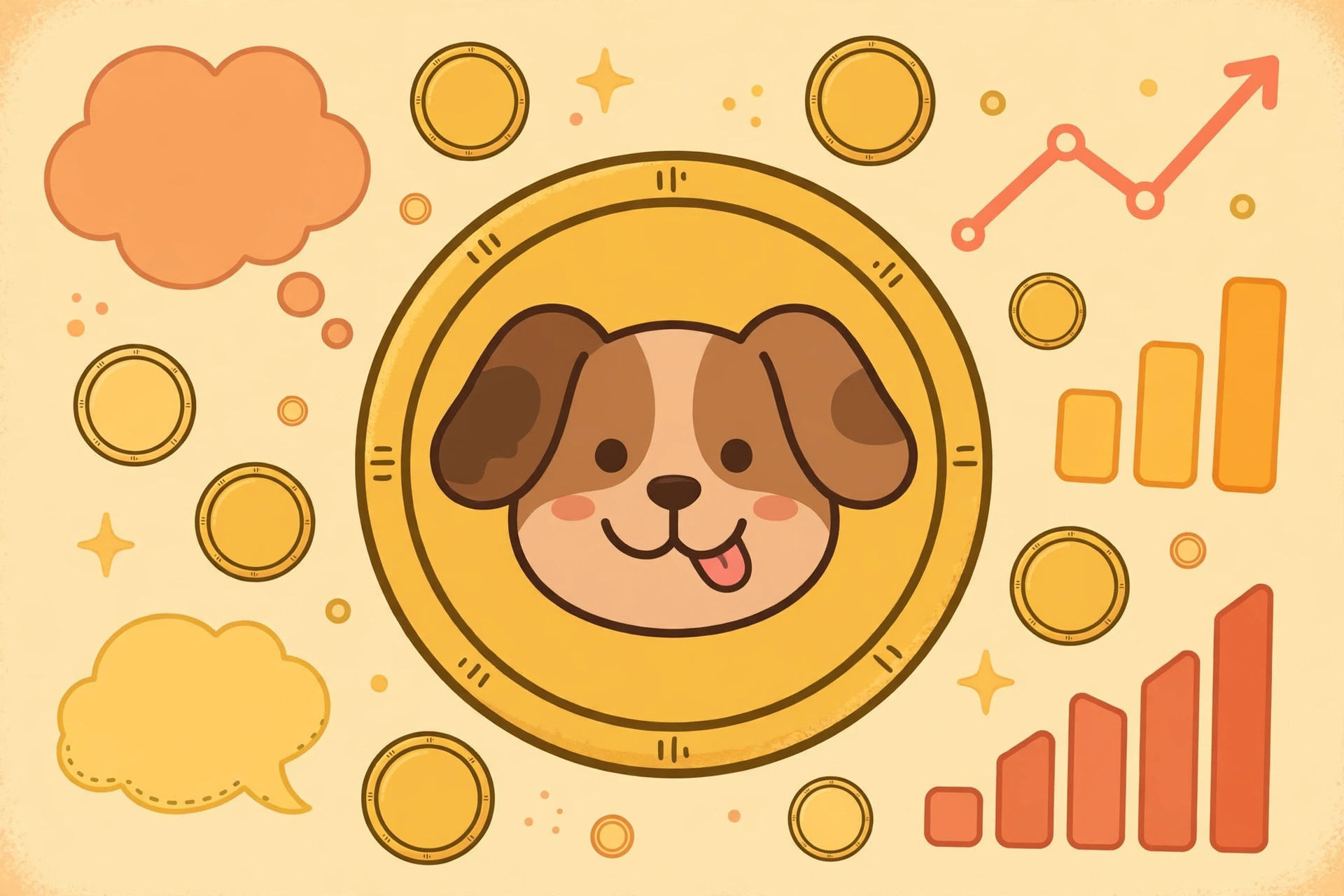
Dogecoin was created in late 2013 by two software engineers, Billy Markus and Jackson Palmer, as a lighthearted alternative to the increasingly serious world of Bitcoin. The joke had several layers. The name and mascot came from the “Doge” meme — a Shiba Inu dog with captions written in broken English, like “such wow” and “very currency” — which was hugely popular online at the time. The coin’s branding was deliberately silly, its community was deliberately friendly, and its early culture was built around tipping: users on forums and social media would tip each other small amounts of Dogecoin as a way of saying thanks, the way you might buy someone a coffee.
That friendliness became Dogecoin’s real identity. While much of crypto culture was competitive and technical, the Dogecoin community raised money for charitable causes, sponsored a NASCAR race car, and helped send the Jamaican bobsled team to the Winter Olympics. It was, for a long time, a small, self-aware community that knew it was a joke and enjoyed the joke.
Technically, Dogecoin is a real cryptocurrency with its own blockchain. It was built by adapting the code of an earlier coin, which itself was adapted from Bitcoin’s code, so it works on familiar principles: transactions are recorded on a public ledger, new coins are created through mining, and anyone can send DOGE to anyone else. Unlike Bitcoin, Dogecoin has no maximum supply cap — new coins are created continuously. That is a meaningful difference: a coin with an endlessly growing supply faces constant downward pressure on its value from new issuance, unless demand keeps growing to absorb it. It is one of the first things a sceptical beginner should notice about any coin, and it applies to Dogecoin and to most of its imitators.
What Are Meme Coins?
A meme coin is a cryptocurrency whose value is driven primarily by internet culture, jokes, community enthusiasm, and social media attention, rather than by a distinctive technology or a real-world use. Dogecoin is the original, but thousands have followed, usually launched quickly and cheaply on blockchains where creating a token costs almost nothing. They tend to share a pattern: a funny name or mascot, a low price per coin that makes buying millions of them feel exciting, a community that rallies around the joke, and a price chart that depends almost entirely on attention.
That low price per coin deserves a pause, because it misleads beginners more than almost anything else in crypto. A coin priced at a fraction of a cent is not “cheap” in any meaningful sense, and a coin priced at a large amount is not “expensive”. What matters is the total value of all coins in existence, and how many coins there are. Buying a million units of a coin with a trillion units in circulation is not the same as buying a small number of units of a scarce coin. Beginners who chase “cheap” coins because they can own millions of them are being fooled by arithmetic, not finding a bargain. Always look at the total supply and the total market value, not the price of one coin in isolation.
Meme coins also differ from other cryptocurrencies in what backs their price. A coin like Bitcoin has a long track record, a fixed supply, and a large network of holders. A platform coin like ETH is needed to pay fees on a network people actually use. A meme coin’s price, by contrast, is backed mainly by belief and attention: as long as people are talking about it, buying it, and posting about it, the price can rise; when attention moves elsewhere, there is often nothing underneath to slow the fall. That is why meme coins can deliver spectacular short-term gains and devastating losses, sometimes to the same people in the same month.
Why Meme Coins Are Extra Volatile
Volatility is normal in crypto, but meme coins take it to another level, for several structural reasons. First, they are overwhelmingly driven by sentiment. A single viral post, a celebrity mention, or a trending hashtag can send a meme coin’s price soaring in hours, and the same attention can vanish just as fast. Prices driven by attention are inherently unstable, because attention is the most fickle resource on the internet.
Second, meme coin ownership is often highly concentrated. The people who create a coin, and their early associates, frequently hold a large share of the total supply. When a few wallets control a large proportion of a coin, those holders can move the price dramatically by selling, and ordinary buyers have no way of knowing when that will happen. Checking how concentrated a coin’s ownership is — something a block explorer can show you — is one of the most useful sceptical habits a beginner can build.
Third, meme coins usually have thin liquidity. That means there are not many buyers and sellers at any given moment, so even a moderately sized trade can swing the price sharply. A coin that doubled in a day can halve the next day on far less trading than you might expect, and during a panic, you may find that you cannot sell at anything close to the price you saw quoted, because there are simply not enough buyers.
Fourth, new meme coins are launched constantly, and attention is a zero-sum game. Today’s viral coin is tomorrow’s forgotten one, because the internet’s capacity for jokes is infinite and its attention span is short. A coin that depends on being the joke of the moment has an expiry date built into its design, even if nobody admits it at the time.
Finally, meme coins attract manipulation. Because they are cheap to create and often lightly traded, they are easy targets for “pump and dump” schemes, in which a group quietly buys a coin, hypes it loudly to attract buyers, and then sells into the rising price, leaving late buyers holding a collapsing asset. Social media makes this easier than ever: coordinated posts, fake testimonials, and bought followers can make a dying coin look like the next big thing for exactly long enough to sell into.
Hype and Social Media: The Engine of Meme Coins
No honest guide to meme coins can skip social media, because social media is where meme coins live. Dogecoin’s biggest price surges were driven not by technological announcements but by waves of online enthusiasm — forum threads, viral posts, and celebrity endorsements that turned a joke coin into a household name. That history is often told as a success story. It is more accurately a story about timing: the people who bought early, before the hype, sometimes profited enormously, while the people who bought at the peak of the hype, after seeing the headlines, often bought at the worst possible moment.
This pattern has a name in investing: buying high because everyone else is buying, and selling low because everyone else is selling. Social media amplifies it, because it shows you the winners and hides the losers. You see the posts from people celebrating gains; you do not see the far larger number of people who quietly lost money and stopped posting. You see screenshots of profits; you do not see the full picture of what those people risked, or whether they sold at all. Survivorship bias — the habit of learning only from the visible winners — is the most expensive cognitive trap in meme coins.
Celebrity endorsements deserve special scepticism. A famous person posting about a coin is not doing research on your behalf. They may hold the coin themselves, they may be paid to promote it, or they may simply be joining a joke. Their post is not evidence about the coin’s future, and in some cases it is the signal that the hype cycle is near its peak — the moment when early holders are looking for new buyers to sell to. If your reason for buying a coin is that someone famous mentioned it, you do not have a reason; you have a reaction.
The same logic applies to online communities. A lively, enthusiastic community is not evidence of value. Communities can be bought, faked, or simply wrong, and the most enthusiastic communities are often the ones most invested in keeping the price up, because their own holdings depend on new buyers arriving. Enthusiasm is a social signal, not a financial one. Treat it accordingly.
Scams in the Meme Coin World
Meme coins are surrounded by scams, and beginners are the primary targets. The most dangerous is the rug pull: the creators of a coin hype it, attract buyers, and then drain the trading pool or sell their large holdings, collapsing the price and disappearing. Rug pulls are especially common with newly launched meme coins, because creating one is cheap, anonymous, and largely unregulated. Our guide to spotting crypto scams and rug pulls covers the warning signs in detail, and they apply here with full force.
Copycat coins are another constant threat. When a meme coin becomes popular, dozens of imitations appear with nearly identical names, logos, and websites, designed to catch buyers who mistype an address or click the wrong link. Always verify a token’s contract address from an official source — the project’s own verified channels, not a random post — before buying, and be suspicious of any coin whose name is a slight variation on a famous one.
Fake airdrops and giveaway scams are everywhere in meme coin communities. A post claims you have won free tokens, or that a celebrity is doubling any crypto sent to a particular address. Both are lies. No legitimate project asks you to send crypto to receive more crypto, and no genuine giveaway asks for your wallet’s recovery phrase. The moment a message asks for either, it is a scam, whatever name or logo it wears.
How to Evaluate Any Meme Coin Sceptically
If you still want to understand a meme coin — as a cultural phenomenon, or because you are considering a small, speculative amount you can afford to lose entirely — here is a sceptical checklist. Work through it before spending anything, and be honest with yourself about the answers.
First, ask what the coin actually does. If the honest answer is “nothing, it is a joke”, then its value depends entirely on continued attention, and you should treat it as a gamble, not an investment. Second, check the supply: is there a cap, or are new coins created endlessly? Is a large share held by a few wallets? Third, look at liquidity: can you actually sell a meaningful amount without crashing the price? Fourth, investigate the creators: are they known, or anonymous? Is there a real team, or just a social media account? Fifth, read the project’s own materials critically — our guide to reading a crypto whitepaper teaches you to spot vague promises, missing technical detail, and claims that do not add up. Sixth, look for independent evidence: is anyone using this coin for anything other than trading it? If the only activity is buying and selling in the hope of a price rise, the coin is a pure speculation vehicle, and its price is a popularity contest.
Finally, and most importantly, decide your exposure before you buy, not after. If you choose to put money into a meme coin, decide in advance the maximum amount you are willing to lose completely, and treat that amount as already gone the moment you buy. Never increase your stake because the price rose — that is how small gambles become large losses — and never borrow money, use rent money, or dip into savings for a meme coin. The moment a meme coin stops being fun money and starts being money you need, you have already made the mistake.
Dogecoin Itself: What Is Fair to Say?
For all the scepticism above, Dogecoin is not the worst thing in crypto. It is old by crypto standards, it has survived multiple market cycles, it has a large and genuinely enthusiastic community, and it is accepted as payment by some merchants. Its longevity sets it apart from the thousands of meme coins that vanished within weeks. That longevity is worth something — but it is not a guarantee of anything. Dogecoin’s price remains extremely volatile, its supply grows indefinitely, and its value still depends heavily on attention and sentiment. Surviving is not the same as thriving, and being famous is not the same as being a sound investment.
Frequently Asked Questions
Is Dogecoin a joke or a real cryptocurrency?
Both. It began as a joke in 2013, but it runs on a real blockchain, can be sent and received like any cryptocurrency, and has survived for over a decade. Its joke origins do not make it fake — but they do explain why its value depends so heavily on culture and attention.
What exactly is a meme coin?
A cryptocurrency whose value is driven mainly by internet culture, jokes, community enthusiasm, and social media attention, rather than by distinctive technology or real-world use. Dogecoin is the original; thousands of imitators have followed.
Why do meme coins go up and down so violently?
Because their prices depend on attention, which is fickle; because ownership is often concentrated in a few hands; because trading is thin, so small trades move the price; and because new meme coins constantly compete for the same attention.
Is a coin priced at a fraction of a cent a bargain?
No. The price of one coin means nothing on its own. What matters is the total supply and the total value of all coins. A coin with trillions of units in circulation is not cheap just because one unit costs almost nothing.
What is a rug pull?
A scam in which a coin’s creators hype it, attract buyers, and then drain its trading pool or sell their large holdings, collapsing the price and disappearing with the funds. Rug pulls are common among newly launched meme coins.
Can a celebrity endorsement make a meme coin safe?
No. Endorsements are not research, and endorsers may hold the coin, be paid to promote it, or simply be joining a joke. A celebrity post is often a sign that hype is peaking, not that the coin is sound.
Should beginners buy meme coins?
This article is not financial advice, and the honest answer is that most beginners should not. If you choose to, only use money you can afford to lose completely, work through the sceptical checklist above, and never borrow or use money you need.
Conclusion
Dogecoin’s story is a great one: a joke coin, a friendly community, a cultural phenomenon that outlived almost every serious project of its era. But the lesson of Dogecoin is not “jokes make money”. It is that attention is powerful, temporary, and dangerous to chase. Meme coins are the purest form of attention-driven speculation in crypto: thrilling when attention arrives, brutal when it leaves, and surrounded by scams designed to catch people who arrive late. If you remember one thing from this guide, make it this: never invest in a meme coin because everyone is talking about it. By the time everyone is talking about it, the people who profited most have usually already arrived — and they are often the ones selling to you.