Baccarat Strategies Explained for Thai Beginners: What Works and What Does Not
Baccarat looks like a game for high rollers in evening dress, but underneath the glamour it is one of the simplest casino games ever made. You do not play the cards yourself, you do not make complicated decisions, and you do not need to memorise anything to sit down at the table. You simply bet on one of three outcomes: the Player hand wins, the Banker hand wins, or the two hands tie.
That simplicity has not stopped an entire industry of “winning systems” growing up around the game. Books, videos and paid courses promise to crack baccarat with pattern charts, progressive betting and secret sequences. This guide separates what genuinely helps from what only feels like it helps, so a beginner can play with clear eyes.
How Baccarat Actually Works
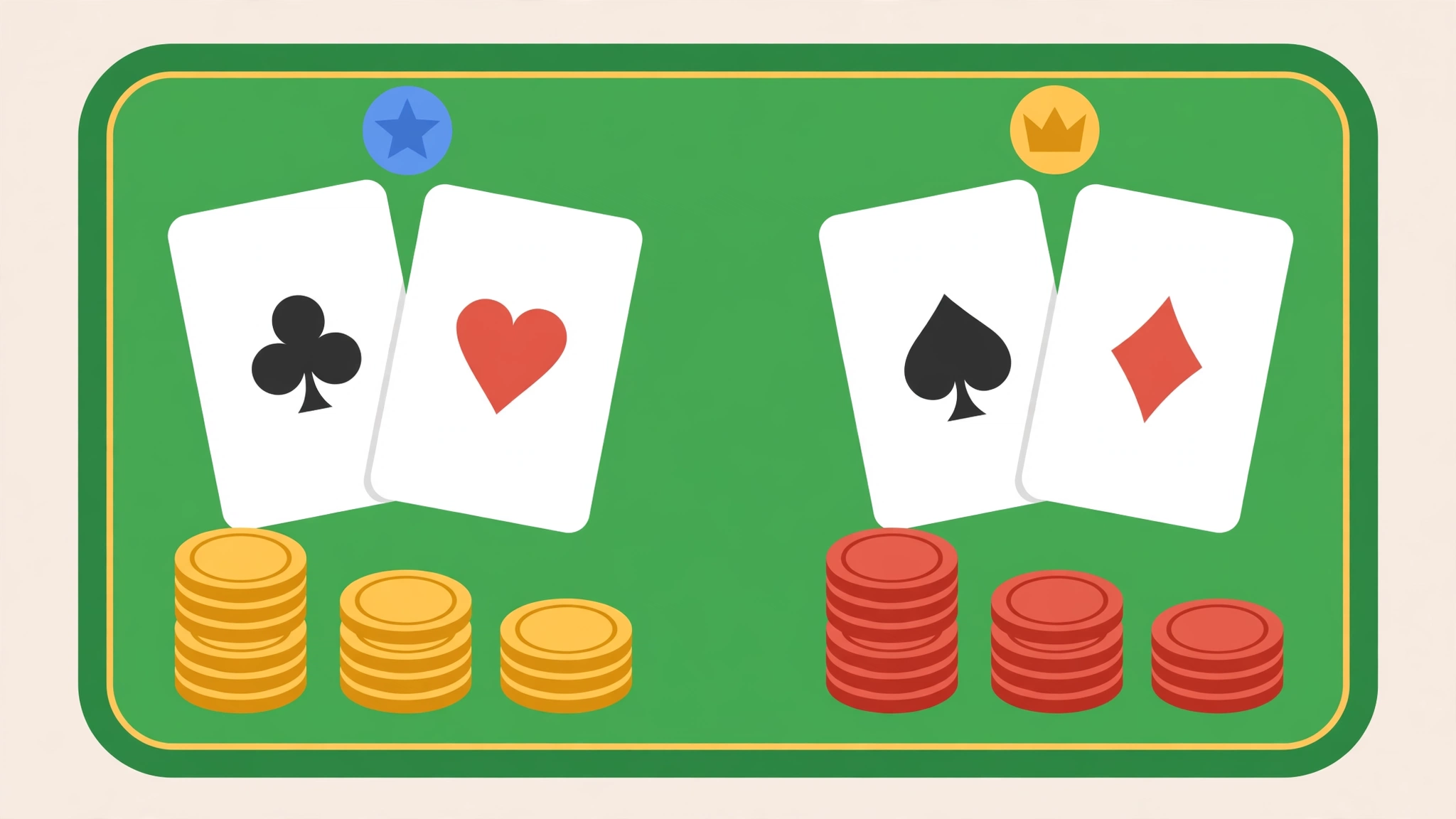
Two hands are dealt: Player and Banker. Each hand receives two cards, sometimes a third according to fixed drawing rules. Cards are worth their face value, tens and picture cards count as zero, and only the last digit of the total matters — so a hand of 7 and 8 totals 15, which counts as 5. The hand closest to 9 wins.
The crucial point for strategy is that you do not control the drawing rules. The dealer follows a fixed table that decides when a third card is drawn, and you cannot hit, stand, split or fold. Your only real decision is which outcome to bet on, and how much to stake. That is a much smaller decision space than poker or blackjack, and it limits how much strategy can possibly matter.
The three bets carry very different house edges. The Banker bet wins slightly more often than the Player bet, because the Banker hand acts last under the drawing rules, and the casino charges a commission — usually 5% — on Banker wins to balance this out. Even after commission, the Banker bet has the lowest house edge of the three, at roughly 1.06%. The Player bet sits at roughly 1.24%. The Tie bet, despite its tempting payout of 8 to 1 or 9 to 1, carries a house edge of around 14%, which makes it one of the worst bets in the entire casino. Knowing just these three numbers already puts you ahead of most casual players.
If you are new to casino games generally, our guide to how casino house edge works explains where these percentages come from and why they matter more than any betting system.
Legal Status in Thailand — Read This First
Gambling is largely prohibited in Thailand. Under the Gambling Act B.E. 2478 (1935), most forms of gambling are illegal, and the only well-known legal exceptions are the government lottery and licensed horse racing at approved racecourses. Online casinos are not licensed in Thailand, and websites offering real-money casino games to people in Thailand operate outside Thai law.
That has practical consequences: an unlicensed site offers no Thai consumer protection if it refuses to pay out, freezes an account or disappears, and Thai authorities periodically block gambling websites and payment channels. Money sent to an offshore platform can simply be lost with no realistic way to recover it.
This article is educational and informational only — it explains how baccarat works because readers ask about it, not to encourage anyone to break local law. Casino games are for adults only (18+), there are no guaranteed winnings in any game, and over time the maths and the fees charged by operators favour the house. Never chase losses, never gamble with borrowed money or money needed for living costs, and if gambling stops being fun, free and confidential help is available from BeGambleAware and Gamblers Anonymous.
The One Strategy That Actually Matters: Bet Banker
If there is a single piece of baccarat strategy worth remembering, it is this: bet on Banker, most of the time. This is not a secret and it is not exciting, which is exactly why it gets ignored in favour of flashier systems. The Banker bet wins about 45.8% of hands, compared with about 44.6% for Player, with ties making up the rest. After the standard 5% commission, the Banker bet still loses less money per hand on average than any other bet on the table.
Some players avoid Banker because paying commission feels like losing, or because they dislike betting on the same outcome repeatedly. That is understandable, but it is a feeling, not a strategy. Over a long session, the maths quietly favours the player who mostly bets Banker and never bets Tie.
Flat betting on Banker — staking the same amount on every hand — is the most honest approach to the game. It keeps your session predictable, it minimises your expected loss, and it removes the temptation to chase losses with bigger stakes. It will not make you rich. Nothing at the baccarat table will, reliably. But it is the least bad way to play a negative-expectation game.
Betting Systems: Martingale, Paroli and Friends
The Martingale system — doubling your stake after every loss — is frequently sold as a baccarat strategy. It fails in baccarat for the same reason it fails everywhere else: stakes grow exponentially, table limits cap your recovery, and your bankroll is finite. A run of eight consecutive losses turns a one-unit starting bet into a 256-unit bet, all to win a single unit of profit. Losing streaks of that length happen regularly over a long session.
The Paroli system works in the opposite direction: you double after wins and return to your base stake after a loss or after three consecutive wins. It feels safer because you are mostly risking the casino’s money during a winning streak. In reality, Paroli simply reshapes your results — many small losses punctuated by occasional larger wins — without changing the average. The house edge applies to every hand regardless of the order in which you stake.
The 1-3-2-4 system is another popular progression. You stake one unit, then three, then two, then four, moving forward after each win and back to the start after a loss. It is less aggressive than Martingale and it gives a session a sense of structure, which many players enjoy. But structure is not advantage. Over thousands of hands, any progression system’s expected result converges on the same figure: your total amount staked multiplied by the house edge of the bets you placed.
The honest summary is that betting systems change the shape of your wins and losses, never the average. They can make a session more entertaining, and they can make short sessions end in profit more often, but they cannot turn baccarat into a winning game.
Pattern Tracking and Scoreboards
Walk past any baccarat table, live or online, and you will see a scoreboard — the famous “roadmaps” with names like the Bead Plate, the Big Road, the Big Eye Boy and the Cockroach Pig. Players study these grids looking for streaks, chop patterns and trends, and some will only bet when a pattern “confirms” itself.
These charts record history, and history does not influence the next hand. Each shoe is dealt from shuffled cards, and while card counting is theoretically possible in baccarat, the edge it offers is so tiny and the conditions so demanding that no beginner should consider it. The scoreboards exist mainly because players enjoy them, and casinos are happy to provide them, because a player studying patterns feels in control while the house edge quietly does its work.
There is one legitimate use for pattern tracking: entertainment. If watching the roads makes the game more fun for you, enjoy them. Just do not increase your stakes because a pattern appeared, and do not believe a streak is “due” to end. The cards do not know what came before.
Bankroll Habits That Beat Any System
Since no betting system changes the maths, the real skill in baccarat is bankroll discipline. Decide your session budget before you sit down, and treat it as the price of entertainment — money you can afford to lose completely. Divide it into stakes that let you play for a reasonable length of time; betting your whole budget in a handful of hands is the fastest route to a short, unhappy session.
Set a win goal and a loss limit in advance, and honour both. A common approach is to stop when you have doubled your session budget or lost it, whichever comes first. Walking away after a good run matters just as much as walking away after a bad one, because the longer you play, the closer your results drift toward the mathematical expectation, which is a slow loss.
Never increase your stakes to recover losses, never borrow money to keep playing, and never play when you are tired, upset or drinking. These rules sound dull next to a glossy betting system, but they are the only advice that reliably protects your money. Our casino bankroll management guide goes into session budgeting in more detail, and it applies to every casino game, not just baccarat.
Frequently Asked Questions
Is Banker really the best bet every time?
Statistically, yes. It has the lowest house edge even after commission. Some players mix in Player bets for variety, which is fine, but it slightly increases your expected loss over time.
Should I ever bet on Tie?
Almost never. The payout looks attractive, but the house edge of around 14% means you lose money far faster than on Banker or Player. A tie bet is a lottery ticket, not a strategy.
Do baccarat pattern charts help?
No, not mathematically. They record past hands, and past hands do not affect future hands. They can make the game more enjoyable, but they do not improve your odds.
Can you count cards in baccarat?
In theory, yes, but the edge is minuscule, the deck penetration in most games is shallow, and the effort required is enormous. For practical purposes, card counting in baccarat is not a viable strategy.
Is baccarat better than roulette or slots?
In terms of house edge, yes — Banker and Player bets are among the lowest-edge bets in the casino, far better than most slots and better than American roulette. That still does not make baccarat a winning game; it just makes it a cheaper one to play.
Conclusion
Baccarat strategy is refreshingly simple once you strip away the systems and scoreboards. Bet Banker, avoid Tie, stake flat, and manage your bankroll. Everything else — the progressions, the pattern charts, the “secret” sequences — is decoration. It can make the game more entertaining, and there is nothing wrong with entertainment, as long as you know what you are paying for.
The players who enjoy baccarat most over the long run are not the ones with the cleverest system. They are the ones who understood the game on day one: a low-edge bet, a fixed budget, and the discipline to walk away. Learn the drawing rules, respect the maths, and treat any system that promises guaranteed profits with the scepticism it deserves.