Craps Guide for Thai Beginners: Dice Bets, Table Basics and House Edge Explained
Craps Guide for Thai Beginners: Dice Bets, Table Basics and House Edge Explained
Walk past a craps table in a casino and you will hear it before you see it.
The Table, the Dice and the People Around It
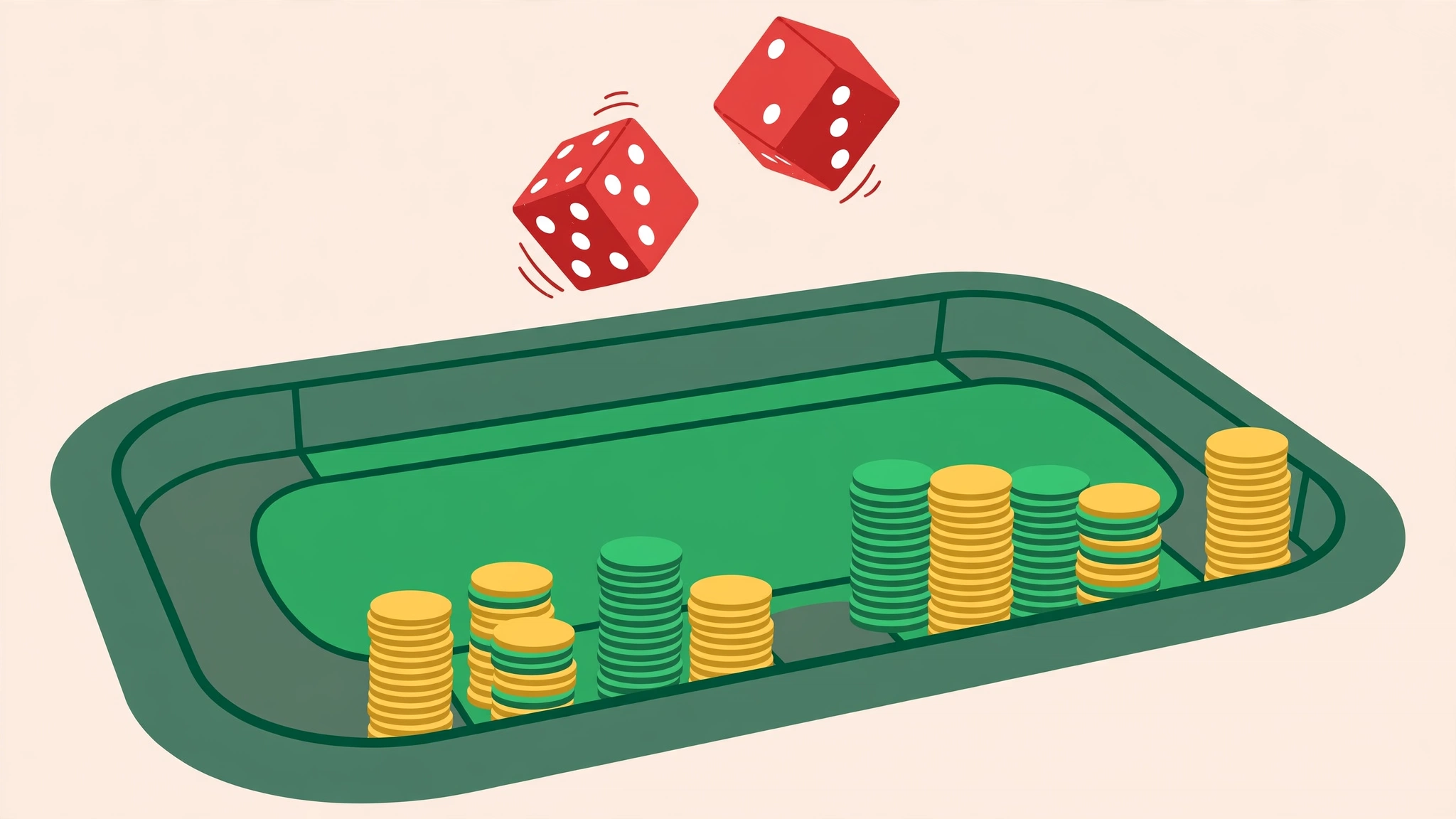
A craps table is long, usually with a dealer crew of several people, and players stand around the edge rather than sitting down. One player at a time is the shooter: the person who rolls the dice. The dice travel to the far end of the table and must bounce off the back wall, which is there to make the roll random. When the shooter finishes — either by rolling a seven after a point is set, which is called sevening out, or by choice in some games — the dice pass to the next player in turn.
You do not have to be the shooter to play. Most people at the table are simply betting on the shooter’s rolls. That shared experience is a big part of the game’s appeal: when the shooter is on a good run, the whole table tends to win together, which is why the cheering can get so loud. It also means you can join a game quietly, place a simple bet, and learn by watching, without anyone expecting you to roll.
The layout printed on the table looks busy because it shows every possible bet at once. Beginners do not need to learn all of them. In fact, most regular players use only a handful of bets again and again. The centre of the table holds the one-roll proposition bets, which are the flashy, high-edge wagers shouted out during play. The areas nearest the players hold the main bets, and those are where a sensible beginner should start.
How a Round Works: The Come-Out Roll and the Point
Every craps sequence starts with a come-out roll. The shooter rolls two dice, and three things can happen. If the total is 7 or 11, that is called a natural, and Pass Line bets win straight away. If the total is 2, 3 or 12, that is craps, and Pass Line bets lose. If the total is anything else — 4, 5, 6, 8, 9 or 10 — that number becomes the point.
Once a point is set, the dealer marks it on the table with a puck, and the game enters its second phase. Now the shooter keeps rolling until one of two things happens: the point number is rolled again, in which case Pass Line bets win, or a 7 is rolled, in which case Pass Line bets lose and the shooter’s turn ends. That is the whole rhythm of the game. A round can last a single roll or dozens of rolls, and a long point phase with many rolls in between is what creates the excitement — and the tension — at the table.
It helps to think of craps as a game of two phases rather than a long list of rules. Phase one decides whether a point is set. Phase two decides whether the point or the seven arrives first. Every bet on the table is, in one way or another, a wager on some part of that story.
The Bets a Beginner Should Learn First
The Pass Line bet is the standard starting bet in craps, and it is the one most beginners should learn first. You place it before the come-out roll. As described above, you win on a natural 7 or 11, lose on 2, 3 or 12, and then, once a point is set, you win if the point repeats before a 7. It is a simple bet with a low house edge of about 1.41%, which makes it one of the fairest bets in the casino.
The Don’t Pass bet is the mirror image. You are betting against the shooter, in a sense: you win on the come-out roll if it is 2 or 3, lose on 7 or 11, and push — neither win nor lose — on 12. Once a point is set, you win if a 7 arrives before the point. Its house edge is slightly lower, about 1.36%, but many players avoid it because it means cheering against the rest of the table. There is no rule against it, and it is a perfectly legitimate bet, but the social atmosphere is worth knowing about before you choose it.
The Come bet works like a Pass Line bet, but you place it after a point has already been set. Your next roll becomes your own personal come-out roll: a 7 or 11 wins, 2, 3 or 12 loses, and any other number becomes your own point, which must then repeat before a 7. The Don’t Come bet is its mirror image. These bets let you join the action mid-round without waiting for a new shooter, and they carry the same low house edges as Pass and Don’t Pass.
Behind each of these bets sits the Odds bet, which is one of the best deals in the casino. Once a point is set, you can place an additional stake behind your Pass, Don’t Pass, Come or Don’t Come bet, and this extra stake pays at true odds — meaning it carries no house edge at all. Casinos limit how much you can place as Odds, often expressed as a multiple of your original bet, but taking the full Odds available is the single most effective way to reduce your overall house edge in craps. If you remember one advanced tip from this guide, make it this one: back your Pass Line bet with Odds whenever you can.
Place Bets, Field Bets and the Bets to Treat With Caution
Once you are comfortable with Pass and Come bets, you will notice players betting directly on numbers. A Place bet is a wager that a specific number — 4, 5, 6, 8, 9 or 10 — will be rolled before a 7. Place bets on 6 and 8 are the most popular because those numbers are rolled most often, and their house edge, around 1.52%, is reasonable. Place bets on 4 and 10 are less attractive, and on 5 and 9 they sit in between. If you want a little variety beyond the Pass Line, Place bets on 6 and 8 are a sensible next step.
The Field bet is a one-roll wager that the next roll will be 2, 3, 4, 9, 10, 11 or 12. It looks appealing because it covers so many numbers, but the house edge is about 5.56%, which is far worse than a Pass Line bet. It pays out often enough to feel rewarding, which is exactly why it is tempting, but over time it drains a bankroll much faster than the main bets.
The centre of the table holds the proposition bets: wagers on a specific number on the next roll, on hard ways (pairs such as two fours making a hard eight), and on combinations like Any Seven or Any Craps. These are the bets with the biggest printed payouts, and also the biggest house edges, often running from around 9% up to more than 16%. They are fun as an occasional small flutter, and there is nothing wrong with placing one for entertainment if you understand the cost, but they should never be the backbone of your play. A beginner who builds a session around proposition bets will usually find the session ends much sooner than expected.
Legal Status in Thailand — Read This First
Gambling is largely prohibited in Thailand. Under the Gambling Act B.E. 2478 (1935), most forms of gambling are illegal, and the only well-known legal exceptions are the government lottery and licensed horse racing at approved racecourses. Online casinos are not licensed in Thailand, and websites offering real-money casino games to people in Thailand operate outside Thai law.
That has practical consequences: an unlicensed site offers no Thai consumer protection if it refuses to pay out, freezes an account or disappears, and Thai authorities periodically block gambling websites and payment channels. Money sent to an offshore platform can simply be lost with no realistic way to recover it.
This article is educational and informational only — it explains how craps works because readers ask about it, not to encourage anyone to break local law. Casino games are for adults only (18+), there are no guaranteed winnings in any game, and over time the maths and the fees charged by operators favour the house. Never chase losses, never gamble with borrowed money or money needed for living costs, and if gambling stops being fun, free and confidential help is available from BeGambleAware and Gamblers Anonymous.
House Edge: Why Bet Choice Matters More Than Dice Skill
No one can control dice in a fair game, and claims about dice setting or controlled throws should be treated with scepticism. The dice must bounce off the back wall precisely to prevent control, and over a long session the results follow the probabilities of two dice. A total of 7 is the most common outcome, because six combinations make seven, while totals of 2 and 12 have only one combination each. That simple fact explains most of craps strategy: bets that fight against the frequency of seven carry a higher edge, and bets that align with the maths carry a lower one.
That is why bet choice matters so much more than any rolling technique. A Pass Line bet with full Odds has a combined house edge well under 1%, while a single-roll Any Seven bet carries an edge of more than 16%. Both bets sit on the same table, in the same game, with the same dice. The difference is entirely in what you choose to wager on. Our guide to how casino house edge works explains where these percentages come from and why they matter more than any system or superstition.
This also means no betting system can rescue a bad bet. Doubling stakes after losses, following a sequence, or increasing bets during a hot streak changes the shape of your results, not the average. The house edge applies to every wager regardless of the order in which you place it, and the longer you play, the closer your results drift toward that mathematical expectation.
Table Etiquette and Pace for First-Timers
A few unwritten rules will help you feel comfortable at a real table. Place your bets before the shooter rolls, and keep your hands clear of the table while the dice are in motion. Do not say the word seven out loud at the table if you can avoid it — many players consider it bad luck, and while it has no effect on the dice, respecting table customs keeps the atmosphere friendly. Handle your chips neatly, and let the dealer place bets in the centre of the table for you rather than reaching across yourself.
Craps moves fast, and that pace is part of its danger for a beginner. It is easy to place bet after bet without noticing how much you have staked in total, especially when the table is winning and everyone is in a good mood. Decide your session budget before you start, divide it into stakes that let you play for a reasonable length of time, and treat that budget as the price of entertainment. Our casino bankroll management guide covers session budgeting in detail, and its advice applies to craps more than most games because of how quickly rounds follow one another.
If you are playing online rather than at a physical table, the same principles apply, but the pace can be even faster, since there is no waiting for other players or for dice to be passed around. Use any available session reminders or limits, take breaks, and never increase your stakes to recover losses. A calm, fixed-stake approach beats an emotional one every time.
Frequently Asked Questions
Is craps hard to learn?
It looks hard because the table is crowded, but the core game is simple: bet on the Pass Line, watch the come-out roll, then watch whether the point or a seven comes first. You can ignore most of the table while you learn.
What is the best bet for a beginner?
The Pass Line bet, backed with Odds once a point is set. It has a low house edge, it is easy to follow, and it lets you cheer along with the rest of the table.
Should I bet Don’t Pass?
Mathematically it is slightly better than Pass, but you are betting against the shooter, which some tables find unsociable. It is a personal choice, not a right or wrong one.
Can dice setting or controlled throwing work?
In a properly run game, no. The dice must hit the back wall, which randomises the outcome, and no credible evidence shows that a player can reliably control fair dice over a long session.
Are proposition bets ever worth it?
Only as small entertainment bets. Their house edges are high, so they should never form the main part of your play or your budget.
Is craps better than slots or roulette?
In terms of house edge, a Pass Line bet with Odds is far better than most slot machines and better than American roulette. That still does not make craps a winning game over time — it just makes it a cheaper one to play.
Conclusion
Craps earns its reputation as the loudest game in the casino, but it does not have to be the most confusing. Learn the come-out roll, learn the point, start with the Pass Line, and add Odds when you are ready. Leave the centre-table proposition bets alone until you understand what they cost, and respect your bankroll the way you would respect any entertainment budget.
Play slowly, watch a few rounds before you bet if that helps, and remember that the dice have no memory. A hot shooter is a run of luck, not a pattern you can predict, and a cold table is not due to turn. Understand the bets, accept the maths, and craps becomes what it should be: a fast, social game that is fun precisely because everyone at the table is sharing the same rolls.