Three Card Poker Guide for Thai Beginners: Rules, Ante and Play, and Pair Plus Explained
Three Card Poker Guide for Thai Beginners: Rules, Ante and Play, and Pair Plus Explained
Three Card Poker is one of the friendliest table games a beginner can find. It uses only three cards per hand, the decisions are few, and a full round takes less than a minute. It was designed, quite deliberately, to be faster and simpler than traditional poker, while keeping the excitement of making a poker hand and the chance of a bonus payout. If standard poker feels slow and full of bluffing and psychology, Three Card Poker is the opposite: you play against the dealer’s hand, not against other players, and there is no bluffing at all.
This guide explains the game from the beginning: the hand rankings, which are different from five-card poker in one important way, the two main bets, the optional Pair Plus side bet, and the simple strategy that most beginners should follow. It also explains the house edge honestly, so you know what each bet really costs.
How the Game Is Played
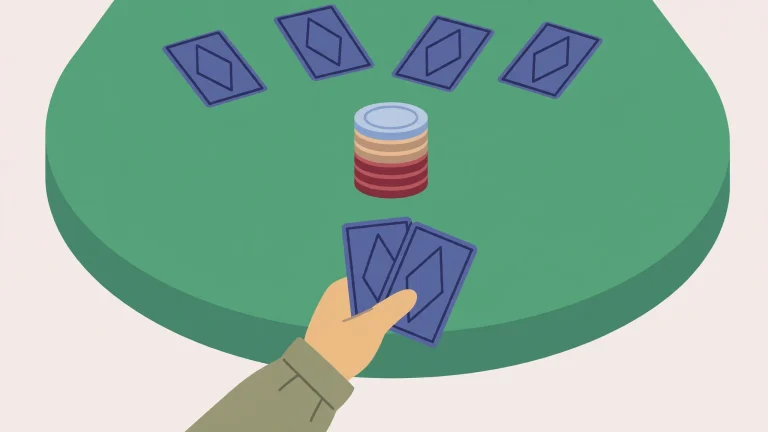
Each player places an Ante bet, and may also place a Pair Plus bet, before any cards are dealt. The dealer then deals three cards face down to each player and three cards to themselves, with the dealer’s cards also face down at first. You look at your own three cards and make one decision: fold and lose your Ante, or place a Play bet equal to your Ante and stay in the hand.
If you play, the dealer turns over their hand. The dealer needs at least a Queen high to qualify — that is, their best hand must be Queen high or better. If the dealer does not qualify, your Play bet is returned to you as a push, and your Ante is paid out. If the dealer does qualify, the two hands are compared, and the higher hand wins: you win both Ante and Play if your hand is higher, and you lose both if the dealer’s hand is higher. A tie is a push.
That is the whole game. There are no further cards, no drawing, no community cards and no second decision. The speed is part of the appeal, but it is also something to be careful about: because hands resolve so quickly, you can play many more hands per hour than in traditional poker, which means your total amount staked can grow fast even with small bets.
Hand Rankings: The One Surprise
Three Card Poker hand rankings mostly follow normal poker, but with one change that trips up newcomers. From highest to lowest, the hands are: straight flush (three cards in sequence and the same suit), three of a kind, straight (three cards in sequence, mixed suits), flush (three cards of the same suit, not in sequence), pair, and high card.
The surprise is the order of straight and flush. In five-card poker, a flush beats a straight. In Three Card Poker, a straight beats a flush. The reason is pure maths: with only three cards, a flush is actually easier to make than a straight, so the rankings are swapped to reflect how rare each hand really is. It is a small detail, but it matters, and getting it wrong can lead you to fold a winning hand or play a losing one.
The highest possible hand is a straight flush, and the lowest qualifying dealer hand is Queen high. An Ace high hand is therefore a real hand in this game, not a weak one, and a King high hand is respectable too. Knowing exactly where your hand sits in the rankings is the only knowledge you need to make the game’s one decision well.
Ante and Play: The Main Bet
The Ante bet is your entry into the game. It is the bet that starts every hand, and it is the bet that the Play decision revolves around. When you place a Play bet, it must be equal to your Ante — you cannot play for less, and you cannot raise it higher. That fixed structure keeps the game simple and removes the betting-round complexity of traditional poker.
There is one extra feature worth knowing about: the Ante Bonus. In most versions of the game, you receive a bonus payout on your Ante bet if you make a straight or better, regardless of whether the dealer qualifies or whether you beat the dealer. The bonus is usually paid on a sliding scale, with a straight flush paying the most. This bonus exists because strong hands are rare, and it softens the disappointment of making a great hand only to find the dealer does not qualify or also holds a strong hand. The exact bonus scale varies by casino, so it is worth checking the table’s payout display before you sit down, but the principle is the same everywhere.
The house edge on the Ante and Play combination, when played with correct basic strategy, is around 3.37%. That is higher than blackjack played well or a Pass Line bet in craps, but lower than many slot machines and side bets. It is a fair price for a fast, simple game, provided you play it correctly and keep your stakes modest.
The Basic Strategy: Play Queen-Six-Four or Better
Three Card Poker has one of the simplest optimal strategies in the casino, and it fits on a single line: play if your hand is Queen, six, four or better, and fold otherwise. In practice, that means you play with any pair or better, any Ace high, any King high, and any Queen high where your second card is a six or higher, or where your second card is a six and your third card is a four or higher — the shorthand Queen-six-four captures the boundary.
Why does this rule work? Because the dealer needs Queen high to qualify, your hand needs to be strong enough to beat the dealer’s qualifying hands often enough to justify risking a second equal stake. Hands weaker than Queen-six-four lose money on average when you play them, because you are putting a second bet at risk on a hand that will usually lose or push. Folding those hands loses only your Ante, which is the cheaper outcome.
This strategy is not a matter of opinion or feel. It comes from working through every possible three-card hand against every possible dealer hand, and it is the mathematically correct play for the standard game. Some players fold too often, throwing away hands that should be played, and others play every hand because folding feels like giving up. Both mistakes cost money over time. Trusting the Queen-six-four rule, even when it feels boring, is the disciplined way to play.
Legal Status in Thailand — Read This First
Gambling is largely prohibited in Thailand. Under the Gambling Act B.E. 2478 (1935), most forms of gambling are illegal, and the only well-known legal exceptions are the government lottery and licensed horse racing at approved racecourses. Online casinos are not licensed in Thailand, and websites offering real-money casino games to people in Thailand operate outside Thai law.
That has practical consequences: an unlicensed site offers no Thai consumer protection if it refuses to pay out, freezes an account or disappears, and Thai authorities periodically block gambling websites and payment channels. Money sent to an offshore platform can simply be lost with no realistic way to recover it.
This article is educational and informational only — it explains how Three Card Poker works because readers ask about it, not to encourage anyone to break local law. Casino games are for adults only (18+), there are no guaranteed winnings in any game, and over time the maths and the fees charged by operators favour the house. Never chase losses, never gamble with borrowed money or money needed for living costs, and if gambling stops being fun, free and confidential help is available from BeGambleAware and Gamblers Anonymous.
Pair Plus: The Side Bet Explained
Pair Plus is an optional side bet that pays purely on the strength of your own hand, regardless of what the dealer holds. You win if you make a pair or better, and the payout grows with the strength of the hand: a pair pays the smallest amount, while a straight flush pays the largest. If you make less than a pair, you lose the Pair Plus bet, even if you go on to win the Ante and Play hand against a dealer who does not qualify.
The appeal is obvious. Pair Plus gives you something to cheer for on every hand, and it pays out on strong hands even when the main game goes against you. It also has a much higher house edge than the main game, usually around 7.28% on standard paytables, and higher still on paytables that pay less for a straight or a flush. That means Pair Plus drains a bankroll roughly twice as fast as the Ante and Play game, hand for hand.
Should a beginner play Pair Plus? It depends on what you want from the game. If you treat it as a small entertainment bet — a modest stake alongside your Ante, placed because you enjoy the chance of a bonus payout — there is nothing wrong with it, as long as you understand the cost. If you are trying to play as efficiently as possible and stretch your budget, skipping Pair Plus is the better choice. What you should not do is treat Pair Plus as a way to make money or to recover losses on the main game. It is a separate bet with its own, worse, maths.
Some tables also offer a Six Card Bonus, which combines your three cards with the dealer’s three cards to make the best five-card poker hand. It works on the same principle as Pair Plus — a side bet on hand strength, independent of the main result — and it carries a similarly high house edge. The same advice applies: fun if kept small, costly if relied upon.
Common Beginner Mistakes
The most common mistake is playing weak hands. Many beginners play any Queen high, or even any hand at all, because folding feels like wasting the Ante. But the Ante is already spent the moment you place it. The decision is only about whether risking a second equal stake is worthwhile, and for hands below Queen-six-four, it is not.
The second mistake is the opposite: folding hands that should be played. Some players fold King high hands or even Ace high hands after a bad run, convinced the dealer must have something better. That is superstition, not strategy. The dealer’s hand is random, and your hand’s strength does not change because of what happened on the previous hand.
The third mistake is over-betting Pair Plus. Because Pair Plus pays out on pairs, which feel common, players sometimes stake as much on Pair Plus as on Ante, or more. Over a session, that side bet can quietly cost more than the main game. Keep side bets small relative to your main bet, or skip them, and your session will last longer.
Finally, remember the pace. Three Card Poker hands resolve in under a minute, and online games can be faster still. Set a session budget before you start, as our casino bankroll management guide recommends, and take breaks. A game this fast rewards a calm, fixed approach more than any other kind of table game. Understanding how casino house edge works will also help you see why the main game and the side bet should be judged separately, rather than as one combined wager.
Frequently Asked Questions
Is Three Card Poker the same as regular poker?
No. You play against the dealer, not other players, there is no bluffing, and you receive only three cards with one decision: play or fold.
Why does a straight beat a flush here?
Because with three cards, a flush is easier to make than a straight, so the rankings are swapped to reflect rarity. In five-card poker, the order is the other way round.
What does it mean when the dealer does not qualify?
The dealer needs Queen high or better. If they have less, your Play bet is returned and your Ante is paid, even if your hand is weaker than the dealer’s cards would suggest.
Should I always play Pair Plus?
Not necessarily. It is fun and pays on strong hands, but its house edge is roughly double that of the main game. Keep it small or skip it if you want your budget to last.
Is Queen-six-four really the best strategy?
Yes, for the standard game it is the mathematically optimal rule. It tells you exactly which hands are worth risking a Play bet on, and which should be folded.
Can I win long-term at Three Card Poker?
No, not reliably. Like every casino table game, it carries a house edge, so over a long session the average result is a loss. The goal is to play well, enjoy the game, and keep losses within a budget you can afford.
Conclusion
Three Card Poker succeeds because it respects a beginner’s time. You learn the rankings, you learn one decision rule, and you are ready to play. Queen-six-four or better, fold the rest, and treat Pair Plus as entertainment rather than strategy. That is genuinely all there is to playing the game well.
The rest is discipline: a fixed budget, modest stakes, and the understanding that a fast game can use up that budget quickly if you are not paying attention. Played that way, Three Card Poker is a pleasant, quick table game with a fair main bet and a clear, honest structure. Played carelessly, with every weak hand played and a large Pair Plus bet on every round, it becomes an expensive one. The difference is not luck. It is the few small decisions this guide has just covered.