Pai Gow Poker Guide for Thai Beginners: Rules, Hands and Simple Strategy
Pai Gow Poker Guide for Thai Beginners: Rules, Hands and Simple Strategy
Pai Gow Poker is the slowest, calmest poker game you will find in a casino, and that is exactly why beginners like it. Most casino games move fast and punish a moment of confusion. Pai Gow Poker does the opposite. You get seven cards, you take your time arranging them, and a large share of hands end in a push, which means nobody wins and nobody loses and your bet simply stays where it is. If you have ever wanted to learn a poker-style game without the pressure of fast betting rounds and bluffing, this is the game to start with.
The game has an older cousin, the traditional Chinese game Pai Gow, which is played with domino-like tiles. Pai Gow Poker keeps the core idea of that older game — split your hand into two parts, a stronger one and a weaker one — but replaces the tiles with playing cards and poker hand rankings. That makes it much easier for a newcomer to pick up, because if you already know roughly what a pair, a straight, or a flush looks like, you already know most of what you need.
This guide explains the game from the very beginning: what you are dealt, how to set your two hands, what the joker does, what the dealer does, and the simple habits that keep beginners out of trouble. You do not need to memorise anything complicated before your first hand. You only need to understand the one rule that the whole game turns on.
How the Game Works
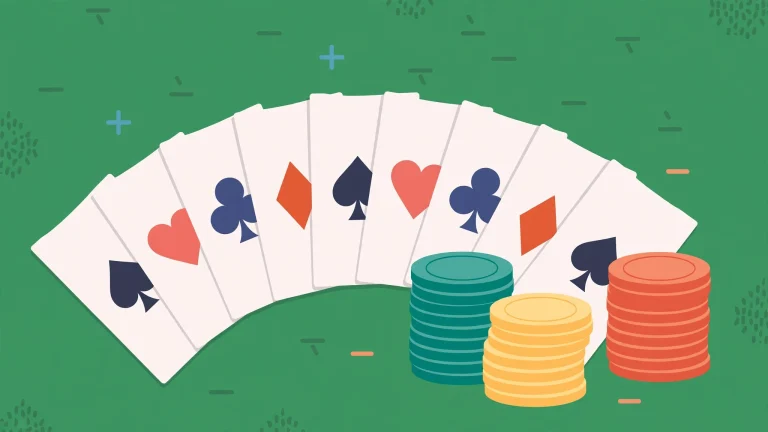
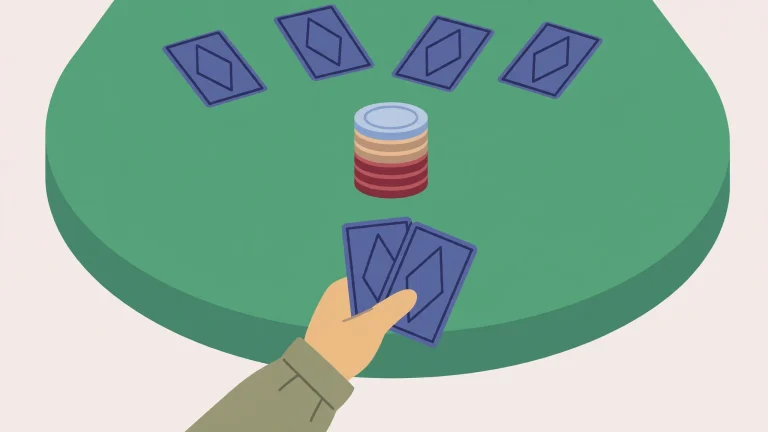
A round of Pai Gow Poker begins with a bet. You place your chips in the betting area, and the dealer deals seven cards to you and seven cards to the dealer, who in this game is often called the banker. Everyone at the table gets their own seven cards, and everyone plays only against the dealer, not against each other. What the player next to you does with their cards has no effect on your result, which takes a lot of social pressure out of the game.
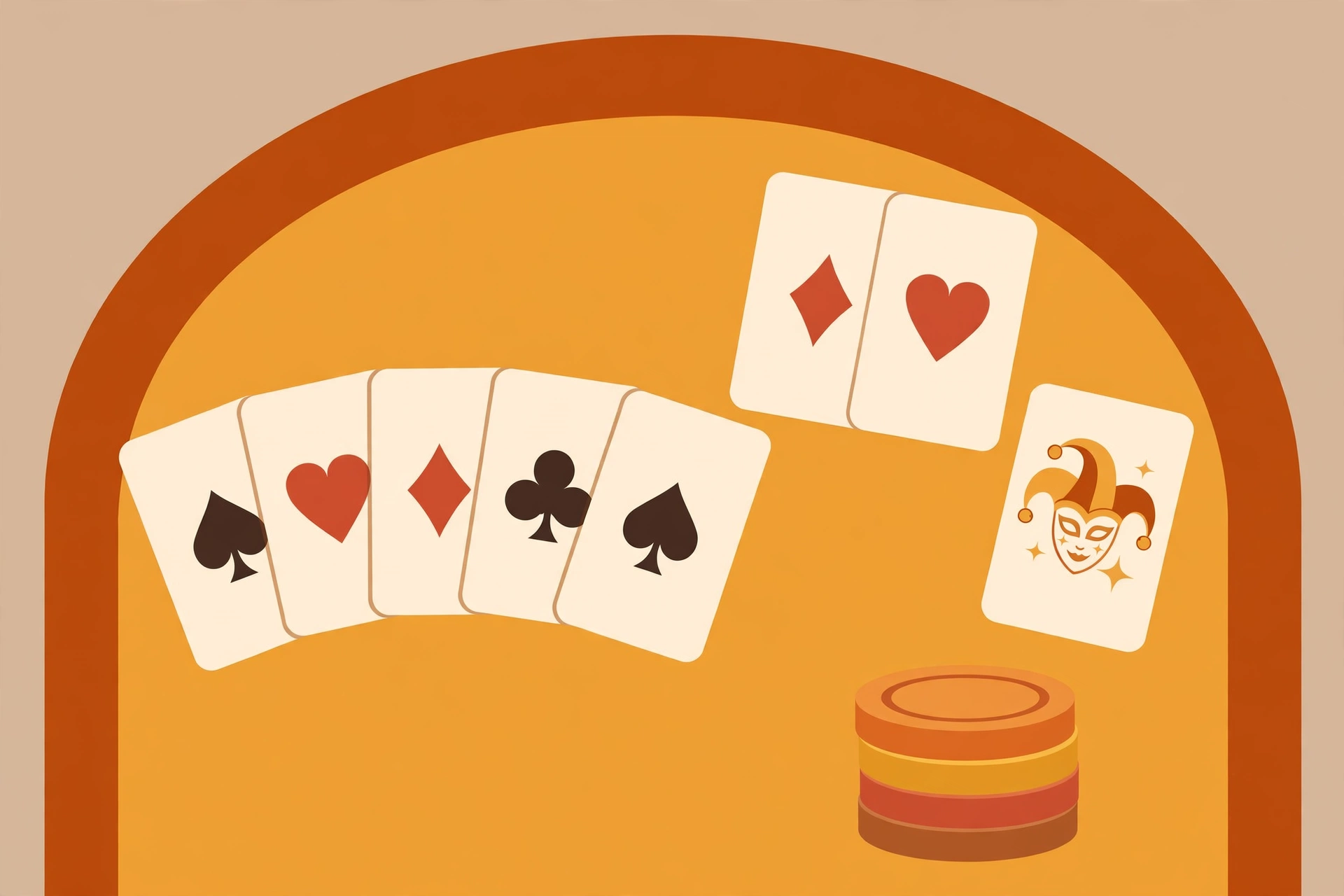
Once the cards are dealt, you split your seven cards into two hands. The first is called the high hand, and it is made of five cards. The second is called the low hand, and it is made of two cards. The five-card hand is ranked using ordinary poker rankings: a pair beats a high card, two pair beats one pair, three of a kind beats two pair, and so on up through straights, flushes, full houses, four of a kind, and straight flushes. The two-card hand can only ever be a pair or a high card, because two cards cannot make a straight or a flush.
Here is the one rule that matters most: your five-card hand must be stronger than your two-card hand. This is called the balancing rule, and it is not optional. If you set your hands the wrong way round, so that your two-card hand outranks your five-card hand, your hand is fouled, and it loses automatically. Every beginner should check this one thing before signalling that they are ready: is my big hand actually bigger than my small hand? Get that right and the rest of the game falls into place.
After every player has set their hands, the dealer reveals the dealer’s own two hands and compares them with yours, hand by hand. To win your bet, both of your hands must beat the dealer’s corresponding hands: your five-card hand must beat the dealer’s five-card hand, and your two-card hand must beat the dealer’s two-card hand. If only one of your hands wins and the other loses, the result is a push, and your bet is returned. If both of your hands lose, you lose your bet. That push rule is the reason the game feels so gentle. Many hands end with nobody winning, which stretches a budget much further than a game where every hand produces a clear winner and loser.
The Joker and How It Changes Things
Pai Gow Poker is played with a standard deck plus one joker, so there are fifty-three cards in play. The joker is not a fully wild card, and understanding exactly what it can and cannot do is important, because beginners often overestimate it.
The joker can be used in two ways. First, it can complete a straight or a flush, filling in whatever rank or suit is missing. Second, if it cannot complete a straight or a flush, it counts as an ace. That is all it does. It cannot be used as a king to make a second pair, for example, or as any card you like in every situation. Think of it as a helpful card with a limited job: it finishes a straight or a flush, and otherwise it is simply the highest single card in the deck.
This matters most when you are deciding how to set your hands. Suppose you hold a joker alongside four cards to a flush. Using the joker to complete the flush in your five-card hand is usually a strong move, because a flush is a genuinely good hand. Suppose instead you hold a joker and no straight or flush is possible. Then the joker is just an ace, and it often belongs in your two-card hand, where a single ace can be the difference between winning and losing that smaller hand. The habit to build is simple: always ask what the joker is actually doing in the hand you are building, and do not assume it is worth more than it is.
One more detail worth knowing is that five aces is possible in this game, because the joker can act as a fifth ace alongside the four aces in the deck. It is an extremely rare hand, and you should never set your cards in the hope of getting it. It is mentioned here only so that you are not confused if you ever see it, or read about it in another guide.
Setting Your Two Hands: The Basics
Setting hands is the skill of Pai Gow Poker, and it is also the part beginners enjoy most, because it feels like solving a small puzzle with every deal. The goal is not to make the strongest possible five-card hand at any cost. The goal is to make both hands as strong as possible together, so that you win both comparisons against the dealer rather than winning one by a mile and losing the other badly.
Start with the simplest case: no pair at all. When your seven cards contain no pair, you put your two highest cards in the two-card hand and the remaining five cards in the five-card hand. The only check is the balancing rule: your five-card hand, as a high-card hand, must still outrank the two-card hand, which is automatic if you put your highest cards in the small hand and make sure the small hand’s top card is not stronger than the big hand’s best card in a way that breaks the rule. In practice, with no pair, this arrangement almost always works, and it is the safe default.
When you hold one pair, the decision is where the pair goes. A low pair usually goes in the five-card hand, with your two highest remaining cards forming the two-card hand. A high pair, such as aces or kings, often goes in the two-card hand instead, because a pair in the small hand is a strong hand to hold there, and your five-card hand can still be decent with the cards left over. The dividing line is a matter of judgement, and dealers and experienced players will sometimes disagree about borderline pairs. As a beginner, you do not need to resolve every borderline case perfectly. A sensible rule is to keep a pair in the five-card hand unless it is a strong pair that clearly improves your two-card hand more than it helps the big hand.
Two pair is the hand that causes beginners the most confusion, so it deserves a clear explanation. With two pair, you normally split them: put the higher pair in the five-card hand and the lower pair in the two-card hand. That gives you a pair in both hands, which is a solid position. The exception is when both pairs are low and your remaining cards are strong; then keeping both pairs together in the five-card hand and putting your two best single cards in the small hand can sometimes be better. Again, do not agonise over borderline cases. Splitting two pair is the standard, sensible play, and it will serve you well while you are learning.
Three of a kind is simpler: keep all three in the five-card hand, and put your two highest remaining cards in the two-card hand. A straight, a flush, or a full house should stay together in the five-card hand in almost every case. Breaking up a made hand to chase a slightly better two-card hand is one of the classic beginner errors, and it usually weakens both hands at once. Keep strong hands whole, and let the two-card hand take whatever is left.
Simple Strategy for Beginners
Good Pai Gow Poker strategy for a beginner can be summed up in a handful of habits. First, always check the balancing rule before you finish setting. A fouled hand loses no matter how good the cards looked, and it is a painful way to lose a hand you might otherwise have won or pushed. Make the check a ritual: big hand stronger than small hand, every time, without exception.
Second, protect both hands rather than maximising one. A five-card hand that is unbeatable means nothing if your two-card hand is so weak that it loses on its own, because then the best you can hope for is a push. The game rewards balance. When you are torn between two ways of setting a hand, choose the one that leaves your weaker hand in better shape, unless the stronger hand gains something dramatic.
Third, keep your stake steady and your sessions slow. Pai Gow Poker already moves slowly compared with other table games, and that is a gift. Do not undo it by raising your bet after a loss or chasing a win with bigger stakes. A flat, comfortable stake lets you enjoy the high number of pushes, learn the setting patterns, and walk away with your budget mostly intact even on an unlucky day. Decide your session budget before you sit down, and decide a stopping point for both winning and losing. The discipline matters more in this game than any clever card arrangement, because the game itself is already gentle — it is the betting behaviour around it that causes trouble.
Fourth, watch a few hands before you play your first one, if the table allows it. Seeing other players set their hands, hearing the dealer explain a house-way decision, and watching how pushes play out will teach you more in ten minutes than reading about the game for an hour. Pai Gow Poker tables tend to be friendly places, partly because players are not competing with each other. Do not be afraid to say you are new. Most players are happy to see a beginner join, and the dealer will help.
Legal Status in Thailand — Read This First
Gambling in Thailand is governed by the Gambling Act B.E. 2478 (1935), and under that law most forms of gambling are prohibited. The only major exceptions are the government lottery and licensed horse racing. Online casinos are NOT licensed in Thailand, and playing at offshore casino sites sits outside any Thai licensing or consumer protection framework. This guide is educational only: it explains how a game works so that readers can understand it, not so that readers will seek out a place to play it.
If you are reading this from Thailand, treat any casino content as information, not as an invitation. You must be 18+ (18 or older) to gamble anywhere it is legal, and even where it is legal, there are no guaranteed winnings in any casino game. The house edge exists precisely because, over time, the casino expects to come out ahead. Do not gamble to recover losses — never chase losses by increasing your bets after a bad run, and never gamble with money needed for rent, food, bills, or family obligations. If gambling stops feeling like entertainment, help is available from BeGambleAware and Gamblers Anonymous, both of which offer free, confidential support and self-assessment tools.
Frequently Asked Questions
How many cards do I get in Pai Gow Poker?
You get seven cards, which you split into a five-card high hand and a two-card low hand. The dealer gets seven cards too, set the same way.
What does the joker do?
The joker completes a straight or a flush, or counts as an ace if it cannot do either. It is not a fully wild card that can be any rank you like.
What happens if I win one hand and lose the other?
That is a push. Your bet is returned, and nobody wins or loses that round. Pushes are common in Pai Gow Poker, which is why the game feels slow and gentle.
What is a fouled hand?
A fouled hand is one where your two-card hand outranks your five-card hand. It loses automatically, so always check the balancing rule before you finish setting.
Can I ask the dealer to set my hand for me?
In most casinos, yes. You can ask the dealer to set your hand the house way, which follows the casino’s written rules. It is a normal request, and a good way to learn.
Is Pai Gow Poker a good game for beginners?
Yes, if you like slow games. The pace is gentle, pushes are frequent, and you play only against the dealer, not against other players. The main skill to learn is setting your two hands well.
Conclusion
Pai Gow Poker rewards patience and balance rather than speed and nerve. Learn the balancing rule, keep strong hands whole, use the joker for what it actually does, ask the dealer for the house way whenever you are unsure, and keep your stakes flat and your sessions slow. Played that way, it is one of the most relaxing games a beginner can learn: seven cards, a small puzzle, and a result that very often ends in a friendly push. The skill you build here — thinking about both hands at once instead of chasing one big hand — will make you a calmer player at any table you sit at next.