How AI Image Generators Work: A Beginner’s Guide
How AI Image Generators Work: A Beginner’s Guide
Type a sentence into an AI image generator — “a lighthouse on a rocky coast at sunset” — and seconds later you have a picture that never existed before. No camera took it, no artist painted it, and no stock library contained it. For a beginner, the experience feels like magic, which makes it easy to misunderstand what is actually happening. This guide explains, in plain language, how text-to-image generators work, how to write prompts that give you better results, where the technology still falls short, and what to think about before using generated images commercially.
You do not need any technical background to follow this. The core ideas are simpler than the jargon makes them sound, and understanding them will immediately improve the images you generate, because you will stop asking the tool for things it cannot do and start asking for things it does well.
What a Text-to-Image Generator Actually Does
An AI image generator is a computer program trained on an enormous collection of images paired with descriptions of what those images show. During training, the program studies millions of examples — photographs, illustrations, paintings, diagrams — and learns statistical patterns: what a lighthouse usually looks like, how light behaves at sunset, what a rocky coast tends to contain, and how those elements typically sit together in a picture. It does not store copies of the training images and retrieve one when you ask. Instead, it builds an internal model of how visual elements relate to words, and it uses that model to create a new image from scratch each time.
That distinction matters. When you prompt for a lighthouse at sunset, the generator is not finding a lighthouse photograph and editing it. It is constructing pixels based on patterns it learned, guided by your words. This is why the same prompt can produce different images each time, why small changes to wording can change the result dramatically, and why the generator sometimes produces something plausible-looking but physically impossible — it learned what things usually look like, not how the real world actually works.
The most common kind of generator today is based on a technique called diffusion, explained in the next section. Other approaches exist, and the field changes quickly, but diffusion is the foundation behind most of the popular tools beginners encounter, so it is the right place to start.
Diffusion, in Plain Language
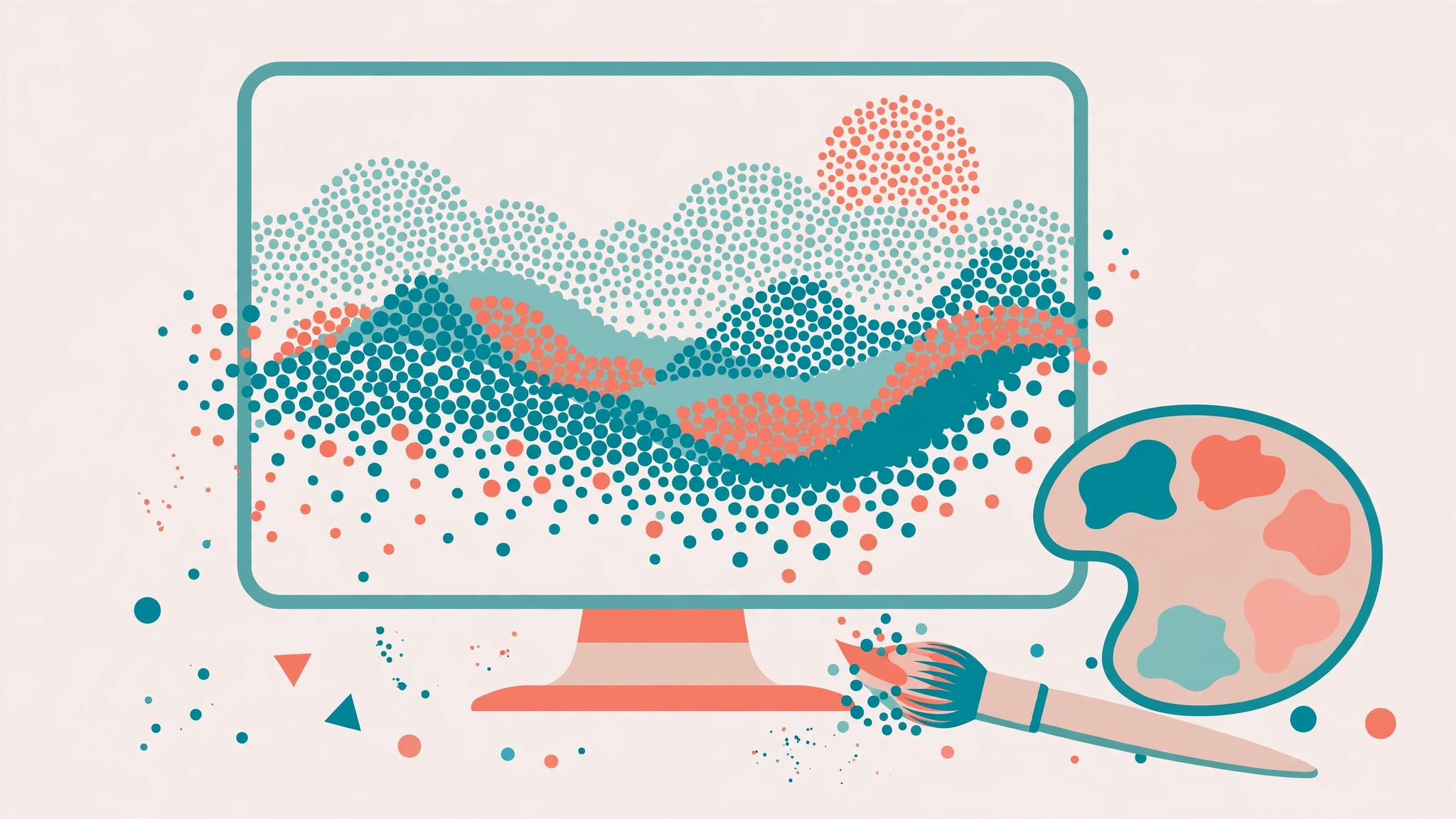
Imagine taking a clear photograph and slowly adding static, like television noise, until the picture disappears completely into random dots. That is the first half of the idea. During training, a diffusion model learns to reverse that process: starting from pure noise, it gradually removes the noise step by step until a coherent image emerges. It learns this by practising on real images that have been deliberately noised up, so it learns what “less noisy” should look like at every stage.
When you generate an image, the process runs in reverse from the start. The model begins with random noise — essentially a blank canvas of static — and your prompt tells it which direction to go. At each step, it removes a little noise in a way that makes the emerging picture match your description more closely. Early steps settle the broad composition: where the sky goes, where the sea goes, roughly where the lighthouse stands. Later steps add detail: the texture of rocks, the shape of windows, the colour of the light. After dozens of steps, the static has become a picture.
This step-by-step process explains several things beginners notice. First, generation takes a few seconds rather than being instant, because the model performs many refinement steps. Second, images sometimes have a slightly dreamlike quality in the details, because the model is guessing what details should look like based on patterns, not copying a real scene. Third, the model can struggle with precise counts and positions — asking for exactly seven apples in a row, or a hand holding a cup in a specific way, often produces something close but not exact, because the model works with overall patterns rather than a precise plan.
It also explains why a “seed” matters. The starting noise is random, and fixing the seed — a number that controls that randomness — lets you reproduce a similar starting point and vary the prompt from there. Many tools expose a seed setting, and it is worth learning if you want to iterate on one promising image rather than starting from scratch each time.
How Your Words Become Guidance
Before diffusion can begin, your prompt must be translated into something the model can use. This is done by a language component that converts words into numerical representations, sometimes called embeddings, which capture meaning and relationships between words. In simple terms, the model knows that “lighthouse” is closer in meaning to “beacon” than to “bicycle”, and that “sunset” relates to warm colours, long shadows and low light. These relationships, learned from vast amounts of text and image descriptions, are what let a short sentence steer the image generation process.
This is why prompt wording matters so much. Vague prompts leave the model to fill in gaps with its most common patterns, which produces generic images. Specific prompts narrow those patterns down. “A lighthouse” could be anything; “a small white lighthouse with red stripes on a rocky cliff above a calm sea at golden sunset, in the style of a watercolour painting” gives the model far more to work with, and the result will usually be closer to what you imagined.
Word order and emphasis also play a role. Words near the start of a prompt tend to carry more weight, and repeating a concept or placing it prominently can strengthen its influence. Different tools handle emphasis differently — some support brackets, weights or ordering tricks — so check the documentation for the tool you use rather than assuming one tool’s syntax works everywhere. A useful habit is to change one thing at a time when iterating: if you change the subject, the style and the lighting all at once and the result gets worse, you will not know which change caused it.
Negative prompts, where a tool allows them, are the other half of prompting. Instead of only saying what you want, you can say what you do not want: no text, no watermark, no extra limbs, no blurry background. This is often more effective than adding more positive description, because it directly removes the common failure modes you keep seeing in your results.
Prompting Basics That Actually Help
Good prompting is less about secret phrases and more about clear, structured description. Start with the subject: what is the main thing in the image, and what is it doing? Then add the setting: where is it, and what surrounds it? Then add the visual qualities: lighting, time of day, colour mood, and medium or style, such as photograph, watercolour, flat illustration, or pencil sketch. Finally, add composition if it matters: a close-up, a wide view, a view from above, or a centred subject.
A practical example makes the structure clear. Instead of “dog”, try “a golden retriever puppy sitting on a wooden porch, looking at the camera, warm afternoon sunlight, soft background, realistic photograph style”. Each added phrase answers a question the model would otherwise guess at, and each guess it does not have to make is one fewer surprise in the result.
Style words deserve care, because they carry strong associations from training data. Asking for “in the style of” a living artist, a famous character, or a well-known brand raises ethical and legal questions, discussed below, and it can also produce inconsistent results, because the model may imitate surface details without understanding the style. Safer and more reliable style descriptions name the medium and mood — “soft watercolour”, “bold flat illustration”, “moody black-and-white photograph” — rather than a person’s name.
Iteration is part of the process, not a sign of failure. Professional users rarely accept the first image a generator produces. They generate several variations, pick the strongest, and refine the prompt or the seed from there. Budget your time accordingly: generating is fast, but choosing and refining is where the quality comes from. If a tool offers variation or inpainting features — regenerating just one part of an image, such as a background or a hand — learn them, because fixing one flawed area beats regenerating the whole image and losing the parts you liked.
Limits: Hands, Text, Counts and Reality
Every beginner meets the same limits, and knowing them in advance saves frustration. Hands are the most famous problem. Human hands have complex shapes, many joints, and countless possible positions, and generators trained on two-dimensional images often produce hands with the wrong number of fingers or impossible bends, especially when hands interact with objects. The problem has improved over time, but it has not disappeared, and close-ups of hands remain a weak spot.
Text inside images is another persistent limit. A generator treats letters as shapes to be guessed from patterns, not as language to be spelled, so signs, labels and book covers in generated images often contain garbled or misspelled words. If your image needs readable text — a poster, a logo, a book cover — plan to add that text afterwards in a design tool, rather than expecting the generator to spell it correctly.
Precise counts, exact positions and consistent characters across multiple images are also difficult, for the same underlying reason: the model works with patterns, not with a plan. Asking for three specific people standing in specific places, or for the same character to look identical in ten different scenes, will usually produce approximations. Tools are improving in this area, with features for character reference and controlled composition, but consistency across a series remains a craft that requires patience and manual correction.
Finally, generated images can look convincing while being physically or factually wrong. Shadows may fall in inconsistent directions, reflections may not match their objects, architecture may contain impossible staircases, and a historical scene may include anachronisms. The image looks plausible because it follows visual patterns, not because it understands physics or history. Never use a generated image as evidence of how something actually looks, and always check details yourself if accuracy matters.
Copyright, Ethics and Honest Use
Copyright around AI-generated images is still evolving, and the rules differ by country and by tool, so this section offers principles rather than legal advice. The training data question is central: many generators were trained on images scraped from the internet, including copyrighted work, and artists and publishers have raised legitimate concerns about that practice. Some tools now train only on licensed or public-domain material, or offer options that exclude certain sources, and choosing such a tool is one practical way to reduce concern.
Your rights over an image you generate also vary. Some tools grant broad commercial rights to the user; others retain rights or impose restrictions, and some jurisdictions treat purely AI-generated images differently from human-created work for copyright purposes. Before using a generated image commercially — on a product, in advertising, or as part of a brand — read the terms of the tool you used, and check the rules that apply where you live and sell. When in doubt, a human designer or a licensed stock image is the safer choice for high-value commercial work.
Ethics go beyond the legal minimum. Do not generate images that impersonate real people, create misleading news imagery, or reproduce a living artist’s distinctive style to compete with them. Label AI-generated images when the context could mislead — a realistic-looking photograph presented as a real event is a different thing from an illustration clearly used as decoration. And respect platform rules: many stock libraries, marketplaces and social platforms now require disclosure of AI-generated content, and violating those rules can cost you an account.
For creators, a sensible approach is to treat AI images as a starting point or a supporting asset, not as a complete replacement for human creativity. Use them for drafts, mockups, blog illustrations, brainstorming and personal projects, where their speed is a genuine advantage. For work where originality, accuracy or artistic identity matters most, invest in human craft, and use AI where it supports that craft rather than substituting for it.
Related reading on this site covers the tools that surround image generation: our guide to AI image upscalers explains how to improve resolution after generation, our better prompts guide covers prompting principles that apply well beyond images, and our best AI tools for content creators places image tools in a wider creative workflow.
Frequently Asked Questions
Do AI image generators copy existing pictures?
No, they do not retrieve and copy a stored picture. They generate a new image from patterns learned during training. However, because training data includes copyrighted material, a generated image can sometimes resemble an existing work closely, which is why commercial use deserves care.
Why do hands and text look wrong in AI images?
Hands have complex, variable shapes that are hard to learn from flat images, and text is treated as visual pattern rather than language, so spelling is often garbled. Both are known limits of current models, and both are improving, but neither is fully solved.
What makes a good prompt for an image generator?
A clear subject, setting, lighting, colour mood, medium or style, and composition, in that order, with one change at a time when iterating. Specific, concrete description beats long lists of adjectives, and negative prompts help remove common flaws.
Can I use AI-generated images commercially?
It depends on the tool’s terms and on the law where you live and sell. Some tools grant broad user rights; others restrict commercial use. Read the terms before commercial use, and prefer licensed or human-created work for high-value projects.
Will AI image generators replace human artists?
They have changed parts of illustration, stock imagery and concept work, but they do not replace judgement, originality, cultural understanding or consistent character and story work. The strongest results still come from humans directing, selecting and refining what AI produces.
Conclusion
AI image generators feel magical because they turn words into pictures in seconds, but the mechanism underneath is understandable: a model trained on vast numbers of image-description pairs, using diffusion to refine random noise into a coherent picture guided by your prompt. Understanding that mechanism explains both the power and the limits — why specific prompts work better, why hands and text fail, why the same prompt gives different results, and why a generated image can look right while being wrong.
Use these tools with that understanding, and they become genuinely useful: fast drafts, illustrations, brainstorming aids, and creative starting points. Prompt clearly, iterate patiently, check details before publishing, and be honest about copyright and disclosure where it matters. The image generator is a powerful assistant for visual ideas. The judgement about which image is right, and whether it is right to use — that part is still yours, and it always will be.