Andar Bahar Guide for Thai Beginners: Rules, Bets and House Edge Explained
Andar Bahar Guide for Thai Beginners: Rules, Bets and House Edge Explained
Andar Bahar is one of the simplest card games in the world, and its simplicity is the whole point. It comes from India, where it has been played for generations as a fast, social game with a single deck of cards and a bet that takes seconds to place. In recent years it has spread to online casinos around the world, where its speed and straightforward rules have made it popular with beginners who find games like poker or blackjack too complicated.
If you have never played a casino card game before, Andar Bahar is a gentle place to start. There are no decisions to make after you place your bet, no hand to play, no cards to hold or discard, and no opponent to read. You bet on a side, the dealer deals cards, and you find out whether you won. This guide explains exactly how that works, what the betting options mean, and what the house edge really is — including the one detail about Andar Bahar odds that many beginners miss.
The Basic Idea: One Middle Card, Two Sides
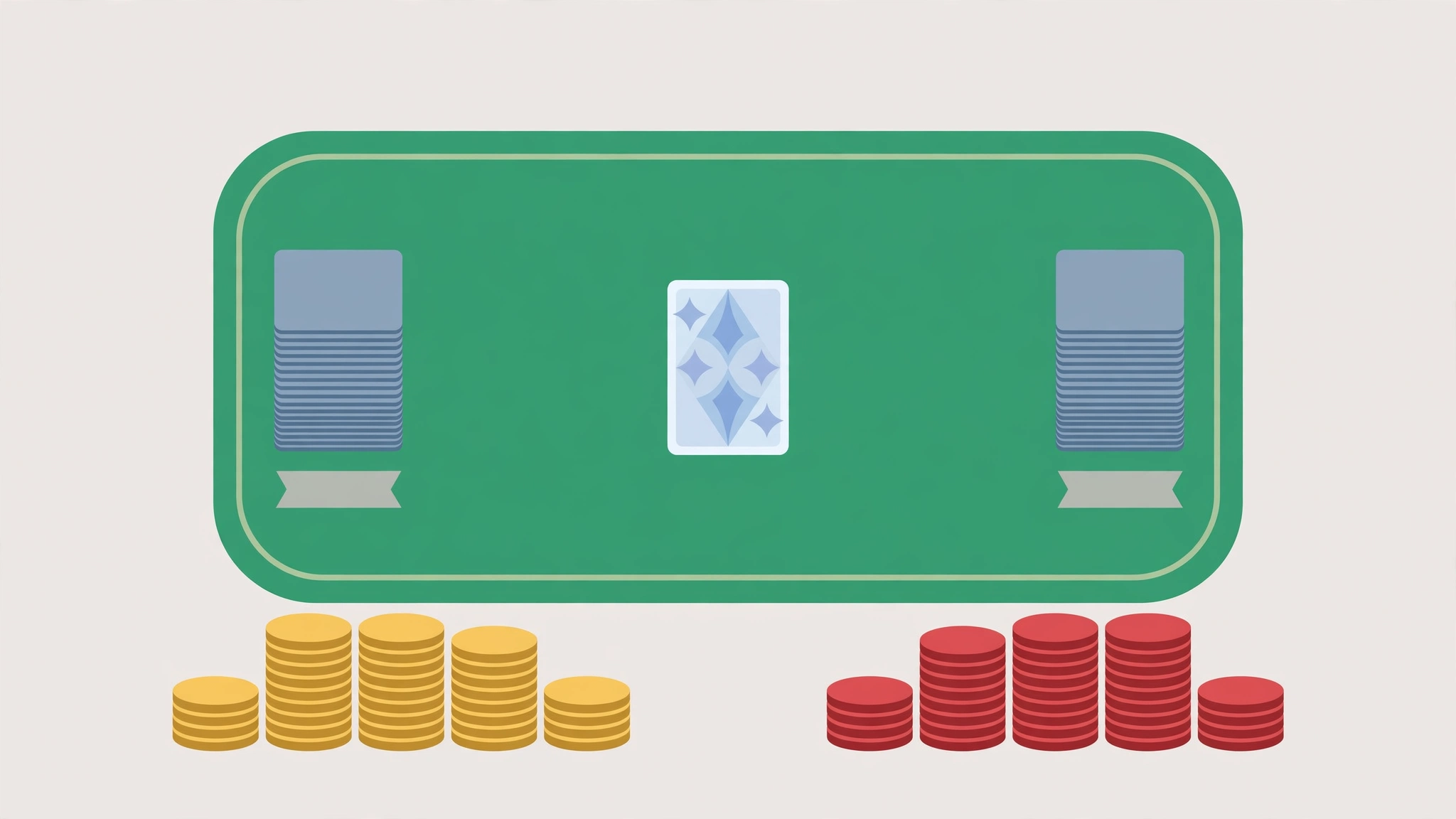
The game begins with a single card dealt face up in the middle of the table. This is often called the joker card, although it is not a joker in the playing-card sense — it is simply the reference card for the round, sometimes also called the house card or the middle card. Its rank matters, not its suit. A seven of hearts and a seven of spades are the same card for the purposes of Andar Bahar.
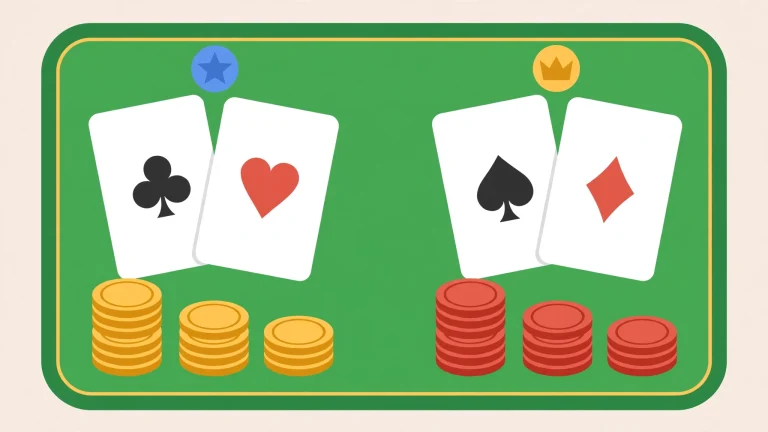
Players then bet on one of two sides: Andar, which means inside, or Bahar, which means outside. These are the two piles of cards that will be dealt during the round, one on each side of the middle card. The dealer then deals cards alternately to the two sides, starting with one side and then the other, until a card appears that matches the rank of the middle card. The side on which that matching card lands wins the round, and bets on that side are paid out.
That is the entire game. There is no further play, no drawing of extra cards after the match, and no comparison of hands. A round can end on the very first card dealt, or it can run for many cards before a match appears. The excitement comes from watching the cards pile up on each side, knowing that each new card could be the one that ends the round.
Which Side Is Dealt First, and Why It Matters
In the traditional game, the first card after the middle card is dealt to Andar. That small detail has a real effect on the odds, and it is the reason the two sides do not pay out equally in most casino versions of the game.
Because Andar receives the first card, it has a slight advantage: if the round ends early, it is slightly more likely to end on Andar’s side. Over many rounds, Andar wins a fraction more often than Bahar. Casinos correct for this by paying Bahar bets slightly more than Andar bets, or by paying both sides at slightly less than even money, depending on the version being played.
The exact payout structure varies. In some versions, Andar pays at odds slightly below even money and Bahar pays at even money. In others, both sides pay at slightly reduced odds, with Bahar paying a touch more to compensate for dealing second. In live online versions, you will often see Andar paying around 0.9 to 1 and Bahar paying 1 to 1, or a similar split. The important point is not the exact numbers, which differ from table to table, but the principle: the side dealt first wins more often, so it pays less. Always check the payout display on the table you are playing before you place a bet, because that display is the real price of the game.
A related variation worth knowing about is the first-card bet. Some tables offer a side bet on whether the matching card will appear on the very first card dealt, or within the first few cards. These bets carry much higher payouts and much higher house edges, and they should be treated the same way as any other side bet: fun in small amounts, costly as a main strategy.
The Main Bets, Step by Step
Placing a bet in Andar Bahar could hardly be simpler. Before the middle card is dealt, or in some versions after it is revealed, you choose Andar or Bahar and place your stake on that side. Once betting closes, the dealer reveals the middle card if it has not already been shown, and then deals alternately to the two sides.
Let us walk through an example. Suppose the middle card is a nine. The dealer deals the first card to Andar: a three. No match. The next card goes to Bahar: a queen. No match. The next card goes to Andar: a king. No match. The next goes to Bahar: a nine. That matches the middle card, so Bahar wins, and all Bahar bets are paid out according to the table’s payout for that side.
Notice what did not happen in that example. No one made a decision after betting. No one folded, raised, or drew a card. The players simply watched. That passivity is part of the game’s charm, especially for beginners, but it also means you have no way to influence the outcome once your bet is placed. Your only decision is which side to back and how much to stake, and that decision is made before the drama begins.
Some versions of the game add a third betting option: a bet that the matching card will appear after a certain number of cards have been dealt, or a bet on the total number of cards in the round. These are sometimes called middle bets or range bets. They add variety, but they also add house edge, and they are best understood as entertainment bets rather than serious wagers.
Side Bets and Extra Options
As with most simple casino games, Andar Bahar tables often offer side bets to add excitement and variety. Common side bets include betting on the suit of the middle card, betting on whether the middle card will be above or below a certain rank, betting on the exact number of cards dealt before a match, or betting that the first card dealt will itself match the middle card.
Each of these side bets has its own payout and its own house edge, and in almost every case that edge is higher than the edge on the main Andar and Bahar bets. The first-card match bet is a good example: it pays handsomely when it hits, because a match on the first card is relatively uncommon, but the payout is still less than the true odds, and the gap between payout and true odds is where the house makes its money.
None of this means side bets are forbidden or foolish. A small side bet can make a round more exciting, and many players enjoy having more than one thing to cheer for. The mistake is treating a side bet as a way to make money, or increasing side-bet stakes to recover losses on the main game. Keep side bets small, keep them separate in your mind from your main bet, and never let them become the bulk of what you stake. If you want to understand why side bets cost more, our guide to how casino house edge works explains the maths in plain terms.
Legal Status in Thailand — Read This First
Gambling is largely prohibited in Thailand. Under the Gambling Act B.E. 2478 (1935), most forms of gambling are illegal, and the only well-known legal exceptions are the government lottery and licensed horse racing at approved racecourses. Online casinos are not licensed in Thailand, and websites offering real-money casino games to people in Thailand operate outside Thai law.
That has practical consequences: an unlicensed site offers no Thai consumer protection if it refuses to pay out, freezes an account or disappears, and Thai authorities periodically block gambling websites and payment channels. Money sent to an offshore platform can simply be lost with no realistic way to recover it.
This article is educational and informational only — it explains how Andar Bahar works because readers ask about it, not to encourage anyone to break local law. Casino games are for adults only (18+), there are no guaranteed winnings in any game, and over time the maths and the fees charged by operators favour the house. Never chase losses, never gamble with borrowed money or money needed for living costs, and if gambling stops being fun, free and confidential help is available from BeGambleAware and Gamblers Anonymous.
House Edge and What It Means for This Game
The house edge on the main Andar and Bahar bets is relatively low compared with many casino side bets, but it is not zero, and it varies by version. On tables where Andar pays slightly below even money and Bahar pays even money, the effective edge is around 3% or a little less, depending on the exact payout split. On tables where both sides pay below even money, the edge is a touch higher. These are reasonable figures for a simple game, comparable to the main bet in Three Card Poker, but worse than a Pass Line bet in craps or a Banker bet in baccarat.
It is worth pausing on what that edge means in practice. A house edge of around 3% means that, over a very large number of rounds, a player staking the same amount each time would expect to lose around 3% of their total amount staked. It does not mean you lose 3% every round, or that you cannot win in a short session. Short sessions are dominated by luck, and many players will finish ahead. But the longer you play, the closer your results drift toward that average, which is a slow loss. No betting pattern changes this: betting on Andar every time, alternating sides, following the previous winner, or doubling after losses all leave the house edge untouched, because each round is independent and the cards have no memory.
That independence is worth emphasising, because Andar Bahar’s speed makes pattern-chasing tempting. After Bahar has won five rounds in a row, it feels as though Andar must be due. It is not. The deck is shuffled, the middle card is random, and the chance of a match on either side does not change because of what happened before. Players who increase their stakes after a losing streak, hoping to recover, are simply staking more money at the same disadvantage, which is the fastest way to turn a small loss into a large one.
Playing Andar Bahar Online: What to Expect
Online Andar Bahar comes in two main forms. The first is a computer-generated game, where the cards are dealt by software using a random number generator. These games are fast, available at any time, and allow very small stakes, which makes them a good way to learn the rules without pressure. The second is a live dealer game, where a real dealer deals physical cards on camera and players bet through an interface. Live games are slower and more social, and they recreate the atmosphere of the traditional game more closely.
Both forms use the same rules, but live games sometimes offer a wider range of side bets, and their payout displays can differ from software games. Whichever form you encounter, the same advice applies: check the payout for Andar and Bahar before you bet, keep side bets small, and be aware of the pace. Software games in particular can run very quickly, with a new round starting seconds after the last one ends. That speed can use up a budget faster than a player expects, so setting a session limit in advance matters even more than in slower games.
Our casino bankroll management guide covers how to set a session budget and stick to it, and its advice is especially relevant to fast games like Andar Bahar. Decide what the session is worth to you before you start, divide it into stakes that let you play for a reasonable time, and stop when you reach either your loss limit or your win goal. Walking away after a good run is just as important as walking away after a bad one.
Frequently Asked Questions
Is Andar Bahar hard to learn?
No. It is one of the easiest casino games to learn. You bet on Andar or Bahar, the dealer deals cards until one matches the middle card, and the side with the match wins.
Why does Bahar sometimes pay more than Andar?
Because Andar receives the first card, it wins slightly more often. Casinos compensate by paying Bahar a little more, or by paying Andar a little less, to balance the odds.
Does the suit of the cards matter?
No, only the rank matters for the main bet. A nine of hearts matches a nine of spades. Suit only matters for certain side bets that specifically bet on suit.
Can I predict which side will win?
No. Each round is independent, and past results do not affect future rounds. Following patterns or streaks does not improve your chances.
Are side bets worth playing?
They can be fun in small amounts, but they carry a higher house edge than the main bets. They should not be the main part of your play or your budget.
Is Andar Bahar better than other simple casino games?
In terms of house edge, its main bets are reasonable — better than most side bets and many slot machines, but worse than the best bets in craps or baccarat. Its real strength is simplicity, not value.
Conclusion
Andar Bahar endures because it does one thing perfectly: it turns a single deck of cards into a quick, tense, social game that anyone can understand in a minute. You do not need to learn hand rankings, betting rounds or complex strategy. You pick a side, you watch the cards, and you find out.
That simplicity should not hide the maths. The side dealt first wins a fraction more often, the payouts reflect that, and the house edge, while modest on the main bets, is real. Side bets cost more, streaks mean nothing, and no system can change the odds. Play with a fixed budget, keep your stakes modest, treat side bets as entertainment, and Andar Bahar is exactly what it has always been: a fast, friendly game that is fun precisely because it asks so little of the player — and rewards a calm head more than a clever system.