Keno Guide for Thai Beginners: How to Play, Pick Numbers and Understand the Odds
Keno Guide for Thai Beginners: How to Play, Pick Numbers and Understand the Odds
Keno is the casino game for people who like lotteries. You pick some numbers, you watch a draw, and you see how many of your numbers come up. There are no cards to learn, no dealer decisions to follow, and no strategy that requires quick thinking. That simplicity is the whole appeal, and it is also the reason beginners should understand the game properly before they play it: Keno is easy to play, but it is also a game where money can drift away quietly if you play too many rounds too quickly.
The game has a long history. It is often traced back to China, where number-draw games were played centuries ago, and it later became a fixture in casinos and in bars and lounges, where players could fill in a ticket, hand it over, and check the draw while they ate or talked. Modern versions keep that relaxed character. In a casino lounge, Keno often runs on a screen while players sit with a drink. Online versions run draws one after another, sometimes very quickly, and that speed changes the experience more than beginners expect.
This guide covers the game in plain language: how a round works, how to pick numbers, how the odds work without invented figures, and how to play slowly enough that Keno stays what it should be — a low-pressure bit of fun, not a drain on your budget.
How a Round Works
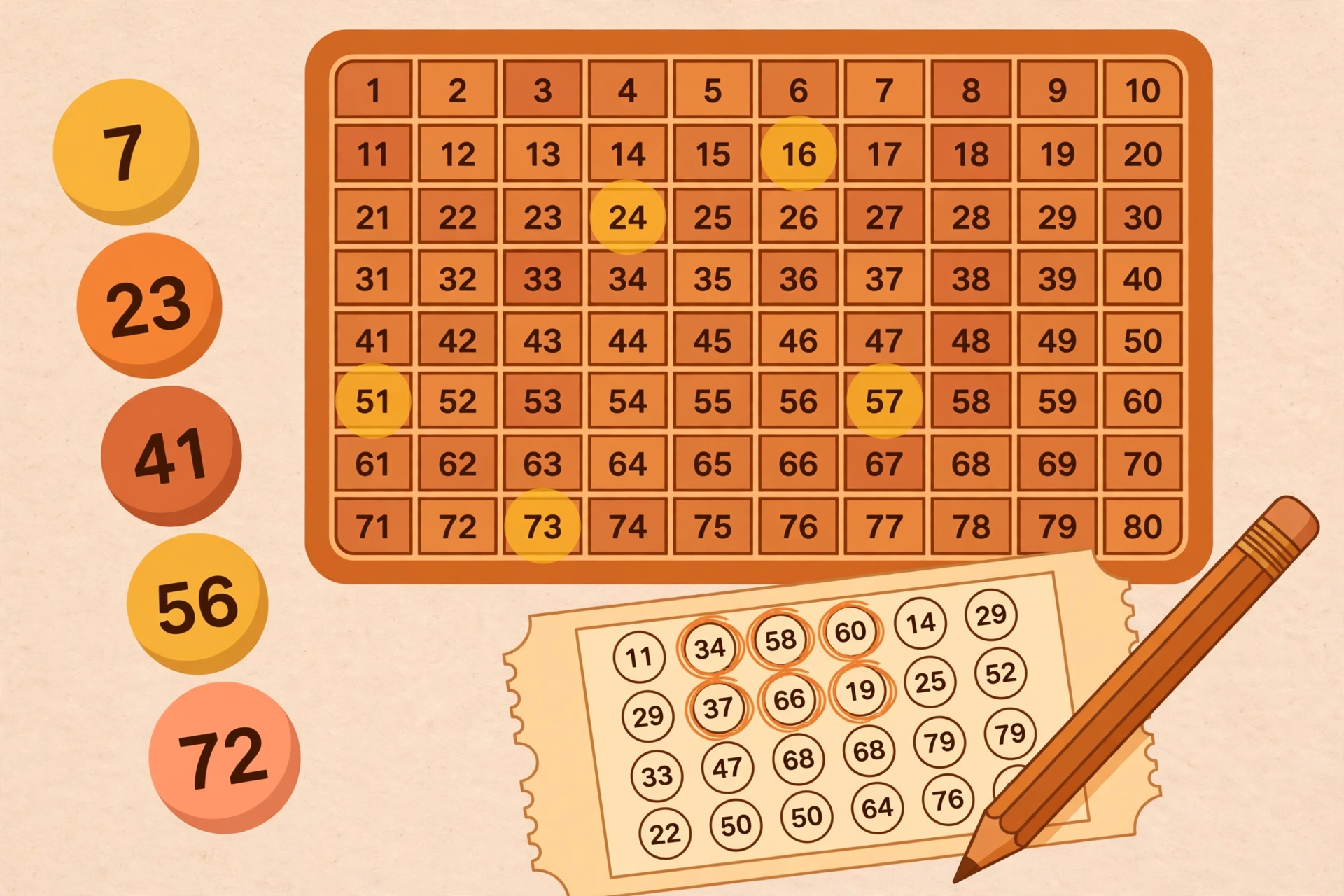
A game of Keno starts with a ticket. The ticket shows a grid of numbers, usually from one to eighty. You choose how many numbers to mark on that ticket. The number you choose is sometimes called a spot count: picking one number is a one-spot ticket, picking five numbers is a five-spot ticket, and so on. Different games allow different maximums, so check what your game offers before you settle on a habit.
Once you have marked your numbers, you choose your stake, which is the amount you are betting on that draw. Then the draw happens. Twenty numbers are drawn at random from the full set, and those drawn numbers are compared with the numbers you picked. You win according to how many of your numbers match the drawn numbers, and the payout depends on both how many numbers you picked and how many of them matched. Matching some of your numbers usually pays a small amount; matching all or nearly all of them pays much more, because it is much harder to do.
That is the entire game. There is no second round of decisions, no card to draw, and no way to change your numbers once the draw begins. You pick, you stake, you watch, and the result is settled. Then a new draw begins, and you can pick the same numbers again, pick new ones, or stop. The simplicity is genuine, and it is worth enjoying for what it is, as long as you respect the pace.
In a lounge or casino setting, draws happen on a schedule, and you may have several minutes between draws. That breathing room is part of the traditional charm of the game. Online, draws can follow each other within seconds or minutes, and it is easy to play many more rounds in an hour than you would in a lounge. Keep that difference in mind, because it is the single biggest factor in how much a Keno session costs.
Picking Numbers: What Actually Matters
Every beginner asks the same question: which numbers should I pick? The honest answer is that no set of numbers is luckier than any other, and no picking method changes your chances. The draw is random. Birthdays, anniversaries, lucky numbers, patterns on the ticket, numbers that came up recently, and numbers that have not come up for a while all have exactly the same chance as any other selection of the same size. That is not a trick answer. It is how random draws work.
What does matter is how many numbers you pick, because that changes the shape of the game. Picking a small number of spots, such as one, two, or three numbers, means you will match something fairly often, but the payouts will be modest. Picking a large number of spots, such as ten or more, means matching all of them is very hard indeed, and you will go many draws without a big win. Most beginners do best in the middle: enough numbers to make the draw interesting to watch, but not so many that a win feels almost out of reach.
There are two common approaches to choosing the actual numbers, and neither is better than the other in terms of odds. Some players pick the same numbers every draw, because it is easy and because they enjoy the feeling that “their” numbers might come up. Some players pick fresh numbers each draw, because they enjoy the variety. Both are fine. The only picking habits worth avoiding are the ones that cost you money without you noticing: picking more spots than you planned because the ticket makes it easy, or raising your stake because you feel a particular set of numbers is “due”. Numbers are never due. A number that has not appeared recently is no more likely to appear next draw than a number that appeared in the last draw.
A useful beginner habit is to decide your spot count and your stake before you start, and then keep both steady for the session. Changing them from draw to draw based on recent results does not improve your odds, and it makes it harder to keep track of what you have spent. Keno rewards steadiness more than cleverness, because there is very little cleverness available in a game of pure chance.
Odds Explained Without Invented Numbers
Odds in Keno come down to one simple idea: the more numbers you need to match, the harder it is to match all of them. That sounds obvious, and it is, but it is worth sitting with for a moment, because it explains the entire payout structure of the game.
Think of it this way. Matching one number out of the twenty drawn is not hard, because twenty numbers are drawn and there are many chances for your single number to be among them. Matching two or three of your numbers is harder, because now you need several specific numbers to all appear in the same draw. Matching eight, nine, or ten of your numbers is harder still by a very large margin, because every additional number you need to match narrows the possibilities sharply. The payouts grow as the task gets harder, which is why matching all your numbers on a large ticket pays so much more than matching a few numbers on a small ticket.
What the payouts do not do is remove the house advantage. Like every casino game, Keno is designed so that, over a long run, the casino expects to come out ahead. The payouts are set below what the true difficulty of matching would justify, and the gap between the true difficulty and the payout is the cost of playing. That gap is part of why Keno should be treated as entertainment with a price, not as a way to make money. No picking system, no pattern, and no staking plan changes that gap.
It helps to compare Keno with games where your decisions matter more. In our sic bo guide for Thai beginners, the choice between a broad bet and a narrow bet changes how often you win. In our guide to how the casino house edge works for beginners, the same idea is explained across games: the house edge is the built-in advantage that makes the casino’s long-term profit, and it exists in every game, including Keno. Understanding that Keno’s edge is part of the game, rather than a flaw you can outsmart, is the most useful thing a beginner can learn about it.
Playing Slowly: The Most Important Keno Skill
If there is one skill that matters in Keno, it is pace. Keno rounds are short, and the game is designed to be repeated. That repetition is where budgets disappear, not in any single dramatic loss. A player who stakes a small amount per draw but plays dozens of draws in an hour can spend far more than a player who stakes a little more per draw but plays only a handful of draws in an evening.
The practical answer is to set a draw limit as well as a money limit. Decide before you start how many draws you will play, and how much you will spend in total, and stop when you reach either limit, whichever comes first. Take breaks between draws, especially online, where the next draw is always one click away. Step away, check how much you have spent against your plan, and only continue if the plan still allows it. This sounds dull, and it is, but dull habits are what keep a game of pure chance affordable.
Another part of playing slowly is resisting the urge to chase a near miss. Keno produces near misses constantly: you match most of your numbers, miss one, and feel that you were “so close”. That feeling is misleading. Being one number short on a large ticket is not evidence that you are about to win. It is simply what happens often in a game where matching most numbers is still far easier than matching all of them. A near miss is not a signal to raise your stake or play more draws. It is just a near miss.
It is also worth deciding in advance what you will do if you do win. A modest win can easily be fed back into more draws until it is gone, which turns a pleasant result into a wasted one. If you win an amount that feels meaningful to you, consider stopping for the session, or at least setting that win aside and continuing only with your original budget. The game will still be there tomorrow.
Legal Status in Thailand — Read This First
Gambling in Thailand is governed by the Gambling Act B.E. 2478 (1935), and under that law most forms of gambling are prohibited. The only major exceptions are the government lottery and licensed horse racing. Online casinos are NOT licensed in Thailand, and playing at offshore casino sites sits outside any Thai licensing or consumer protection framework. This guide is educational only: it explains how a game works so that readers can understand it, not so that readers will seek out a place to play it.
If you are reading this from Thailand, treat any casino content as information, not as an invitation. You must be 18+ (18 or older) to gamble anywhere it is legal, and even where it is legal, there are no guaranteed winnings in any casino game. The house edge exists precisely because, over time, the casino expects to come out ahead. Do not gamble to recover losses — never chase losses by increasing your bets after a bad run, and never gamble with money needed for rent, food, bills, or family obligations. If gambling stops feeling like entertainment, help is available from BeGambleAware and Gamblers Anonymous, both of which offer free, confidential support and self-assessment tools.
Common Beginner Mistakes
The first mistake is playing too fast, especially online, where draws follow each other without a natural pause. The second is believing that some numbers are due, or that a picking system can beat a random draw. The third is picking too many spots and then being surprised when a big win never arrives, even though matching that many numbers is very hard. The fourth is chasing near misses by raising stakes or playing extra draws. The fifth is treating Keno as a way to make money rather than as entertainment with a price. Avoid these, keep your stake steady, and Keno stays the relaxed game it is meant to be.
Frequently Asked Questions
How many numbers are drawn in Keno?
Twenty numbers are drawn in a standard game, from a field that usually runs from one to eighty. You win according to how many of your picked numbers match the drawn numbers.
How many numbers should a beginner pick?
A middle range works well for most beginners: enough numbers to make the draw interesting, but not so many that matching all of them becomes extremely unlikely. The exact count matters less than keeping it steady.
Do lucky numbers or patterns improve my chances?
No. The draw is random, so every selection of the same size has the same chance. Birthdays, patterns, and numbers that have or have not appeared recently make no difference.
Can a betting system help me win at Keno?
No. Doubling stakes after losses or following a staking pattern does not change the odds of the next draw. It only changes how much you risk.
Why do I keep getting near misses?
Because matching most of your numbers is much easier than matching all of them. A near miss is a normal result in Keno, not a sign that a win is coming next.
Is Keno the same online as in a lounge?
The rules are the same, but the pace is usually much faster online. That speed is the main difference, and it is why setting draw limits matters more online.
Conclusion
Keno is at its best when it is played slowly, with numbers picked for fun rather than for a system, and with a budget decided in advance. Pick a sensible number of spots, keep your stake steady, understand that more spots mean harder wins and bigger payouts, and do not let near misses or “due” numbers talk you into extra draws. Played that way, Keno is exactly what it promises to be: a simple, relaxed number game that you can enjoy without needing to learn anything complicated. The discipline is not in the picking. It is in the pace, the budget, and knowing when to stop.