Crypto vs Stocks for Beginners: Differences, Risks and How to Think About Both
Risk disclaimer: Cryptocurrencies are volatile and can lose most or all of their value. Nothing in this article is financial advice. Never invest money you cannot afford to lose, and do your own research before buying any cryptocurrency.
If you are new to investing, crypto vs stocks is probably the first comparison you run into, and it is also one of the most confusing. Both are talked about as ways to grow money, both have passionate supporters, and both can lose you money if you go in without understanding what you are buying. But they are not two versions of the same thing. A stock and a cryptocurrency work in fundamentally different ways, they are regulated differently, they move for different reasons, and they demand different kinds of patience from the person who owns them.
That difference matters more than any short-term price move. People who treat crypto like a stock, or a stock like crypto, usually end up surprised. A stock gives you a claim on a real business with revenue, employees, customers and, in many cases, a long track record you can study. A cryptocurrency gives you a token on a network, and its value depends on whether people keep using that network, trusting it, and believing it will be useful in the future. Both can be worth studying. Neither is a shortcut to getting rich. The goal of this guide is to explain the differences plainly, so you can think about both clearly instead of choosing a side based on hype.
What You Actually Own
The most important difference between crypto and stocks is what you own when you buy. When you buy a share of a stock, you buy a small piece of a company. That company owns things, sells products or services, earns revenue, pays employees, and is run by a board and a management team that can be held accountable by shareholders. If the company does well over time, its earnings tend to grow, and the share price often follows, slowly and unevenly, but with a real business underneath it. Some companies also pay dividends, which means they share a portion of their profits with shareholders in cash. You can read a company’s financial statements, look at its sales, its debts, its competitors, and its history, and form a view about whether it is well run.
When you buy a cryptocurrency, you do not buy a piece of a company. You buy a token that lives on a blockchain network. That token may be used to pay transaction fees, to participate in a network, to vote on changes, or simply to be traded. Its value is not tied to a company’s earnings, because there is usually no company earning money behind it in the same way. Instead, its value depends on demand for the token, confidence in the network, the usefulness of the technology, and the mood of a market that is still young and often driven by sentiment. Some crypto projects do generate fees or have teams building products, but the link between that activity and the token’s price is much looser and harder to measure than the link between a company’s profits and its share price.
This is why the research looks different. For a stock, you can ask whether the business is profitable, whether it is growing, and whether it is fairly priced compared with its earnings. For a cryptocurrency, you have to ask different questions: what problem does this network solve, who actually uses it, how is the token supply controlled, who runs the network, and what would happen if people stopped caring about it. Our guide to what Bitcoin is explains how the oldest cryptocurrency works and why it is often described as digital gold rather than as a company, and our guide to what Ethereum is explains a network that works more like a platform for applications. Reading those two will help you see that even within crypto, different coins are trying to do very different things.
Volatility: How Much Prices Move, and How Fast
Volatility is where most beginners first feel the difference between crypto and stocks. Stock prices move every day, and a single stock can fall sharply if a company reports bad results. But the stock market as a whole, especially a broad collection of large companies, tends to move in a narrower range. A fall of a few percent in a day is a big day for a major stock index. A fall of ten percent or more in a single stock is painful, but it usually comes with a clear reason, such as an earnings miss or a scandal.
Cryptocurrency prices move much more, and much faster. It is normal for a major cryptocurrency to rise or fall by ten percent or more in a single day, and smaller coins can move by far larger amounts. A coin can lose half its value in a few weeks during a downturn, and then recover some of it just as quickly. This is not a rare event in crypto. It is part of how the market behaves, because the market is smaller, younger, less regulated, and more driven by speculation and by traders using borrowed money. The same volatility that can produce large gains in a short time can produce large losses in a short time, and beginners often underestimate the second half of that sentence until they experience it.
That difference changes how you should think about position size. A beginner who puts a small amount into a broad stock fund and watches it fall by a few percent can usually wait it out. A beginner who puts the same proportion into a cryptocurrency and watches it fall by half may panic and sell at the worst moment. The honest question is not whether you can handle volatility in theory, but whether you can handle it in practice, when your own money is falling and everyone online is predicting it will fall further. Our guide to surviving a crypto bear market explains how long downturns in crypto can last and why emotional decisions during them are so costly.
Volatility also changes what counts as a reasonable time horizon. Stocks are generally thought of as a long-term holding, measured in years, because businesses take time to grow. Crypto is often traded on much shorter horizons, which encourages constant checking, reacting to news, and chasing whatever coin is rising today. That style of behaviour is exhausting and, for most people, unprofitable. If you do buy crypto, treating it with the same patience you would bring to a stock, and checking it far less often, is usually a better approach than trying to trade every move.
Regulation and Protection
Stocks exist inside a legal framework that has been built up over many decades. In most countries, a company that wants to sell shares to the public must publish audited financial statements, follow disclosure rules, and answer to a regulator. Stock exchanges have listing rules, brokers are licensed, and investors in many countries have some form of protection if a broker fails. That does not mean stocks are safe. Companies still fail, fraud still happens, and share prices still fall. But there is a system of rules, records, and accountability around them, and you can usually find out who is responsible when something goes wrong.
Cryptocurrency regulation is newer, patchier, and different in every country. Some countries have clear rules for exchanges and tokens, some have banned crypto trading outright, and many are still working out what the rules should be. A cryptocurrency exchange may be licensed in one country and unregulated in another. A token that is legal to trade in one place may be treated as a security somewhere else. Tax rules vary too, and they can be surprisingly complicated, because every trade, and in some places every swap between coins, can count as a taxable event. Our guide to crypto taxes explains the basics of what to keep track of, but the key point here is that you cannot assume the rules for stocks apply to crypto, or that the rules are the same wherever you live.
Protection is also different. If you buy a stock through a regulated broker and the broker fails, you may be covered by an investor protection scheme up to a limit. If you hold crypto on an exchange and the exchange fails, is hacked, or freezes withdrawals, you may lose everything, with little or no recourse. That is why many experienced crypto holders move their coins into a wallet they control themselves, rather than leaving them on an exchange indefinitely. Our guide to crypto wallets explains the options, from exchange accounts to hardware wallets, and the trade-offs of each.
Regulation also affects what information you can trust. A listed company must tell the truth in its filings, or face serious consequences. A crypto project can make big promises in a white paper or on social media with far less accountability, and some projects are outright scams. That is not a reason to dismiss all of crypto, but it is a reason to be far more sceptical of claims made about crypto projects than you would be of claims made by a listed company.
How Prices Are Driven
Stock prices are driven, over the long term, by business performance. If a company grows its sales and profits year after year, its share price tends to rise over time, even if it falls in the short term. In the short term, stock prices are also driven by interest rates, economic news, and market sentiment, but the underlying business is always there, anchoring the price to something real. An investor can look at a company’s earnings, compare it with its competitors, and judge whether the price is reasonable.
Crypto prices are driven by a different mix. Technology developments matter, such as an upgrade to a network or a new application built on it. Adoption matters, such as whether more people and businesses start using a coin. Regulation matters enormously, because a single announcement can move the whole market. But sentiment matters most of all in the short term. Crypto markets are heavily influenced by social media, by fear of missing out, by leveraged trading, and by cycles of enthusiasm and panic that can last for months. A coin can rise sharply because it is being talked about, and fall sharply because the conversation moves on, without anything about the underlying technology changing.
That is why crypto prices are so hard to predict. With a stock, you can at least ask whether the business is doing well. With a cryptocurrency, you are often trying to predict what other people will think about it in the future, which is a much harder question. This does not mean crypto prices are random, but it does mean they are less anchored to measurable fundamentals, and that a beginner should be very wary of anyone who claims to know where a coin’s price is going.
When You Can Trade, and What It Costs
Stocks trade during set market hours, usually on weekdays, and markets close at weekends and on holidays. That sounds like a limitation, but for most beginners it is a useful one. It creates natural pauses, it stops you from reacting to every headline at three in the morning, and it gives you time to think. Crypto markets never close. You can buy and sell at any hour of any day, including weekends and holidays, and prices can move sharply while you are asleep. That freedom is appealing, but it also means there is no break from the market, and the temptation to check prices constantly is much stronger.
Costs are different too. Buying a stock through a modern broker often involves low or no commission, though there may be other fees, and the difference between the buy and sell price is usually small for large, popular stocks. Buying crypto usually involves a fee charged by the exchange, a spread between the buy and sell price, and, on some networks, a fee to move the coins, which can vary widely depending on how busy the network is. For smaller coins, the spread can be large, and for frequent trading, the costs add up quickly. A beginner who trades often can lose a surprising amount to fees alone, even before price moves are taken into account.
Liquidity also matters. Large stocks are easy to buy and sell in large amounts without moving the price. Large cryptocurrencies are also fairly liquid, but smaller coins can be hard to sell quickly at a fair price, especially during a market panic, when everyone is trying to sell at once and there are few buyers. That is another reason beginners are usually better off sticking to the largest and most established assets, in either market, rather than chasing small, illiquid ones.
Returns, Risk, and What History Can and Cannot Tell You
It is tempting to compare the past returns of crypto and stocks and conclude that one is obviously better. Crypto has produced extraordinary gains in some periods, far larger than anything the stock market has produced in the same time. It has also produced extraordinary losses. Stocks have produced steadier, more modest returns over long periods, with occasional sharp falls, but with a much longer track record to study.
The problem with comparing past returns is that crypto’s history is short, and it is dominated by a few dramatic cycles. A coin that rose a hundredfold in its early years may never do so again, because it is now much larger and better known. A stock market index that returned a steady average over decades has done so through wars, recessions, and crises, which tells you something about its resilience, even if it tells you nothing about next year. Past returns are not a promise, in either market, and they are especially unreliable for an asset class that is still young and still changing.
A more useful way to think about returns is to ask what kind of risk you are taking for them. Stocks carry business risk, market risk, and economic risk, but they also carry the possibility of steady growth from real economic activity. Crypto carries technology risk, regulatory risk, security risk, and the risk that a project simply fails or is abandoned. The potential rewards in crypto are higher, but so are the risks, and the range of possible outcomes is much wider. A beginner should not focus only on the best-case outcome. They should ask what the worst case looks like, and whether they could live with it.
How Beginners Usually Go Wrong With Each
Beginners make different mistakes in each market, and it helps to know them in advance. With stocks, the common mistakes are buying a single company because a friend recommended it, without understanding the business; chasing a stock that has already risen sharply; selling in a panic during a market fall; and trading too often, which racks up costs and taxes. The cure is usually the same: diversify, think long term, and do not try to time the market.
With crypto, the common mistakes are similar but amplified. Beginners buy a coin because it is trending on social media, without understanding what it does. They buy small, unknown coins hoping for a huge gain, and lose most of their money when the coin collapses. They leave their coins on an exchange and lose them when the exchange fails. They use borrowed money to trade, which magnifies losses. They fall for scams promising guaranteed returns, or for fake giveaways and phishing sites that steal their coins. And they check prices constantly, which makes every fall feel like a crisis. Our guide to how to buy crypto safely covers the practical safety steps, and it is worth reading before you buy anything.
The shared mistake, in both markets, is confusing a good story with a good investment. A company can have an exciting product and still be a bad investment if its shares are overpriced. A cryptocurrency can have interesting technology and still be a bad investment if its token is overvalued, or if nobody ends up using it. Stories are easy to tell. Returns are harder to earn.
How to Think About Both Sensibly
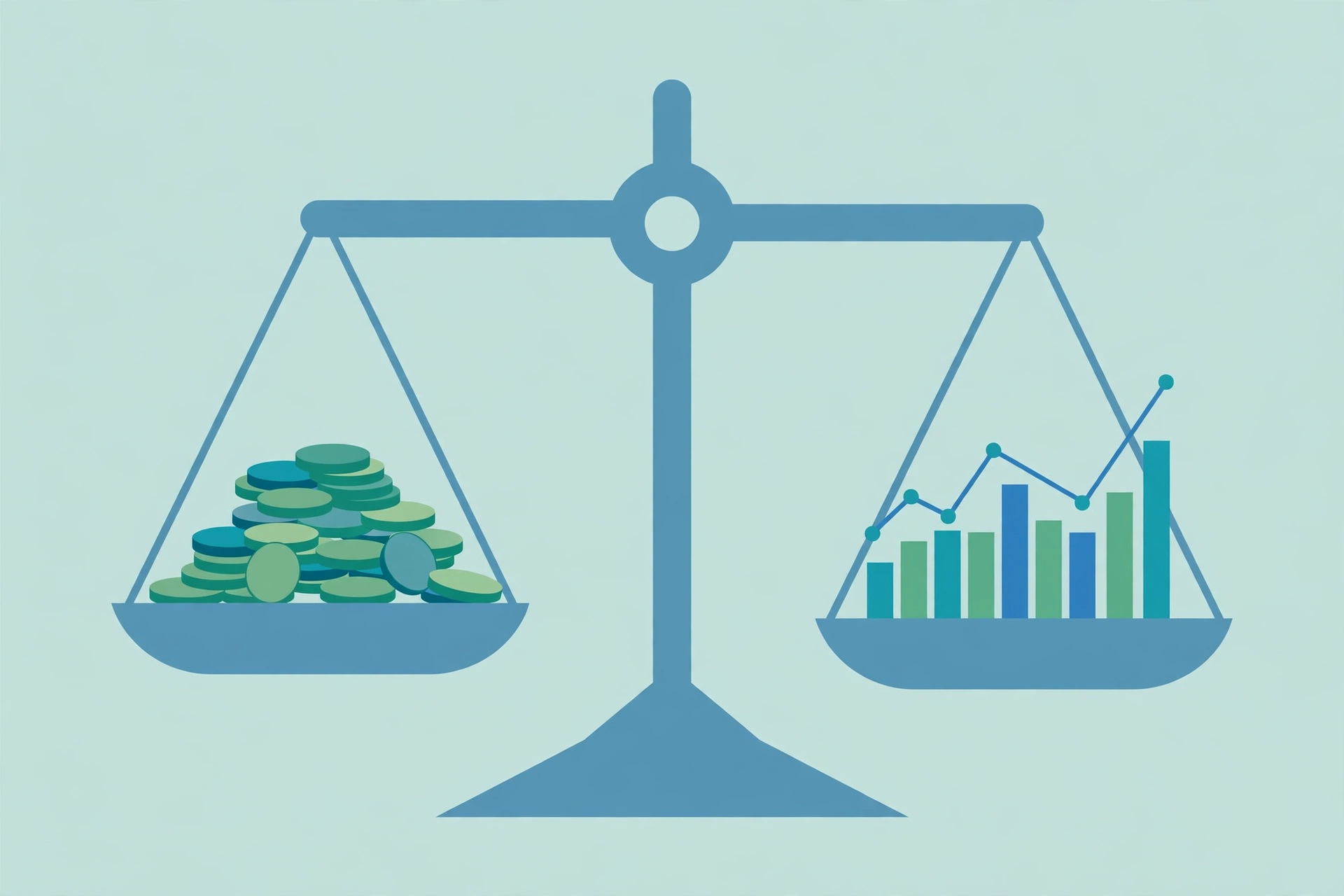
So how should a beginner think about crypto vs stocks? Start by treating them as different tools for different purposes, not as rivals in a contest. Stocks, especially a broad, diversified collection of them, are the traditional foundation of long-term investing, because they represent ownership of real businesses that produce goods and services people need. Crypto, at this stage, is better thought of as a high-risk, speculative holding that may or may not grow into something more established over time. Some people choose to hold no crypto at all, and that is a perfectly reasonable decision. Others choose to hold a small amount, as a way to learn about the technology and to participate in its possible growth, while keeping the bulk of their money in more traditional investments.
If you do decide to hold both, keep them separate in your mind. Do not judge your stocks by crypto standards, and do not judge your crypto by stock standards. A stock that rises by ten percent in a year is doing well. A cryptocurrency that rises by ten percent in a day is having a normal day, and may fall by the same amount tomorrow. Do not expect stock-like steadiness from crypto, and do not expect crypto-like excitement from stocks. Expecting the wrong thing from either one is how disappointment turns into bad decisions.
Size matters more than selection for most beginners. A small amount in crypto, an amount you could lose entirely without changing your life, is a very different decision from putting a large share of your savings into it. The same is true of a single stock. Diversification, patience, and a clear limit on how much you are willing to risk are more important than picking the perfect coin or the perfect share, because no beginner picks perfectly, and the cost of being wrong is much lower when the amount at risk is small.
Education matters too. Before buying either, learn the basics of how it works, how it is taxed where you live, how you will store it safely, and what you will do when it falls. Write down your plan in advance, including how much you will buy, how long you plan to hold it, and at what point you would sell. A written plan, made when you are calm, is far more useful than a decision made in the middle of a price swing.
Frequently Asked Questions
Is crypto riskier than stocks?
Yes, in general. Cryptocurrencies are more volatile, less regulated, and less anchored to measurable business fundamentals than stocks. Individual stocks can be very risky too, especially small or unprofitable companies, but the crypto market as a whole carries higher risk than a broad stock market.
Should beginners buy crypto or stocks first?
Most beginners are better off learning about stocks first, because the concepts of owning a business, reading financial statements, and diversifying are easier to grasp, and the market is more regulated. If you are curious about crypto, start by learning how it works, and only consider a small amount after you understand the risks.
Can crypto replace stocks in a portfolio?
It is better to think of crypto as a separate, high-risk holding rather than a replacement for stocks. Stocks represent ownership of businesses that generate earnings. Crypto represents a token on a network whose future is uncertain. They play different roles, and most portfolios that include crypto keep it as a small share of the total.
Why is crypto so much more volatile than stocks?
Crypto markets are smaller, younger, trade around the clock, and are heavily influenced by sentiment, speculation, and leveraged trading. Stocks are tied to business earnings and trade within a more established, regulated system, which tends to dampen day-to-day swings, even though stocks can still fall sharply.
Do stocks or crypto pay income?
Many stocks pay dividends, which are cash payments from company profits. Most cryptocurrencies do not pay dividends. Some crypto can earn rewards through staking or lending, but those carry their own risks and are not the same as a dividend from a profitable business.
Is crypto regulated like stocks?
No. Stocks are regulated under long-established rules in most countries, with disclosure requirements and investor protections. Crypto regulation is newer and varies widely by country, and protections for crypto holders are generally weaker, especially when coins are held on an exchange.
Can I lose all my money in crypto?
Yes, it is possible to lose most or all of the money you put into a cryptocurrency, especially a small or unproven one, if its price collapses, the project fails, or your coins are stolen or lost through an exchange failure. The same is theoretically possible with a single stock, but much less likely with a diversified stock portfolio.
Can I lose all my money in stocks?
With a single company, yes, if it goes bankrupt. With a diversified portfolio of many companies, a total loss is extremely unlikely, because it would require many businesses to fail at once. That is one of the main reasons diversification matters so much in stock investing.
How much of my money should go into crypto?
There is no single right answer, and anyone who gives you a number is guessing. A common approach among cautious investors is to keep crypto as a small share of a portfolio, an amount they could lose entirely without serious harm. The key principle is never to invest money you cannot afford to lose, and never to borrow money to buy crypto.
Do I need to understand blockchain to buy crypto?
You do not need to be a technical expert, but you should understand the basics: what the coin does, how its supply works, how you will store it, and what the main risks are. Buying a coin you do not understand, based only on a price chart or a social media post, is one of the most common beginner mistakes.
Conclusion
Crypto vs stocks is not a contest with a single winner. Stocks are ownership of real businesses, with earnings, regulation, and a long track record, and they have been the foundation of long-term investing for generations. Crypto is a newer, more volatile, and less regulated asset, built on technology that may become very important, but whose future is still uncertain. Both can be studied, both can be owned sensibly, and both can hurt you if you buy without understanding what you are doing.
The sensible approach for most beginners is to learn about stocks first, to understand diversification and long-term thinking, and to treat crypto, if they choose to hold any at all, as a small, high-risk part of a broader plan, not as the whole plan. Learn how each market works, keep your position sizes modest, store your crypto safely, keep records for tax, and write down your plan before you buy. If you want to go deeper into crypto itself, start with what Bitcoin is and what Ethereum is, read our guide to buying crypto safely before any purchase, and remember that the most important skill in either market is not picking winners, but managing risk and staying patient when prices move against you.