Bitcoin Halving Explained for Beginners: What It Is, Why It Happens and What It Means
Risk disclaimer: Cryptocurrencies are volatile and can lose most or all of their value. Nothing in this article is financial advice. Never invest money you cannot afford to lose, and do your own research before buying any cryptocurrency.
The Bitcoin halving is one of the most talked-about events in cryptocurrency, and one of the most misunderstood. Every four years or so, people start counting down to it, predicting what it will do to the price, and arguing about whether it is already priced in. Some of that conversation is useful. Much of it is noise. To understand the halving, you do not need to follow the countdown or the price predictions. You need to understand a simple idea at the heart of Bitcoin: new bitcoins are created at a predictable rate, and every so often, that rate is cut in half.
This guide explains the Bitcoin halving from scratch, without invented prices or promises about what will happen next. You will learn what the halving is, why it happens every four years, how Bitcoin’s supply works, what has happened around past halvings in general terms, and what a beginner should and should not take from all of it.
What Is the Bitcoin Halving?
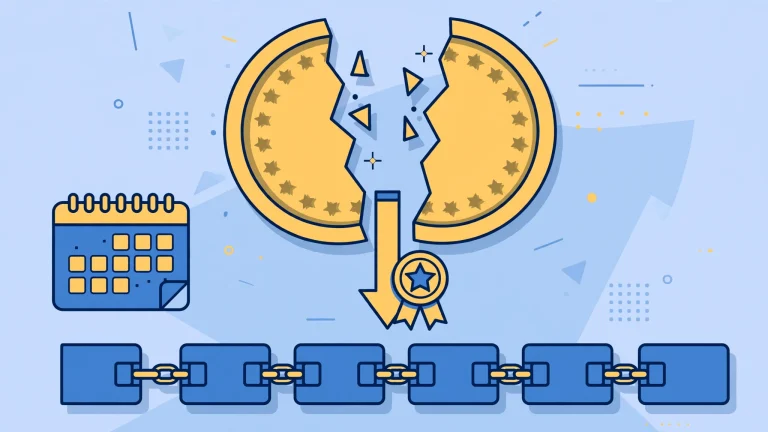
The Bitcoin halving is an event built into Bitcoin’s code that cuts in half the reward miners receive for adding a new block to the blockchain. Miners are the computers that secure the Bitcoin network by competing to solve puzzles, a process called proof of work. When a miner wins, it adds a block of transactions to the chain, and it receives newly created bitcoins as a reward, plus the transaction fees from that block. The halving reduces that reward by half.
When Bitcoin started in 2009, the reward was 50 bitcoins per block. After the first halving, it became 25. After the second, it became 12.5. After the third, it became 6.25. After the most recent halving, it became 3.125. That pattern will continue, with the reward halving again and again, until the total supply approaches its fixed limit, after which miners will be paid only from transaction fees.
The halving is not decided by a company, a government, or a vote. It is written into Bitcoin’s code, and it happens automatically after a fixed number of blocks have been added to the chain. That number is 210,000 blocks. Because a new block is added roughly every ten minutes, 210,000 blocks take roughly four years to complete. That is why the halving is often described as happening every four years, even though the exact date depends on how quickly blocks are actually produced, which can vary slightly.
Our guide to what Bitcoin is explains Bitcoin’s design in more detail, including mining and the blockchain, and our guide to crypto mining explains how miners work and why they matter to the network.
Why Does the Halving Happen Every Four Years?
The halving exists because of a decision made by Bitcoin’s creator, Satoshi Nakamoto, about how Bitcoin’s supply should work. Unlike a traditional currency, where a central bank can create more money whenever it chooses, Bitcoin has a fixed total supply of 21 million coins. That limit is written into the code, and it cannot be changed without the agreement of the network as a whole, which would be extremely difficult to achieve. The halving is the mechanism that makes that limit work in practice.
Think of it this way: if new bitcoins were created at a constant rate forever, the total supply would keep growing without limit. If they were created all at once, the early holders would own everything, and there would be no incentive for miners to secure the network over time. The halving solves both problems. It creates new coins at a steady rate to reward miners, but it reduces that rate over time, so that the total supply grows more and more slowly, approaching the 21 million limit gradually, over many decades.
That design is meant to make Bitcoin scarce. Scarcity, on its own, does not make something valuable. Plenty of scarce things are worthless. But scarcity combined with demand can support value, and the halving is Bitcoin’s way of ensuring that new supply becomes scarcer over time, in a way that everyone can predict in advance. You can look at the code and know exactly when the next halving will happen, and how many new bitcoins will be created after it, for decades into the future. That predictability is unusual for a financial asset, and it is one of the reasons the halving attracts so much attention.
It is also worth noting that the halving is not the only way Bitcoin’s supply is controlled. Some bitcoins are lost forever, because their owners lost the private keys needed to access them, or because they were sent to an address that no one controls. Those coins are still counted in the total supply, but they can never be spent. That means the number of bitcoins actually available to trade is smaller than the number that have been created, and that gap will only grow over time.
How Bitcoin’s Supply Works
To understand the halving, it helps to understand Bitcoin’s supply in a little more detail. New bitcoins are created only as mining rewards. There is no other way to create them. Every ten minutes or so, a new block is added, and the miner who added it receives the current reward. That is the only source of new supply. No one can create bitcoins out of thin air, and no one can change the reward except through the halving schedule.
The supply grows quickly at first, and then more slowly. In the early years, when the reward was 50 bitcoins per block, new supply was being created rapidly. As the reward has halved, the rate of new supply has fallen. After each halving, the number of new bitcoins created per day is cut in half. That means the inflation rate of Bitcoin, the rate at which its supply grows, falls after every halving, and it will continue to fall until the supply approaches 21 million.
That is very different from how traditional currencies work. A central bank can increase the money supply quickly if it chooses to, and it often does, especially in a crisis. Bitcoin’s supply schedule is fixed and transparent, and it cannot be changed by a single decision. Supporters see that as a strength, because it protects holders from sudden inflation. Critics point out that a fixed supply can also be a problem, because it means Bitcoin cannot respond to changes in demand in the way a central bank can, and it can make prices more volatile.
It is also important to understand that the halving does not change the number of bitcoins that already exist. It only changes the rate at which new ones are created. After a halving, the same number of bitcoins are in circulation as before, plus the new ones created since then. The halving does not make your existing bitcoins worth more by itself. It only reduces the flow of new supply, and whether that affects the price depends on demand, which is a separate question.
What Happens to Miners at the Halving?
Miners are directly affected by the halving, because their income is cut in half overnight, at least in terms of the number of new bitcoins they receive. A miner that was earning a certain number of bitcoins per block before the halving earns half as many after it, unless the price of Bitcoin rises enough to make up the difference, or unless transaction fees rise enough to compensate.
That creates a real challenge for miners, especially those with high costs. Mining requires expensive equipment and a lot of electricity, and miners have to pay those costs whether the price of Bitcoin is rising or falling. After a halving, less efficient miners, or those in places where electricity is expensive, may find that mining is no longer profitable, and they may switch off their machines. That can cause the network’s total computing power, called the hash rate, to fall temporarily, until the remaining miners adjust, or until the price rises enough to make mining profitable again.
In practice, the network has a built-in adjustment that helps with this. Roughly every two weeks, Bitcoin adjusts the difficulty of the mining puzzles, based on how quickly blocks have been added. If many miners switch off and blocks are being added more slowly, the difficulty falls, which makes mining easier and more profitable for those who remain. If many miners join and blocks are being added too quickly, the difficulty rises. That adjustment keeps the block time close to ten minutes on average, regardless of how many miners are active.
Over the long term, the halving also changes the economics of mining. As the reward falls, transaction fees become a larger share of miners’ income. Eventually, when the reward becomes very small, fees will be the main source of income for miners. That raises questions about whether fees alone will be enough to keep miners securing the network, and whether the network will remain secure if fees are low. Those are long-term questions, and they are still being debated, but they are worth knowing about, because they show that the halving is not just a price event. It is a change in how the network pays for its own security.
What Has Happened Around Past Halvings?
Past halvings have been followed, in general terms, by periods of rising prices, but the picture is more complicated than the simple story suggests. In the months and years after each of the early halvings, Bitcoin’s price rose substantially from its level before the halving. That has led many people to conclude that halvings cause price rises, and to expect the same pattern to repeat after every future halving.
There are reasons to be cautious about that conclusion. First, there have only been a handful of halvings so far, which is a very small number of examples to draw a firm conclusion from. Second, each halving happened in a different economic environment, with different levels of adoption, regulation, and market sentiment, so it is hard to know how much of the price move was caused by the halving and how much was caused by other factors. Third, the price often rose well before the halving, as people anticipated it, and it also fell sharply at times after it, so the timing was never as simple as a rise on the day of the halving.
It is also important to remember that correlation is not causation. A price rise after a halving could be caused by the reduction in new supply, or it could be caused by growing interest in Bitcoin, by changes in the wider economy, by new products that made it easier to buy Bitcoin, or by a general cycle of enthusiasm in crypto markets. Our guide to surviving a crypto bear market explains how long crypto downturns can last, and why price moves in crypto are rarely driven by a single factor.
A beginner should be very wary of anyone who uses past halvings to predict a specific price, or to promise that the price will rise after the next one. The halving is a real event with a real effect on supply, but supply is only one part of the price. Demand matters at least as much, and demand is driven by many things that have nothing to do with the halving, including regulation, adoption, the wider economy, and market sentiment. Anyone who tells you that the halving guarantees a price rise is selling you a story, not an analysis.
The Halving and the Idea of Scarcity
The halving is often discussed in terms of scarcity, and it helps to understand what that means, and what it does not mean. Bitcoin is scarce in the sense that its total supply is fixed at 21 million, and the rate at which new coins are created falls over time. That is a clear, predictable form of scarcity, and it is different from traditional currencies, whose supply can be increased at will.
But scarcity alone does not create value. For something to be valuable, people have to want it, and they have to believe it will remain useful or desirable in the future. Gold is scarce, and it is also widely desired, for jewellery, for industry, and as a store of value. Bitcoin is scarce, and it is desired by a growing number of people, but its future demand is less certain than gold’s, because it is a newer technology, it is still evolving, and its uses are still being worked out.
It is also worth remembering that Bitcoin is not the only scarce cryptocurrency. Many other coins have fixed supplies, or supplies that grow slowly, and scarcity has not made all of them valuable. What matters is not just how many coins exist, but how many people want to hold them, use them, and trust the network they run on. The halving affects the supply side of that equation, but it does not, by itself, create demand.
A useful way to think about it is that the halving makes Bitcoin’s supply more predictable, not necessarily more valuable. Predictability is a strength, because it lets people plan and make decisions with more confidence. But predictability does not guarantee a price rise, and it does not protect holders from falls caused by falling demand, by regulation, or by a wider market downturn.
Common Misconceptions About the Halving
There are several common misconceptions about the halving that beginners should be aware of. The first is that the halving doubles the price, or that it has a direct, mechanical effect on price. It does not. The halving reduces the rate of new supply, but the price depends on the balance between supply and demand, and demand can move in either direction, for reasons that have nothing to do with the halving.
The second misconception is that the halving happens on a specific date that is known far in advance. In fact, the halving happens after a specific number of blocks, and because block times vary slightly, the exact date is not known until it is close. It is roughly every four years, but the precise day can shift by days or weeks depending on how quickly blocks are produced.
The third misconception is that the halving is a one-time event, or that it will stop after a few more cycles. In fact, halvings will continue for many decades, with the reward getting smaller and smaller, until it becomes negligible. The last new bitcoins will not be created for well over a century, and the total supply will approach 21 million very gradually.
The fourth misconception is that the halving makes Bitcoin a good investment by itself. It does not. The halving is one feature of Bitcoin’s design, and it is worth understanding, but it is not a reason to buy Bitcoin on its own. A beginner should understand Bitcoin as a whole, including its technology, its uses, its risks, and its competition, before deciding whether to buy any. Learning to read a crypto price chart can help you understand how prices move, but it will not tell you where the price will go after a halving.
What Should a Beginner Do Around a Halving?
If you are a beginner, the halving is best treated as a learning opportunity, not as a trading signal. Use the attention around it to learn how Bitcoin works, how its supply is controlled, and how miners are paid. Read about past halvings in general terms, but do not use them to predict the future. Understand that the price may rise, fall, or stay roughly the same around a halving, and that short-term price moves are driven by many factors, not just the halving.
Do not buy Bitcoin just because a halving is coming, and do not sell just because one has passed. Make decisions based on your own understanding of Bitcoin, your own financial situation, and your own time horizon, not on a countdown or on social media predictions. If you do decide to buy, do it safely, using a reputable exchange, storing your coins securely, and keeping records for tax. Our guide to how to buy crypto safely explains the practical steps, and it is worth reading before any purchase.
It is also worth remembering that the halving is not the only important event in Bitcoin. Upgrades to the network, changes in regulation, new products that make Bitcoin easier to buy or use, and developments in the wider economy can all have a larger effect on the price than the halving. A beginner who focuses only on the halving will miss much of what actually drives Bitcoin’s price and its future.
Frequently Asked Questions
What is the Bitcoin halving in simple terms?
The Bitcoin halving is an automatic event in Bitcoin’s code that cuts in half the reward miners receive for adding a new block. It happens after every 210,000 blocks, roughly every four years, and it reduces the rate at which new bitcoins are created.
Why does the halving happen?
It happens to control Bitcoin’s supply. Bitcoin has a fixed total supply of 21 million coins, and the halving ensures that new coins are created more and more slowly over time, approaching that limit gradually, while still rewarding miners for securing the network.
How often does the Bitcoin halving happen?
Roughly every four years, after 210,000 blocks have been added to the chain. Because blocks take about ten minutes each, 210,000 blocks take about four years, but the exact date varies slightly depending on how quickly blocks are produced.
What was the reward before and after the most recent halving?
When Bitcoin started, the reward was 50 bitcoins per block. It has halved several times since then, and after the most recent halving, it became 3.125 bitcoins per block. It will halve again at the next halving.
Does the halving make Bitcoin’s price go up?
Not necessarily. Past halvings have been followed by price rises in general terms, but that does not guarantee the same will happen again. The price depends on both supply and demand, and demand is driven by many factors beyond the halving, including regulation, adoption, and market sentiment.
What happens to miners after a halving?
Miners earn half as many new bitcoins per block, so their income falls unless the price rises or transaction fees increase. Less efficient miners may stop mining, but the network adjusts its difficulty to keep block times close to ten minutes, and fees become a larger share of miners’ income over time.
Will there be a last halving?
Halvings will continue for many decades, with the reward getting smaller each time, until the total supply approaches 21 million. The last new bitcoins will not be created for well over a century, after which miners will be paid only from transaction fees.
Does the halving affect the bitcoins I already own?
No. The halving does not change the number of bitcoins that already exist, or the value of the coins you hold directly. It only changes the rate at which new bitcoins are created, and any effect on price depends on how the market reacts to that change in supply.
Is the halving already priced in?
That is a subject of debate. Some people argue that because the halving is predictable and known in advance, the market has already accounted for it in the price. Others argue that its effects play out over time, as the reduced supply gradually affects the market. There is no consensus, and no way to know for certain.
Should I buy Bitcoin before a halving?
There is no reliable answer to that question, and anyone who gives you one is guessing. The halving is one factor among many, and buying based on a single event, without understanding Bitcoin as a whole, is a poor way to make an investment decision. Learn how Bitcoin works, understand the risks, and make a decision based on your own situation, not on a countdown.
Conclusion
The Bitcoin halving is a simple idea with far-reaching effects. Every 210,000 blocks, roughly every four years, the reward for mining a new block is cut in half, reducing the rate at which new bitcoins are created, and bringing the total supply closer to its fixed limit of 21 million. That design makes Bitcoin’s supply predictable and increasingly scarce over time, which is one of its most distinctive features, and one of the reasons it attracts so much attention.
But the halving is not a price guarantee, and it is not a reason to buy Bitcoin on its own. Past halvings have been followed by rising prices in general terms, but the sample is small, the circumstances were different each time, and demand, regulation, and sentiment matter at least as much as supply. The miners who secure the network are directly affected, the economics of mining change with each halving, and the long-term question of how the network will be secured when rewards become very small is still open.
For a beginner, the best approach is to understand the halving as part of Bitcoin’s design, not as a trading signal. Start with what Bitcoin is, learn how mining works, and read our guide to buying crypto safely before any purchase. If you do decide to buy, do so with money you can afford to lose, store your coins securely, and remember that no single event, including the halving, can tell you where the price will go next.